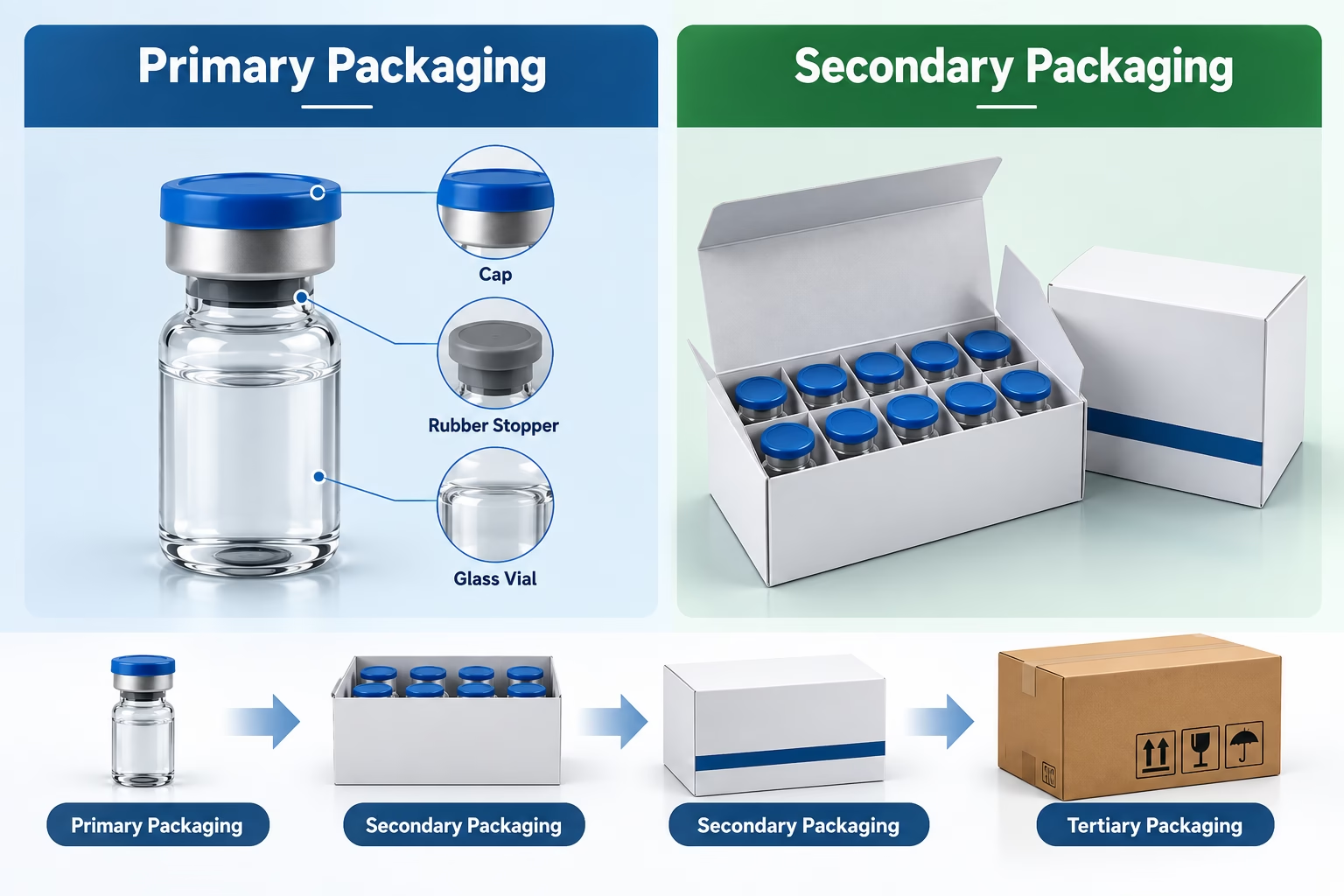
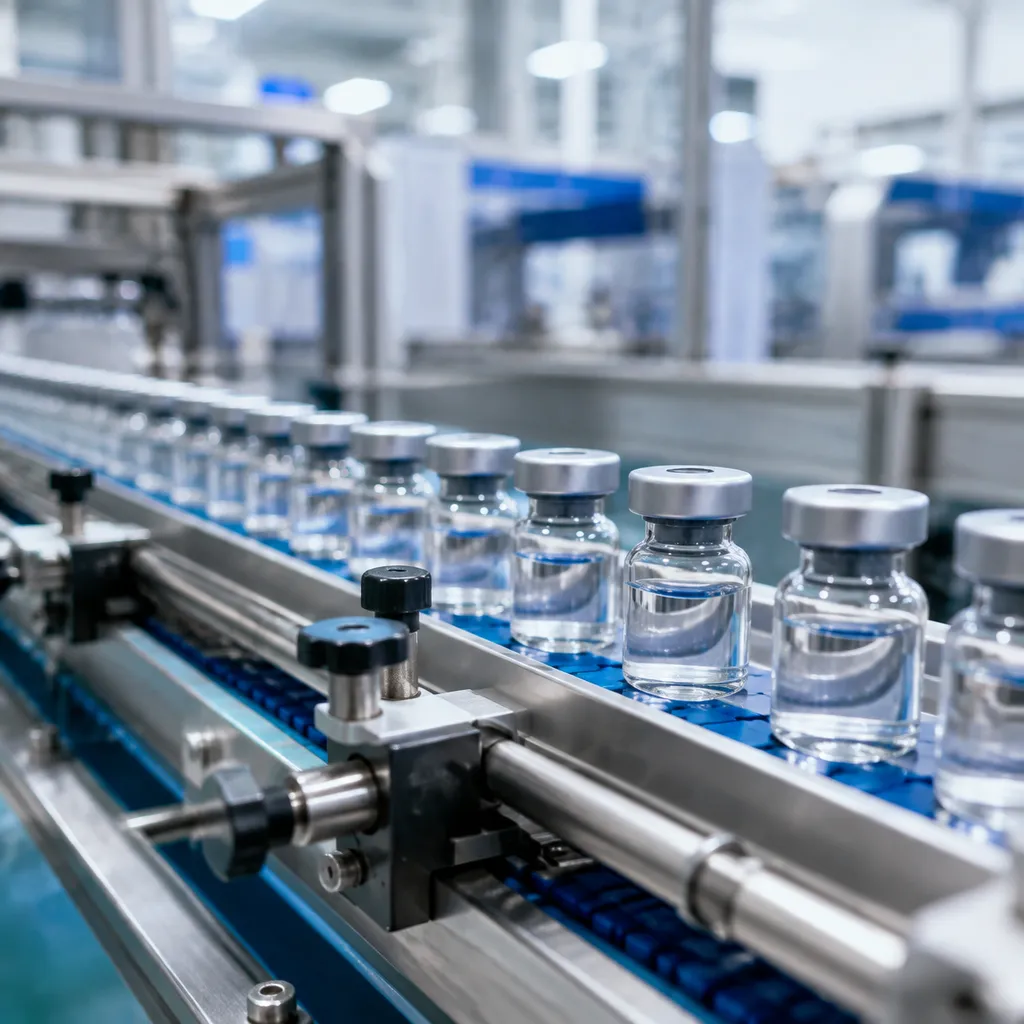
Primary Packaging Process: Step-by-Step Fill-Finish Operations
Component Preparation & Decontamination
Sterility assurance begins long before fluid contacts the container. Raw vials undergo rigorous decontamination to achieve necessary bioburden reduction.
- Infeed & Washing: Glass vials enter rotary or linear ultrasonic washing stations. High-pressure WFI (Water for Injection) and sterile air cycles blast away particulates, silicon oil residues, and foreign matter.
- Dry-Heat Depyrogenation: Cleaned vials transition directly into a continuous dry-heat depyrogenation tunnel. Operating under a controlled heat profile of 250°C to 350°C, this process completely inactivates pyrogens and bacterial endotoxins via thermal destruction.
Precision Liquid & Powder Dosing
Maintaining product potency requires exact dosing accuracy across millions of units. We deploy advanced pharmaceutical vial filling technologies tailored to formulation viscosity and shear sensitivity.
| Dosing Technology | Primary Application | Key Advantage |
|---|---|---|
| Peristaltic Pumps | Shear-sensitive biologics & single-use lines | Zero cross-contamination; gentle fluid path |
| Rotary Piston Pumps | High-viscosity liquids & suspensions | Exceptional long-term volumetric repeatability |
| Rolling-Diaphragm Systems | High-value, low-volume parenteral products | Minimal hold-up volume and ultra-precise filling |
To verify dosing integrity without slowing production, automated In-Process Control (IPC) check-weighing systems continuously weigh vials in real time, maintaining tight filling tolerances within ±0.1%.
Primary Sealing: Stoppering & Crimping
Immediate container closure preserves drug efficacy and prevents ambient oxygen or moisture ingress during aseptic vial processing.
- Elastomeric Rubber Stopper Insertion: An elastomeric rubber stopper is fully inserted immediately after liquid dosing. For lyophilized (freeze-dried) formulations, stoppers are partially inserted, leaving vent channels open for freeze-drying sublimated moisture prior to final seating.
- Aluminum Flip-Off Cap Crimping: Vials undergo precise vial capping and crimping using continuous roller crimping mechanisms. We execute aluminum flip-off cap crimping under Grade A unidirectional airflow to eliminate metallic particle generation during aluminum skirt deformation.
CCIT & Automated Visual Inspection
Defective container closure integrity directly threatens patient safety. Our secondary validation layers combine non-destructive physical testing with high-speed optical scanning.
- Container Closure Integrity Testing (CCIT): We utilize High-Voltage Leak Detection (HVLD) for conductive liquids, Headspace Gas Analysis (HGA) for oxygen-sensitive or freeze-dried drugs, and Vacuum Decay to identify micro-leaks in the container-closure seal.
- High-Speed Visual Inspection: A state-of-the-art vial inspection machine scans every unit at high line speeds. Multi-camera optical systems instantly detect particle presence, liquid volume anomalies, glass cracks, cosmetic flange deformities, and stopper seat misalignment.
Advances in Ready-To-Use (RTU) Nest & Tub Packaging
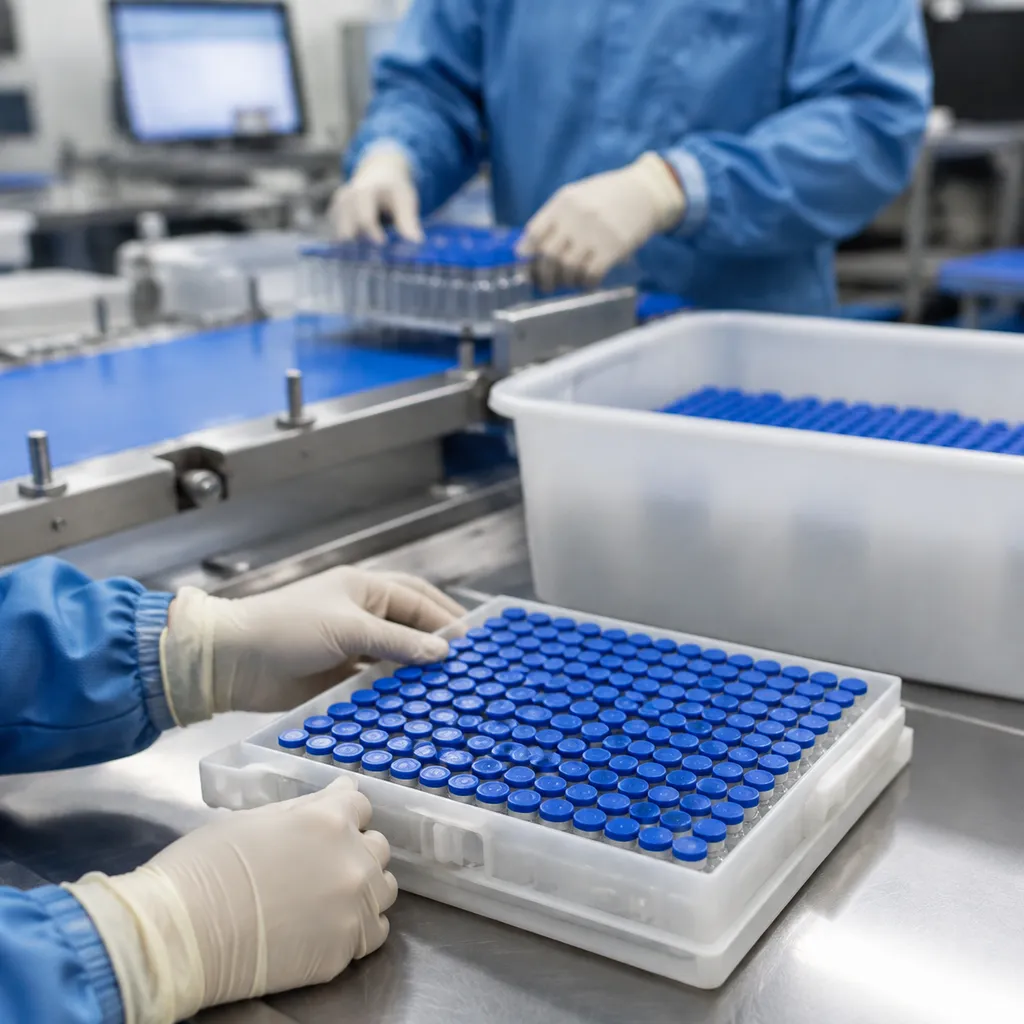
Evolution from Bulk Vials to RTU Formats
Traditional processing requires dedicated washing machines and energy-draining dry-heat depyrogenation tunnels. We eliminate these bottlenecks by introducing pre-sterilized RTU components that arrive clean and ready for immediate aseptic filling.
- Process Simplification: Completely removes on-site washing, rinsing, and depyrogenation cycles.
- Structural Protection: Nest configurations prevent glass-to-glass contact, eliminating cosmetic scratches, micro-fractures, and acoustic noise on the line.
- Particle Control: Direct handling by the neck or body in structured grids maintains strict bioburden and particulate control.
To ensure pristine handling before aseptic entry, integrating a specialized custom vial packaging design with inserts helps maintain strict container isolation across every transport phase.
Architecture of Nest & Tub Systems
RTU containment relies on multi-layer barrier design to guarantee sterility from the supplier to the filling needle.
- Outer Tub & Bag: Rigid polypropylene outer tub sealed in single or double aseptic bags.
- Tyvek Lid: Porous, breathable barrier allowing gas/E-beam sterilization while maintaining container sterility.
- Nest Carrier & Positioning Trays: Precision polymer grid holds each vial securely by the finish or base.
- Aseptic Automation: Fully compatible with high-speed automated denesting stations inside Restricted Access Barrier Systems (RABS) and automated isolators.
Material Innovations in RTU Vials
| Vial Material Type | Structural Profile | Primary Benefits | Best Applications |
|---|---|---|---|
| Moulded Glass | Heavy wall, robust mechanical strength | High chemical resistance, shock tolerance | Large volume parenterals, high-pressure processing |
| Tubular Glass | Uniform wall thickness, excellent clarity | Flawless thermal transfer, consistent dimensions | Standard liquid & lyophilized biopharmaceuticals |
| COP / COC Polymer | Unbreakable advanced medical plastic | Zero delamination, high pH tolerance, glass-like transparency | Fragile biologics, deep cold-chain storage (-80°C) |
Cyclic Olefin Polymer (COP) and Cyclic Olefin Copolymer (COC) vials eliminate heavy metal leaching, prevent glass delamination flakes, and tolerate severe freezing regimes without cracking—making them the ideal choice for modern high-value biopharmaceuticals.
Secondary Vial Packaging Process: Trays, Cushioning, and Transit Protection
The secondary vial packaging process bridges critical fill-finish operations and global distribution. We focus on structural integrity, thermal stability, and automated handling to guarantee that drug products reach end-users without degradation or breakage.
+-----------------------------------------------------------------------+
| Secondary Vial Packaging Flow |
+-----------------------------------------------------------------------+
| 1. Precision Tray Nesting (Snap-fit / Loose-drop) |
| 2. Automated Labeling & Vision Verification (2D DataMatrix) |
| 3. Cartoning & Tamper-Evident Hot-Melt Sealing |
| 4. DSCSA / EU FMD Line-Level Track & Trace Serialization |
+-----------------------------------------------------------------------+
Primary Objectives in Secondary Packaging
Secondary packaging must withstand aggressive mechanical stresses while maintaining strict environmental parameters during international freight:
- Transit Protection & Vibration Damping: Glass containers must be isolated to eliminate glass-to-glass contact, lateral migration, and shock damage during multi-modal transport. Utilizing a custom vial sample box for safe storage and shipping ensures structural stability across complex supply chain routes.
- Cold-Chain & Ultra-Low Temperature (-80°C) Stability: Secondary materials must resist brittle fracture under extreme freeze-thaw cycles while maintaining uniform cold air distribution around each container.
High-Stability Plastic Vial Trays and Holders
We engineer secondary vial packaging trays designed specifically to integrate into high-speed automated packaging lines.
| Feature | Snap-Fit Tray Design | Loose-Drop Clearance Channels |
|---|---|---|
| Primary Mechanism | Mechanical retention tabs secure vial neck | Open vertical clearance with side guide rails |
| Robotic Loading | High-precision pick-and-place end effectors | Gravity feed or high-speed continuous drop |
| Best Used For | High-vibration transport & inverted handling | Ultra-high-speed automated lines (300+ vials/min) |
| Thermal Profile | Ideal for -80°C deep cold-chain storage | Standard refrigerated (2°C to 8°C) logistics |
- Denesting Geometry: Stackable and nestable tray footprints reduce cleanroom storage volume by up to 40% while preventing jam-ups on automated feeder lines.
- Jiahua Package Advantage: We deliver custom OEM/ODM plastic tray engineering tailored to specific container dimensions. Whether you are scaling production or referencing a peptide vial sizes guide for 2ml to 10ml containers, our custom tooling guarantees precise tolerances for seamless robotic integration.
Cartoning, Labeling, and Compliance Serialization
Once placed in protective trays, containers enter high-speed secondary cartoning and compliance tracking:
- Precision Labeling: Wrap-around pressure-sensitive labels are applied with inline camera verification for 2D DataMatrix codes, lot numbers, and expiration dates.
- Automated Cartoning: High-speed cartoning machines load tray inserts into folding cartons, applying hot-melt adhesive closures and anti-tampering security seals.
- Regulatory Serialization: Fully compliant with DSCSA (US) and EU Falsified Medicines Directive (FMD) mandates, executing unit-level, carton-level, and aggregation case-level serialization in real time.
Materials and Precision Standards for Vial Packaging Accessories
Polymer Selection and E&L Compliance
We engineer components for the critical vial packaging process using high-purity, medical-grade resins. Choosing the right material ensures chemical compatibility, structural integrity, and zero degradation across various sterilization methods.
- USP Class VI Compliant Resins: We process Polypropylene (PP), Polyethylene (PE), Cyclic Olefin Copolymer (COC/COP), PETG, and Polystyrene (PS) depending on thermal and mechanical requirements.
- Extractables & Leachables (E&L) Control: Every resin batch undergoes rigorous E&L testing to ensure zero chemical migration into pharmaceutical formulations.
- Sterilization Inertness: Formulations maintain high tensile strength and clarity under E-beam, gamma radiation, and autoclave processing.
To safeguard delicate formulations during shipping and storage, our specialized vial packaging for secure transit uses certified polymers built to maintain structural resilience.
Cleanroom Injection Molding and Dimensional Accuracy
Precision molding directly affects line automation. We operate high-speed production inside ISO Class 7 (Class 10,000) and ISO Class 8 (Class 100,000) cleanroom facilities to prevent particulate contamination and keep bioburden levels minimal.
| Metric / Parameter | Standards & Performance Targets |
|---|---|
| Dimensional Tolerance | Holds ultra-tight limits to ±0.02 mm for flawless robotic pick-and-place operation |
| Environmental Control | Continuous air particulate counts and automated microbial monitoring |
| Quality Verification | 100% inline high-speed optical camera scanning for micro-defects |
Holding exact dimensional tolerances guarantees that automated denesting, tray loading, and high-speed robotic grippers operate without jamming or component misalignment.
Rapid Prototyping and High-Cavitation Production
We take custom components from initial design concepts to high-volume commercial production through a structured three-phase engineering workflow:
- Phase 1: CAD & Mold Flow Simulation — Advanced structural modeling and rheology simulation analyze stress distribution and optimize gate placements before steel tooling begins.
- Phase 2: Rapid Tooling & Fast Sampling — Fast-track prototype tooling delivers functional samples in 7–10 days for standard profiles and 2–4 weeks for custom complex geometries.
- Phase 3: Validation & Mass Production — Complete IQ/OQ/PQ validation, full bioburden documentation, and seamless scaling into multi-cavitation molds for high-volume commercial manufacturing.
Optimizing the Vial Packaging Process: Quality Control and Line Efficiency

Common Defects & Root Cause Mitigations
| Packaging Defect | Primary Root Cause | Mitigation Strategy |
|---|---|---|
| Capping Wrinkles & Flange Distortion | Incorrect vertical sealing force or worn crimping rollers | Calibrate sealing head pressure profiles and set strict mechanical tolerances. |
| Glass Chipping & Micro-Particulates | Glass-to-glass contact during high-speed handling | Transition to precision custom vial packaging trays and RTU nest carriers that isolate individual containers. |
| Label Flagging & Poor Adhesion | Low vial surface energy or ambient humidity fluctuations | Implement inline plasma surface treatment and regulate cleanroom humidity controls. |
Maximizing Overall Equipment Effectiveness (OEE)
Achieving high OEE on automated fill-finish lines requires balancing speed with real-time inspection protocols:
- Eliminating Throughput Bottlenecks: We synchronize high-speed primary filling and capping lines directly with secondary cartoning units, preventing container backup and reducing thermal exposure risks.
- Speed vs. Precision Calibration: Line speeds of 100–300+ vials/min require integrated 100% check-weighing, high-speed vision verification, and robotic tray loading without compromising container stability.
- Buffer Zone Optimization: Deploying dynamic accumulators between primary crimping and secondary packaging machinery ensures continuous operation during downstream material reloads.
Future Trends in Pharmaceutical Vial Packaging
Emerging Trends in Secondary Packaging
- Eco-Friendly Mono-Material Plastics: Transitioning to fully recyclable mono-material medical plastics for secondary trays, simplifying disposal without compromising cleanroom cleanliness.
- Smart Tracking & RFID Integration: Embedding RFID tags and smart sensors directly into secondary carriers for real-time location and temperature verification across complex logistics routes.
- Strategic OEM/ODM Reliance: Drug manufacturers increasingly rely on specialized custom packaging engineering to optimize line integration and eliminate mechanical downtime.
To see how advanced structural design supports these fill-finish trends, explore our specialized vial packaging solutions engineered for modern pharmaceutical lines.
Checklist for Selecting an OEM Packaging Partner
Selecting the right manufacturing partner directly impacts your line OEE, bioburden management, and overall operational stability. Here is what we strictly adhere to—and what you should demand—when evaluating a packaging supplier:
| Evaluation Criteria | Technical & Quality Standards |
|---|---|
| Cleanroom & Compliance | Certified ISO Class 7 and ISO Class 8 cleanroom injection molding supported by complete cGMP documentation. |
| Tooling & Sampling | In-house mold building, rapid tooling turnarounds, and fast-track sampling within 7 to 10 business days. |
| Traceability & IP | Full batch traceability, complete material test reports (MTRs), USP Class VI resin verification, and strict IP protection agreements. |
Partnering with a proven manufacturer ensures your packaging integrates smoothly with automated pick-and-place equipment. Examine our precision-engineered vial holders and trays designed to ensure physical protection and seamless handling across high-speed packaging lines.
Frequently Asked Questions: Vial Packaging Process
Q1: What is the primary difference between primary and secondary vial packaging processes?
Primary packaging directly contacts the formulation to maintain sterility and drug stability throughout its shelf life. Secondary packaging provides structural support, shock absorption, cold-chain protection, and serialization for logistics.
| Packaging Level | Primary Vial Packaging Process | Secondary Vial Packaging Process |
|---|---|---|
| Main Objective | Sterile containment & drug integrity | Physical protection, transit stability & compliance |
| Core Components | Vials, elastomeric stoppers, aluminum caps | Custom plastic trays, cartons, outer cases, labels |
| Operating Area | Grade A/B Aseptic Fill-Finish Line | ISO Class 7/8 Cleanroom or Automated Packaging Line |
Q2: How do Nest & Tub RTU systems improve aseptic filling efficiency?
Ready-to-Use (RTU) Nest & Tub configurations arrive pre-washed, depyrogenated, and gamma-sterilized. They bypass resource-intensive washing and heating tunnels on your line, eliminate glass-to-glass contact, and feed directly into high-speed automated denesting stations. We engineer advanced pre-sterilized RTU packaging systems to optimize aseptic throughput in isolators and RABS lines.
Q3: Why are precise dimensional tolerances (±0.02 mm) critical for automated secondary packaging?
High-speed packaging lines rely on automated robotic pick-and-place grippers. Dimensional deviations greater than ±0.02 mm cause misalignment, line jams, crushed flanges, or dropped vials during tray insertion. Tight tolerances ensure zero downtime and maintain peak Overall Equipment Effectiveness (OEE).
Q4: What materials are recommended for secondary vial trays used in deep cold-chain storage?
For deep cold-chain and ultra-low temperature environments (-80°C), medical-grade Polypropylene (PP), PETG, and Cyclic Olefin Copolymer (COC/COP) are ideal. These USP Class VI materials resist thermal shock, maintain structural flexibility, and prevent tray cracking or warping during freezing and thawing cycles.
Q5: What is the typical lead time for custom OEM vial tray development with Jiahua package?
We expedite OEM/ODM packaging projects using integrated tooling and in-house cleanroom molding operations:
| Development Stage | Lead Time |
|---|---|
| CAD Structural Design & Mold Flow Simulation | 24–48 Hours |
| Rapid Tooling & Sample Production | 7–10 Days |
| Custom High-Cavitation Prototype Tooling | 2–4 Weeks |
| Full Bioburden Validation & Mass Production | 2–3 Weeks |
Partner with us through our custom packaging development services to accelerate your clinical and commercial packaging timelines.