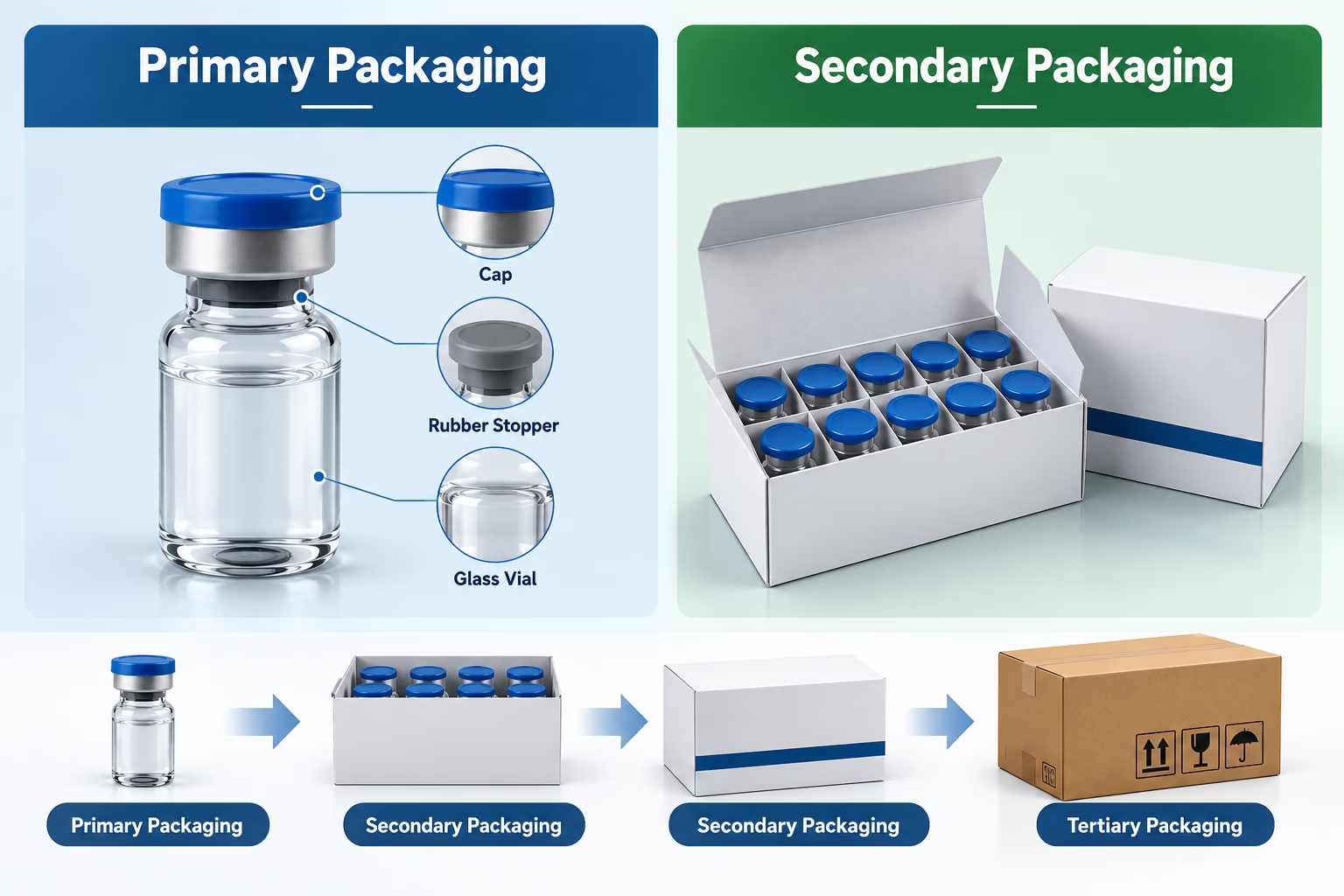
What Buyers Mean When Searching for Cerebrolysin Vial Packaging
When pharmaceutical buyers search for cerebrolysin injection vial packaging, they are looking for precise containment systems tailored to fragile glass containers. Searching for cerebrolysin vial packaging involves distinct structural and protective requirements depending on the stage of manufacturing and distribution.
Finished Product vs. Bulk Packaging
To choose the right solution, buyers must distinguish between primary containment, secondary packaging, and transport-level protection.
| Packaging Category | Core Function | Common Formats |
|---|---|---|
| Finished Injectable Packaging | commercial unit ready for pharmacy or clinical distribution | Printed cartons, custom trays, batch-labeled boxes |
| Secondary Packaging | Exterior containment providing structural support and light shielding | Rigid folding boxes, outer protection sleeves |
| Ready-to-Use (RTU) Packaging | Sterile-ready trays designed for direct filling line integration | Pre-sterilized nest and tub systems, thermoformed trays |
| Transport & Protective Packaging | Multi-unit bulk transit protection for international logistics | Shock-absorbing foam inserts, heavy-duty shipping trays |
Core Procurement Goals
- Breakage Prevention: Securing glass ampoules and vials with precision-fit cavities to withstand mechanical shock and impact.
- Sterility and Cleanliness Control: Ensuring particulate-free, medical-grade materials that meet cleanroom packaging protocols.
- Temperature Stability: Supporting both ambient shipping and cold-chain logistics without structural degradation.
- Export Compliance: Meeting international shipping standards for global pharmaceutical distribution.
Why Packaging Quality Matters
- Product Safety: Prevents micro-fractures, seal damage, and product loss during handling.
- Regulatory Compliance: Adheres to strict pharmaceutical packaging standards and material traceability.
- Brand Integrity: Delivers professional presentation that reinforces product authenticity and quality.
- Logistics Efficiency: Optimizes warehouse stacking, handling speed, and transport density.
Common Packaging Formats for Cerebrolysin Injection Products
When we engineer cerebrolysin injection vial packaging and ampoule systems, our core focus is eliminating glass-to-glass contact while maintaining cleanroom standards. Injectable medications demand specific physical protection tailored to the container size, fluid volume, and automation needs of the production line.
| Format Type | Typical Volumes | Key Packaging Feature | Primary Benefit |
|---|---|---|---|
| Ampoule Packs | 1 ml, 5 ml, 10 ml | Multi-cavity thermoformed insert | Shock absorption & neck protection |
| Vial Packs | 2 ml – 50 ml | Secure outer box with precision tray | Vial stability & label visibility |
| RTU Tray Systems | Standard ISO Vials | Ready-To-Use pre-sterilized tray | Direct automated line integration |
| Nest & Tub Systems | High-value Injectables | Matrix tub with suspended nest | Particulate reduction & shock isolation |
Ampoule packaging
- Target Capacities: Specially designed to secure standard 1 ml, 5 ml, or 10 ml glass ampoules without stress on the break-ring.
- Anti-Shock Protection: Molded contours grip each neck and base firmly to prevent displacement during long-distance transport.
- Multi-Unit Layouts: Supplied in multi-piece configurations, utilizing specialized ampoule packaging materials engineered for durability and sterility control.
Vial packaging
- Structural Stability: Custom inner trays keep glass vials firmly in place, avoiding tilt and friction during warehousing.
- Labeling & Traceability: Engineered with clear display areas for regulatory labels, batch verification numbers, and usage instructions.
- Storage & Distribution: High space-efficiency for bulk shipping, matching specifications found in our custom vial sample box solutions for safe transport.
RTU tray systems for injectable packaging
- Cleanroom Ready: Pre-cleaned and sterile-ready cerebrolysin vial packaging trays designed to enter aseptic manufacturing areas directly.
- Automated Line Compatibility: Fully aligned with automated de-nesting, filling, and capping equipment to eliminate manual handling.
- Manufacturing Efficiency: Drives up packaging throughput while minimizing contamination risks during high-speed operations.
Nest and tub packaging
- Zero Container Contact: Vials remain suspended in precise grid positions inside the tub, shielding glass bodies from impact.
- Low Particulate Risk: Precision-molded medical plastics limit friction dust and particulate generation inside the pack.
- Cold-Chain Resistance: Material formulations stay tough and flexible under low temperatures, ideal for refrigerated or frozen transport.
Key Requirements for Cerebrolysin Injection Vial Packaging
Glass ampoules and vials containing delicate peptide-based solutions demand rigorous protection.
| Packaging Requirement | Critical Engineering Feature | Functional Impact |
|---|---|---|
| Protection Against Breakage | Anti-slip cavities & shock-absorbing walls | Prevents glass-to-glass contact and impact damage |
| Cleanliness & Contamination | Low-particulate thermoformed materials | Maintains sterile-ready conditions in cleanrooms |
| Accurate Dimensional Fit | Precision-molded cavity tolerances | Eliminates internal vial movement during transit |
| Transport & Cold-Chain Stability | Temperature-stable polymer structures | Protects integrity across ambient and refrigerated shipping |
Precision Protection Against Breakage
When shipping fragile glass containers, internal movement causes hairline cracks and structural failure. Our cerebrolysin vial packaging utilizes custom-engineered cavities and anti-slip positioning to lock each unit securely in place. Combining rigid outer cartons with shock-absorbing inner structures mitigates vibration across multi-modal transport routes.
Cleanliness and Contamination Control
Injectable products leave zero room for particulate contamination. We manufacture our sterile packaging trays in controlled environments using medical-grade polymers. These materials generate minimal static and low particulate counts, ensuring seamless integration with automated packing lines and aseptic environments.
Dimensional Precision Fit
Standard off-the-shelf trays allow micro-shifting that compromises glass integrity. We engineer custom cavities tailored directly to your exact vial diameter, total height, and neck geometry. Utilizing a custom vial packaging design with compliant inserts ensures every container snaps snugly into place without excess pressure.
Storage and Transportation Stability
Whether managed through standard ambient logistics or strict temperature-controlled distribution, secondary packaging must maintain structural rigidity. Our specialized cerebrolysin injection ampoule packaging holds up under heavy stacking pressure, humidity shifts, and cold-chain transport, preventing tray warping and keeping your injectable products secure from factory floor to end user.
Material Options for Cerebrolysin Vial Packaging
Choosing the right polymer for cerebrolysin vial packaging is critical for maintaining structural integrity, sterility compliance, and product safety throughout shipping and storage. We utilize medical-grade resins engineered to withstand mechanical shock and cleanroom environments.
| Polymer Material | Core Properties | Primary Packaging Function |
|---|---|---|
| Medical-Grade PP | High durability, chemical resistance, low particulate generation | Rigid trays, structural inserts, and multi-vial protective boxes |
| PE (Polyethylene) | Flexible, excellent impact damping, moisture-resistant | Shock-absorbing partitions, protective caps, and flexible inserts |
| COP & COC | Glass-like optical clarity, ultra-low extractables, superior barrier | Premium injectable housing and specialized high-purity packaging |
| PETG & PS | Crisp visibility, easy thermoforming, cost-effective rigid structure | Secondary display trays, outer clamshells, and rigid blisters |
Medical-Grade Polypropylene (PP)
We use medical-grade PP as our standard resin for robust cerebrolysin injection vial packaging. Its exceptional tensile strength and resistance to cracking ensure that delicate glass ampoules and vials stay firmly positioned without shifting during automated cartoning.
Polyethylene (PE)
PE provides crucial flexibility and vibration damping. We incorporate PE elements into packaging systems that face heavy transport handling, absorbing shock energy to prevent micro-fractures in glass containers.
High-Purity COP and COC
Cyclic Olefin Polymer (COP) and Cyclic Olefin Copolymer (COC) deliver high transparency alongside chemical inertness. For high-value injectable formulations, these resins offer the thermal stability and low-leachable profile required for strict pharmaceutical standards. You can explore our specialized vial packaging for pharmaceuticals designed for secure cold-chain transit.
Efficient PETG and PS Formations
PETG and Polystyrene (PS) allow precision thermoforming with rapid production cycles. They create clear, rigid packaging structures that make batch inspection and dosage verification fast and simple on production lines.
How to Choose the Right Material
Selecting the best polymer for your packaging footprint depends on specific operational demands:
- Vial Volume and Mass: Heavier multi-dose vials require the high load-bearing capacity of medical-grade PP or thick PETG.
- Transit Conditions: For long-distance export or cold-chain storage, choose materials like PE or modified PP that remain ductile at low temperatures.
- Sterility and Regulatory Needs: Ensure materials meet USP Class VI compliance and can endure required sterilization routines without degradation.
- Custom Dimensions: For non-standard vial heights or specialized batch sizes, review our custom glass vial packaging options to tailor tray geometries and cavity arrangements.
Performance Factors for Cerebrolysin Injection Vial Packaging
Inner Cavity Size and Precision Fit
Glass containers require exact tolerances. If a thermoformed cavity is even a fraction of a millimeter too loose, glass-on-glass friction and impact during shipping will cause hairline fractures or shattering. Conversely, an overly tight fit creates stress during loading. We engineer high-precision vial tray packaging with exact retention contours that lock each unit securely in place, eliminating unwanted movement while maintaining easy removal.
Outer Box Structure and Load-Bearing Strength
Primary inner trays are only as protective as the secondary carton surrounding them. When transporting bulk shipments of cerebrolysin vial packaging, box compression strength is critical. We construct outer boxes using high-burst-strength paperboard and rigid flute structures designed to withstand heavy top-load pressure during pallet stacking, warehouse storage, and long-distance transit.
Tray Layout and Cavity Optimization
Whether designing compact retail sets or high-density transit trays, cavity layout directly dictates package safety and logistics efficiency:
- Single-row layouts: Best for 5-unit or 10-unit prescription packs, offering clean presentation and effortless access for healthcare providers.
- Multi-cavity grids: Engineered to maximize pack density for bulk pharmaceutical supply, significantly cutting freight costs while guaranteeing zero contact between adjacent vials.
Regulatory Space and Packaging Line Efficiency
Pharmaceutical compliance requires designated, unobstructed zones for batch numbers, serialization barcodes, expiration dates, and dosage details. Our custom vial box packaging with inserts provides flat, scan-ready surface areas for automated labeling and vision inspection lines.
Structure also dictates manufacturing throughput. We optimize cavity lead-ins and wall angles to ensure smooth robotic pick-and-place operation on high-speed automated lines as well as quick manual packing.
Jiahua Package Manufacturing Advantages for Cerebrolysin Vial Packaging
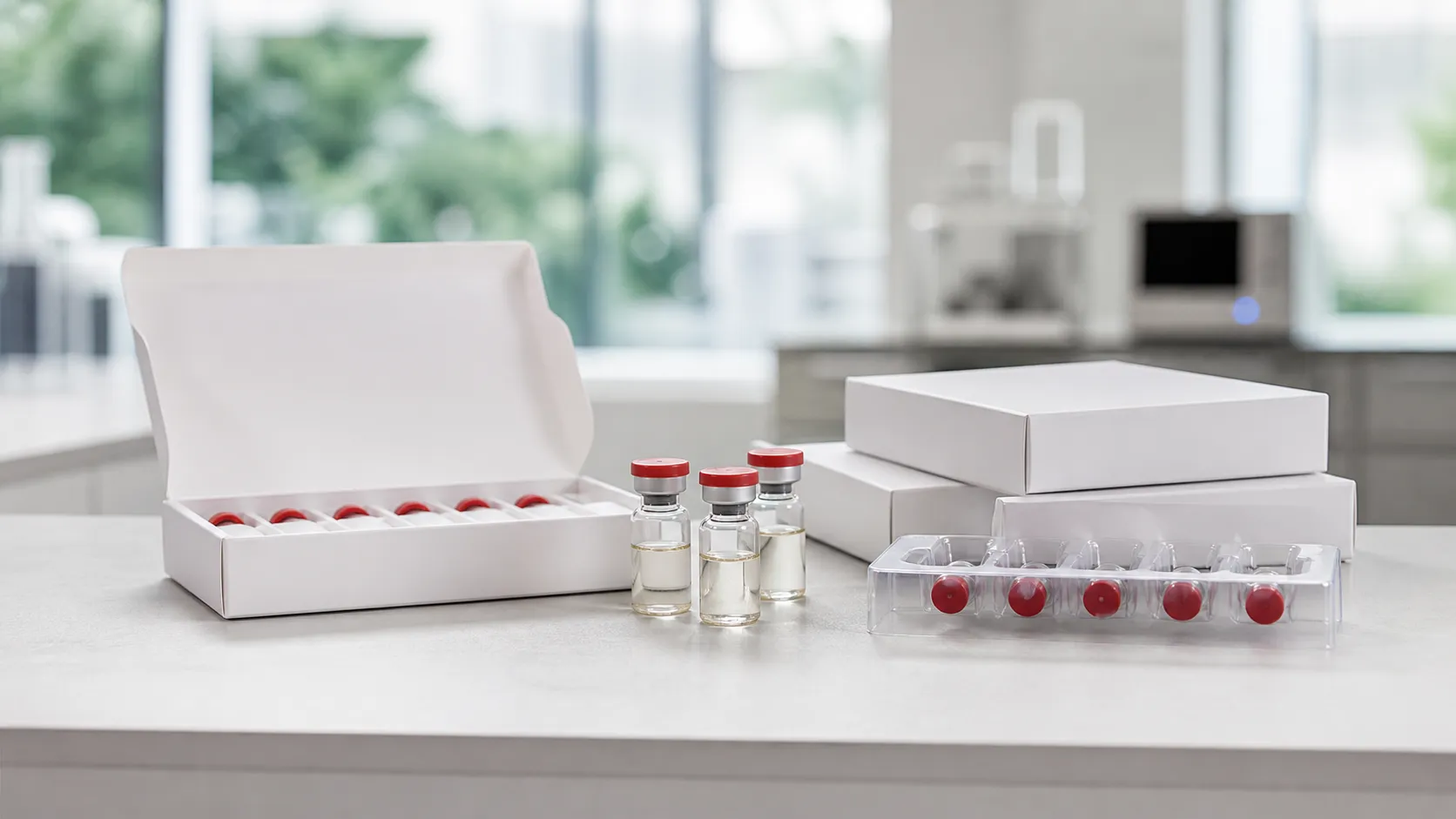
Core Manufacturing Capabilities
| Advantage | Technical Detail | Value for Pharmaceutical Buyers |
|---|---|---|
| Cleanroom Production | ISO Class 7 & ISO Class 8 controlled environments | Low particulate counts, zero contamination risk for injectable products |
| Precision Injection Molding | Ultra-tight tolerances & automated production | Perfect fit, zero movement, smooth integration with automated packaging lines |
| Tailored Customization | OEM/ODM custom sizes, tray layouts, and designs | Optimized cavity dimensions specifically for glass vials and ampoules |
| Global Service Model | China manufacturing base + U.S. office support | Localized technical consultation with cost-effective, scalable production |
Cleanroom-Based Production & Quality Control
Injectable packaging demands absolute cleanliness. As a specialized cleanroom packaging manufacturer, we produce our trays and protective containers in certified ISO Class 7 and ISO Class 8 environments. This strict environmental control minimizes particulate generation and bioburden risks, ensuring every cerebrolysin injection vial packaging unit complies with international hygienic requirements.
OEM/ODM Development & Precision Tooling
Standard packaging often leaves gaps that cause vial movement and glass breakage during shipping. We address this through full OEM/ODM custom engineering:
- Exact Cavity Fit: We map inner cavity dimensions directly to your vial diameter, neck height, and glass wall thickness to lock each unit securely in place.
- In-House Tooling: Our team oversees complete custom mold development to ensure high-accuracy tooling, fast prototype iterations, and long-term production stability.
- High-Volume Repeatability: Advanced injection molding provides strict dimensional consistency, eliminating line stoppages on high-speed automated packaging machinery.
Fast Prototyping & Global Supply Network
We speed up product launches through rapid CAD modeling and fast-turnaround sampling, letting you validate physical fit and shock performance before mass manufacturing.
Combining our high-capacity production facilities in China with responsive U.S. office support, we offer seamless technical guidance and reliable global delivery. Whether you need standard trays or scalable custom pharmaceutical packaging solutions, we deliver high performance, regulatory compliance, and consistent supply.
How to Choose the Right Cerebrolysin Vial Packaging Solution
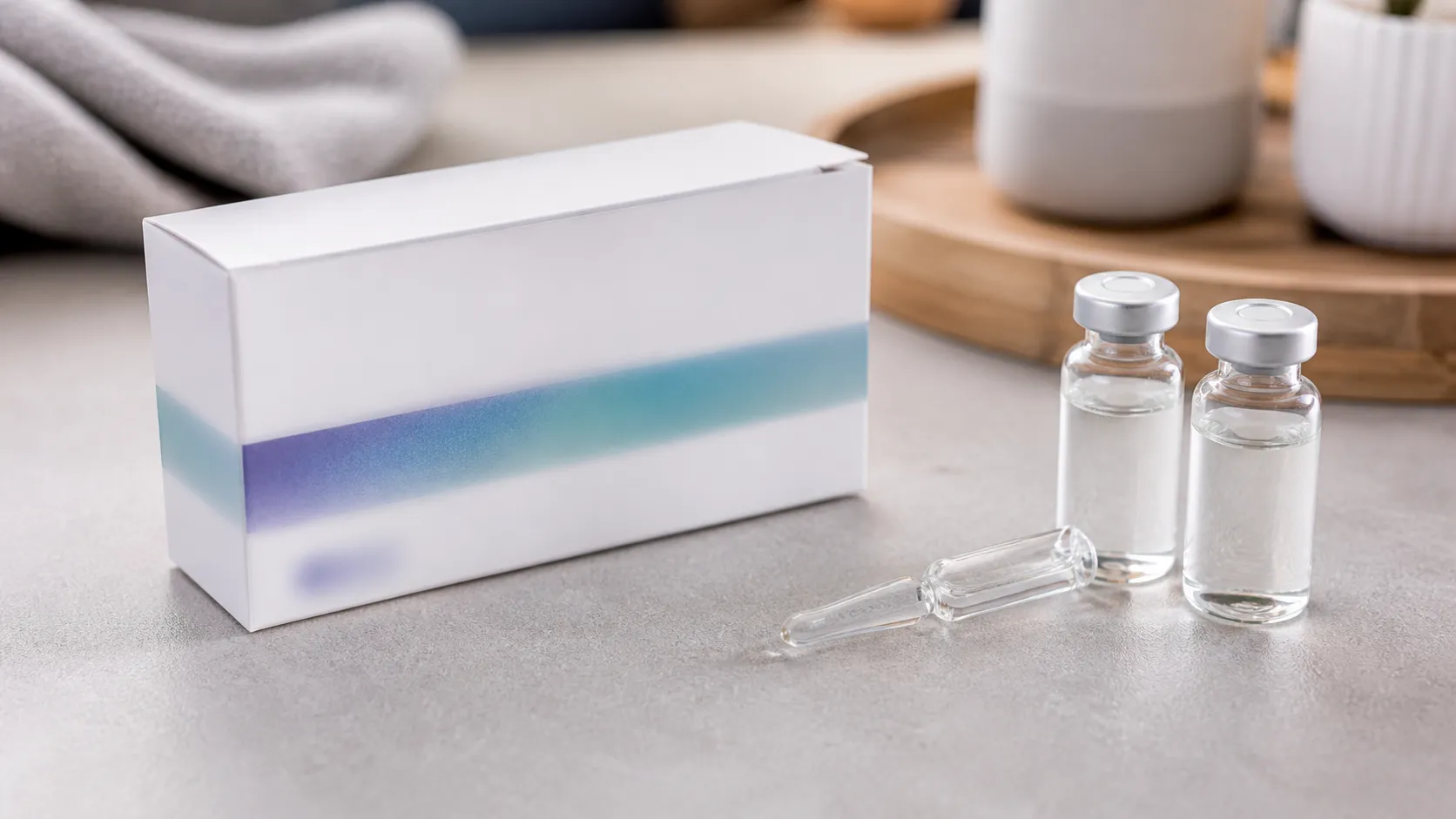
1. Start with Precise Container Specifications
Before choosing a tray or box structure, gather exact measurements for your glass containers. Even a millimeter variance in glass thickness or neck height affects tray cavity retention and shock resistance.
- Key Container Metrics: Fill volume (e.g., 1 ml, 5 ml, 10 ml), outer diameter, total height, glass wall thickness, and target unit count per pack.
- Container Format: Determine whether your line uses dedicated vial packaging solutions or specialized ampoule packaging solutions to ensure correct cavity fit and anti-breakage support.
2. Match Packaging to Your Supply Chain Scenario
Your operational route dictates the required structural strength and material properties.
| Supply Chain Stage | Primary Packaging Focus | Key Requirement |
|---|---|---|
| Factory Filling Line | Automated denesting and packing | High dimensional stability, RTU tray compatibility |
| Warehouse & Logistics | Stacking strength and density | Rigid outer box structure, impact-resistant trays |
| Cold-Chain / Export | Thermal stability and damp protection | Non-brittle medical plastics (e.g., Medical PP, PETG) |
| Pharmacy / Hospital | Quick identification and clean handling | Secure cavity positioning, clear batch labeling space |
3. Verify Material and Cleanroom Compliance
To prevent product contamination and pass regulatory audits, ensure your cerebrolysin injection vial packaging meets target market standards:
- Cleanroom Manufacturing: Trays molded in ISO Class 7 or ISO Class 8 environments to minimize particulate loading and bioburden.
- Material Standards: Medical-grade polymers certified to USP Class VI, ISO 10993, REACH, and RoHS standards.
- Full Traceability: Complete lot documentation and material safety reports to streamline customs clearance and quality audits.
4. Decide Between Standard and Custom Formats
- Standard Packaging: Best for fast turnarounds, standard ISO vial sizes, and lower initial tooling investment.
- Custom Packaging: Ideal for unique vial contours, high-speed automated packaging lines, multi-cavity combo boxes, or optimizing transport volume for long-distance export.
OEM/ODM Packaging Development Process at Jiahua Package
We engineer custom OEM and ODM cerebrolysin injection vial packaging solutions tailored to exact pharmaceutical requirements. Our end-to-end development workflow balances rapid turnarounds with stringent quality control to ensure total product protection during global distribution.
| Step | Development Phase | Core Deliverables |
|---|---|---|
| 01 | Requirement Confirmation | Vial size specs, material choice, cleanroom requirements, and order volume |
| 02 | Structural CAD Design | Custom tray layouts, shock-absorption features, and stackability modeling |
| 03 | Sampling & Validation | Functional prototyping, exact fit checks, and transport simulation tests |
| 04 | Mass Production & QC | Cleanroom injection molding, automated dimensional checks, and batch tracking |
| 05 | Delivery & Technical Support | Export-ready logistics, packaging line adjustments, and supply chain continuity |
Step 1 — Requirement Confirmation
We start by gathering the precise physical specs of your ampoule or glass vial, including total height, outer diameter, wall thickness, and target unit count per box. We also clarify sterility expectations, temperature conditions during transit, and material preferences (such as medical-grade PP or PETG).
Step 2 — Structural Design and CAD Development
Our design team generates 3D CAD models and cavity layouts optimized for high-speed automated packing or manual assembly. For sterile-ready environments, we design custom RTU packaging solutions with engineered retention clips and shock-absorbing walls that prevent glass-to-glass contact.
Step 3 — Sampling and Validation
We create rapid prototype samples for physical evaluation before mold production. Your engineering team tests these samples for dimensional precision, vial retention, drop resistance, and thermal stability to confirm complete protection.
Step 4 — Mass Production and Quality Control
After prototype approval, we transition to precision mold-based manufacturing inside our ISO-certified cleanrooms. Every production run of cerebrolysin vial packaging undergoes continuous optical inspections, bioburden checks, and strict lot traceability to maintain compliance.
Step 5 — Delivery and After-Sales Support
We handle export packaging and global logistics for smooth distribution. Our engineers remain engaged post-delivery to offer technical assistance, optimize packaging performance on your filling lines, and support long-term volume scaling.
Quality Control Standards for Cerebrolysin Vial Packaging
We enforce strict quality control protocols across every stage of manufacturing to guarantee that our cerebrolysin vial packaging satisfies global pharmaceutical standards. Injectable glass products demand uncompromising safety, zero contamination, and exact physical protection.
| Quality Control Pillar | Inspection & Process Standard | Core Benefit |
|---|---|---|
| Dimensional Accuracy | Precise tolerance checks, digital caliper verification, mold-fit testing | Prevents glass movement and eliminates transportation damage |
| Material Compliance | Medical-grade resin selection, USP Class VI material options, raw testing | Guarantees non-reactive, non-toxic packaging integrity |
| Bioburden & Cleanliness | ISO Class 7/8 cleanroom handling, particulate control, air washing | Minimizes bioburden and supports sterile packaging workflows |
| Batch Traceability | Complete lot tracking, production logging, CoA documentation | Provides full supply chain transparency for regulatory audits |
Strict Inspection Standards for Injectable Packaging
Maintaining consistent quality across large production runs requires systematic testing. We verify every batch of cerebrolysin injection vial packaging using advanced inspection methods:
- Precision Fit & Tolerance Control: We test vial cavities against micro-tolerances to ensure glass ampoules snap securely into place without stress concentration.
- Certified Material Safety: All plastic resins are fully vetted to meet global compliance criteria. You can review our operational compliance and quality certifications to verify our testing rigor.
- Cleanroom Bioburden Reduction: Molded packaging trays are processed in controlled cleanroom environments to lower particulate generation and contamination risks.
- End-to-End Lot Tracking: Each shipment includes complete documentation, linking raw material batches directly to finished packaging lots for quick verification.
Real-World Scenarios for Cerebrolysin Injection Vial Packaging
| Supply Chain Stage | Primary Packaging Priority | Key Packaging Features |
|---|---|---|
| Pharmaceutical Manufacturers | Automation & Line Efficiency | High-precision dimensions, nest & tub compatibility, low particulate emission |
| Export Suppliers | Long-Distance Transit Protection | Anti-shock cavity design, stackable outer cartons, temperature-resistant materials |
| Distributors & Wholesalers | Storage & Handling Efficiency | Compact tray footprints, clear batch labeling areas, shelf-ready presentation |
| Hospitals & Pharmacies | Safety & Rapid Identification | Single-dose accessibility, tamper-evident structures, clear lot identification |
Tailored Protection Across the Supply Chain
- Pharmaceutical Manufacturers: Large-scale filling lines demand precise tray tolerances to prevent line jams. Our specialized pharmaceutical packaging solutions integrate smoothly into automated de-nesting, inspection, and cartoning systems.
- Export Suppliers: Shipping liquid injectables overseas exposes glass containers to heavy vibration and sudden drops. Engineered cerebrolysin vial packaging locks every unit firmly in place to eliminate glass-to-glass contact during transit.
- Distributors & Wholesalers: Optimized inner cavity layouts maximize pallet space while safeguarding individual boxes, simplifying warehouse inventory audits and bulk order fulfillment.
- Hospitals & Pharmacies: Fast-paced clinical settings rely on quick-open tray designs and high-contrast labeling zones, ensuring healthcare staff can rapidly verify dosage details and lot numbers without risking accidental vial drops.
Why Packaging Buyers Choose Jiahua Package for Cerebrolysin Vial Packaging
| Advantage Category | Key Capability & Benefit |
|---|---|
| Sterile-Ready Focus | Designed for injectable products with strict contamination control and low particulate generation. |
| Custom Engineering | In-house precision mold development tailored to exact glass ampoule and vial dimensions. |
| Supply & Logistics | High-capacity manufacturing, rapid project turnaround, and export-ready logistics support. |
| B2B Communication | Direct engineering consultations, transparent specs, and prompt quotation delivery. |
Core Strengths for Injectable Packaging
- Contamination Control: Our production processes prioritize bioburden reduction, delivering sterile packaging trays that keep delicate cerebrolysin injection vial packaging secure and ultra-clean.
- Precision Mold Development: We design custom cavity structures that lock glass vials in place, preventing micro-fractures during ambient or cold-chain shipping.
- Fast Prototyping: Streamline your project rollout using our fast sampling services to test exact dimensional fits before committing to full-scale production.
- Global Compliance Support: We provide comprehensive documentation and batch traceability to help pharmaceutical exporters meet international regulatory requirements. Review our pharmaceutical packaging guides for detailed material and structural compliance standards.
Frequently Asked Questions About Cerebrolysin Vial Packaging
We address key technical and procurement questions regarding custom cerebrolysin injection vial packaging to help streamline your sourcing decisions.
FAQ Quick Reference
| Question | Key Details & Solutions |
|---|---|
| Can you customize packaging for different vial sizes? | Yes. We engineer tailored cavity dimensions for 1 ml, 2 ml, 5 ml, 10 ml, and 20 ml glass containers. |
| What is the best packaging type for Cerebrolysin ampoules? | Thermoformed inserts paired with rigid paperboard outer boxes provide optimal shock absorption and glass isolation. |
| Do you provide cleanroom-produced pharmaceutical trays? | Yes. We manufacture sterile-ready trays inside ISO Class 7 and ISO Class 8 cleanroom facilities to minimize particulate risk. |
| Is the packaging compatible with cold-chain shipping? | Yes. Our medical-grade polymers maintain structural integrity without cracking during refrigerated or cold-chain export. |
Project Setup and Order Details
- What information do you need to start a custom project?
To start designing your cerebrolysin vial packaging, we need: - Exact glass vial or ampoule dimensions (diameter, total height, neck width).
- Cavity configuration per box (e.g., 5-unit, 10-unit, or 20-unit layouts).
- Storage conditions (ambient vs. cold-chain requirements).
- Estimated order volume and cleanroom processing standards.
- How long does sampling usually take?
Initial CAD design files and 3D mockups are provided within 24 to 48 hours. Physical prototypes are produced and shipped for validation within 3 to 7 business days. - Can you support full OEM and ODM orders?
Yes. We manage full custom packaging development, from precision mold fabrication to automated mass manufacturing. You can choose from our scalable custom peptide vial boxes or request bespoke custom window vial boxes with inserts tailored to your exact brand and safety specifications.
- What information do you need to start a custom project?