
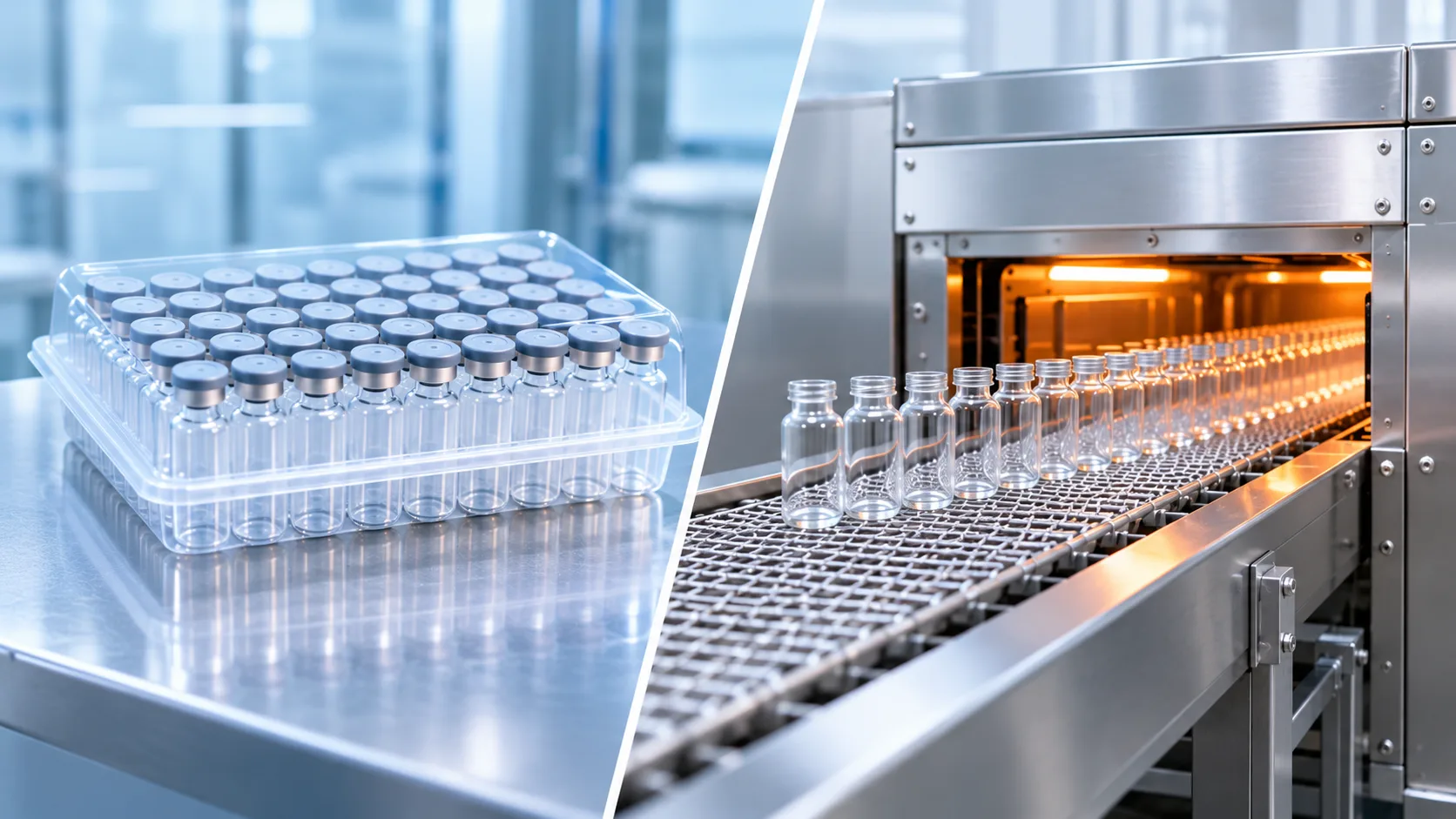
Are you weighing whether to switch to pre-sterilized containers or stick with traditional in-house preparation?
It is one of the most critical decisions for any fill-finish facility.
The debate between RTU packaging vs wash-and-depyrogenate processing directly impacts your cleanroom footprint, validation timeline, and operational bottom line. One offers rapid flexibility and lower initial capital expense; the other delivers unmatched unit-cost control at high volumes.
In this guide, we break down the real-world trade-offs in cleanroom space, contamination risks, and total cost of ownership so you can make the right strategic call for your production line.
Let's dive right in.
How Does Traditional Wash-and-Depyrogenate Processing Work?
For decades, the standard in pharmaceutical fill-finish operations has relied on preparing bulk glass containers directly on the manufacturing floor. In our experience running these lines, this front-end preparation accounts for a massive share of everyday engineering headaches, maintenance downtime, and utility costs.
Before a single container reaches the filling needles, it must pass through an intensive mechanical cleaning and thermal sterilization train.
Bulk Glass Infeed and Mechanical Sorting
The process begins in Grade C or D preparation zones:
Manual or semi-automated depalletizing: Bulk vials arrive tightly packed in shrink-wrapped trays, requiring manual debagging and operator handling.
Mechanical unscrambling: Vials are pushed onto rotary tables or sorting tracks to form a single file.
Surface friction risks: Heavy glass-to-glass contact during this mechanical feed frequently causes micro-scratches, cosmetic scuffing, and container jams.
Multi-Stage Rotary Washing Cycles
Once sorted, bulk glass enters a linear or rotary washing unit:
Alternating spray needles penetrate each inverted container to blast interior and exterior surfaces.
Cycles alternate between filtered compressed air, recycled water, and a final rinse of heated Water for Injection (WFI).
The goal is strictly particulate reduction, rinsing away residual glass shards, dust, and packaging debris accumulated during transit.
Continuous Dry-Heat Depyrogenation Tunnels
Clean, wet vials index directly onto the stainless-steel mesh belt of a continuous depyrogenation tunnel.
Drying, baking, and cooling zones: Vials move through three distinct zones maintained under continuous Grade A (ISO 5) laminar airflow.
Extreme heat profiling: Electric heating elements bring the depyrogenation chamber to temperatures typically between 300°C and 350°C.
Endotoxin destruction: Vials must sustain precise dwell times to achieve a documented 3-log reduction in bacterial endotoxins before being cooled back down to ambient cleanroom temperatures for filling.
High-Consumption Clean Utilities
Keeping this infrastructure alive puts an enormous strain on facility resources:
Water for Injection (WFI): Continuous high-volume rinses demand continuous generation and recirculation loops.
Pure steam & compressed air: Steam generators and compressors must run without interruption to supply sterile drying air and clean-in-place (CIP) cycles.
Electrical power: Industrial tunnel heating coils draw massive electrical loads to maintain thermal equilibrium against cleanroom airflow drafts.
Rigorous Validation and Compliance Burdens
Proving an in-house washing and depyrogenation line works is an ongoing compliance burden:
Thermal air mapping: Technicians must routinely calibrate and map thermocouple arrays across the tunnel's belt width to detect cold spots.
Endotoxin challenge testing: Facilities must regularly inoculate standard vials with high-titer E. coli lipopolysaccharide (LPS), run them through the tunnel, and verify pyrogen breakdown via LAL assays.
Airflow balancing: Engineers must constantly monitor differential pressure across Grade A, B, and C boundaries to prevent unsterilized air from entering the cooling zone.
Mechanical Wear, Line Clearances, and Glass Breakage
Traditional bulk processing involves heavy mechanical movement, thermal stress, and physical friction:
Thermal shock: Rapid heating or cooling imbalances inside the tunnel can shatter fragile borosilicate walls.
Broken vial protocols: A single cracked or exploded vial inside the tunnel or starwheel halts the entire batch. Operators must halt production, perform line clearances, vacuum glass shards, and inspect surrounding filters.
Format changeover delays: Switching from one vial size to another requires removing and replacing extensive format parts across the unscrambler, wash needles, transport belts, and infeed screws.
What Is RTU Packaging and How Does It Transform Fill-Finish?
Ready-to-use (RTU) packaging fundamentally redefines fill-finish operations by removing the entire container preparation step from the pharmaceutical plant. Instead of receiving bulk glass that requires immediate washing, rinsing, and depyrogenation, drug manufacturers receive fully prepared, pre-sterilized primary packaging that feeds directly into sterile filling zones.
In our experience working with fill-finish facilities, adopting RTU formats is the fastest way to strip complexity, mechanical failure points, and unnecessary overhead out of sterile manufacturing suites.
Standardized Nest and Tub Configurations
At the core of RTU technology is the nest and tub architecture. Primary containers—whether high-hydrolytic borosilicate vials or cartridges—are held suspended in a high-density polymer nest, sealed inside a protective tub with a breathable Tyvek lid, and double-bagged for sterile barrier protection.
By utilizing a standardized vial nest and tub system for RTU aseptic fill-finish, facilities can run multiple container formats across identical conveyor geometries. The containers remain suspended and separated, ensuring zero contact during shipment, handling, and loading.
Validated Terminal Sterilization
We handle container depyrogenation and sterilization upstream under strict ISO and GMP conditions, eliminating the customer's need for validated heat tunnels. Depending on the container specification and drug delivery requirements, sterility is achieved through validated processing methods:
- Ethylene Oxide (EtO): Widely utilized for nested glass configurations, penetrating the Tyvek barrier to deliver a validated Sterility Assurance Level (SAL) without altering glass surface chemistry.
- Gamma Irradiation: High-energy electron beam or gamma processing for rapid, chemical-free microbial destruction.
- Thermal Treatment: Controlled dry-heat depyrogenation prior to cleanroom nesting and terminal sealing.
Streamlined Cleanroom Entry and Surface Decontamination
Transitioning nested packaging from non-classified logistics areas into Grade A/B filling zones requires minimal processing steps compared to bulk glass prep. Modern barrier lines integrate automated transfer protocols:
- Automated Debagging: Robotic arms strip outer and inner protective bags to minimize particulate shed.
- VHP Airlocks: Validated Vaporized Hydrogen Peroxide chambers decontaminate the exterior tub surface rapidly.
- Pulsed-Light Decontamination: High-intensity UV flashes provide rapid, in-line bioburden control for high-speed transfers without heat buildup.
Direct Robotic De-Nesting in Isolator and RABS Environments
Inside restricted access barrier systems (RABS) or modern isolators, robotic end-effectors grip and lift nested containers directly from the tub. Because the orientation of every container is fixed and predictable:
- Zero Human Intervention: Grippers move along programmed Cartesian or multi-axis paths, eliminating operator glove-port interventions.
- Precision Indexing: Containers transition straight to filling and stoppering needles without vibratory feeding or mechanical sorting screws.
- Smooth Integration: Systems handle delicate containers with precise, repeatable motion profiles that protect barrier integrity.
Eliminating Glass-to-Glass Contact and Particulates
Traditional unscramblers and depyrogenation tunnels push bulk glass together under high line pressure, creating micro-abrasions, surface flaws, and cosmetic friction marks. These mechanical impacts generate sub-visible glass particulates that increase batch rejection rates.
RTU packaging isolates every container inside its individual nest pocket. Containers never touch from the moment they are packaged at our facility to the moment they are filled and capped on your line, maximizing container strength and sharply cutting particulate contamination.
Accelerated Format Changeovers
Drug delivery portfolios are shifting toward diverse formats, including nested pharmaceutical cartridge nest and tub sterile packaging for auto-injectors and pen systems.
Because nests share standard outer tub dimensions across vials, syringes, and cartridges, line clearance and changeover times drop from an entire shift to under an hour:
- Shared Handling Tooling: Operators only swap out robotic gripper heads and filling needles rather than entire sorting bowls, star wheels, and tunnel feed screws.
- Reduced Line Re-Validation: Consistent container presentation simplifies recipe changes on modular filling equipment.
- Multi-Product Efficiency: Filling facilities pivot smoothly between small-batch biologics, customized drug therapies, and clinical trial lots on a single, compact machine footprint.
RTU Packaging vs Wash-and-Depyrogenate Processing: Direct Operational Comparison
In our experience working with sterile manufacturing teams, the operational friction between traditional in-house preparation and ready-to-use solutions becomes glaringly obvious once lines are running daily batches.
Below is an operational comparison of how both workflows perform across key manufacturing metrics:
| Operational Metric | Traditional Wash-and-Depyrogenate | Ready-To-Use (RTU) Processing |
|---|---|---|
| Cleanroom Footprint | Large Grade C/D preparation zones required for washers, water systems, and depyrogenation tunnels | Minimized footprint; eliminates prep zones, focusing space strictly on compact Grade A/B isolators |
| Sterility Assurance Level (SAL) | Dependent on continuous in-house cycle validation, thermal profiling, and mechanical cleaning | Pre-validated SAL (typically $10^{-6}$) achieved via standardized, supplier-certified sterilization |
| Particulate Risk | Frequent glass-to-glass contact during bulk feeding generates cosmetic flaws and sub-visible particulates | Zero glass-to-glass contact in nested matrix configurations; defect and rejection rates drop significantly |
| Line Clearance & Changeover | 4 to 8+ hours needed for mechanical change parts, tunnel cooling, and cleaning validation | Under 60 minutes with rapid robotic recipe changes and minimal mechanical tooling adjustments |
| Maintenance Downtime | High; multiple moving assemblies, pure steam lines, rotary nozzles, and high-temp tunnel belts | Low; simplified debagging and robotic de-nesting stations with fewer wearing parts |
| Batch Flexibility | Optimized for rigid, massive runs of a single container format | Agile; easily transitions between vials, syringes, and cartridges on shared, flexible filling lines |
Cleanroom Footprint: Grade A/B vs Grade C/D Space
Traditional bulk vial processing consumes substantial facility real estate. Before a single vial reaches the Grade A filling needle, it requires an extensive chain of upstream equipment:
Grade C/D Support Areas: Must house rotary bottle washers, high-volume Water for Injection (WFI) loops, pure steam generators, and bulk depyrogenation tunnels.
Massive HVAC Loads: Managing the heat load from continuous 300°C dry-heat tunnels demands heavy air-handling infrastructure.
Switching to RTU packaging cuts out the entire upstream washing and thermal footprint. Because containers enter pre-sterilized and depyrogenated, facilities bypass the dirty prep loop altogether. This cleanroom footprint reduction allows teams to place compact robotic isolators directly into smaller Grade B cleanrooms, slashing upfront cleanroom build costs and recurring facility air handling expenses.
Sterility Assurance Level and Particulate Control
Sterility assurance in a traditional wash-and-depyrogenate setup rests entirely on in-house engineering controls:
Validation Strain: Quality teams continuously validate thermal heat distribution, endotoxin log-reduction challenge tests, and nozzle spray pressures.
Particulate Generation: Unscrambling bulk glass generates continuous glass-to-glass friction, introducing cosmetic scuffs and sub-visible particles that elevate automatic rejection rates.
RTU containers shift this burden. Primary packaging arrives inside secured nest-and-tub configurations where each container is held suspended, completely isolated from its neighbors. Containers arrive certified with validated sterility assurance levels, removing endotoxin risks and minimizing particle generation before filling starts.
Line Clearance Speed and Scheduled Maintenance Downtime
Downtime during batch transitions eats into operational margins.
On a bulk processing line, line clearance is a multi-hour ordeal. Technicians must purge infeed turntables, clear stuck containers, cool down depyrogenation tunnels, clean washing stations, and swap mechanical format parts across several standalone machines.
With RTU fill-finish operations, line clearance is fast. Because the outer footprint is restricted to debagging and de-nesting cells, operators execute complete format changes in under an hour. Modern filling lines simply swap robotic gripper profiles and adjust isolator fill pumps, boosting overall equipment effectiveness (OEE).
Processing Flexibility: High-Volume Blockbusters vs Small-Batch Biologics
Traditional wash lines excel when running millions of units of a single container size year-round. However, modern pharmaceutical pipelines have shifted rapidly toward personalized therapies, orphan drugs, and targeted cell and gene applications.
For agile filling demands, utilizing a sterile RTU vial tray kit for biologics eliminates the logistical bottleneck of re-validating a massive tunnel for small batch sizes. Contract Development and Manufacturing Organizations (CDMOs) and biologic producers can run a 2 mL vial batch in the morning, perform a rapid line swap, and run prefilled cartridges or syringes in the afternoon on the exact same nested platform.
Operator Intervention Frequency in Closed Barriers
Modern compliance mandates strict separation between operators and open product. Traditional processing lines feature several mechanical intervention points:
Bulk unscrambler jams
Tunnel discharge tipping
Starwheel transfers between disparate machine modules
Every physical intervention in a Grade A zone risks batch rejection. Nested RTU processing is natively built for automated handling. Robotic handling arms peel the sterile lid, lift the nest, and position containers under dosing needles inside closed RABS or isolator systems. Eliminating human touchpoints simplifies environmental monitoring, minimizes gloved interventions, and guarantees smoother regulatory reviews.
Total Cost of Ownership: CapEx vs OpEx Breakdown
Upfront CapEx: Heavy Machinery vs Compact Automation
Building a traditional wash-and-depyrogenate line requires a massive initial layout:
- Bulk processing equipment: High-speed rotary vial washers and continuous dry-heat depyrogenation tunnels demand millions in initial capital.
- Utility infrastructure: High-capacity Water for Injection (WFI) distillation systems, pure steam generators, and massive compressed air loops.
- Cleanroom footprint: Washing and depyrogenation lines span across Grade D preparation areas through to Grade A/B zones, requiring huge HVAC installations and high square-footage facilities.
By contrast, an RTU line bypasses upstream prep machinery entirely. Capital is redirected into compact debagging stations and automated robotic de-nesters integrated directly within closed RABS or isolators. We see companies slash cleanroom footprint requirements by 40% to 60%, drastically cutting cleanroom qualification and civil engineering costs.
Per-Unit Packaging Costs: Raw Glass vs Pre-Sterilized Tubs
The packaging materials themselves sit on opposite ends of the ledger:
- Bulk glass containers: Minimal unit cost out of the box, but delivered unwashed and non-sterile. All processing expenses are absorbed downstream by your facility.
- Ready-to-use vials and cartridges: Higher per-unit price. The containers arrive washed, depyrogenated, and pre-sterilized inside standardized sterile pharmaceutical trays for safe drug handling within nest and tub configurations. The supplier assumes the regulatory burden and energy cost of preparation.
OpEx: Utilities, Maintenance, and Labor Overhead
The operational gap widens significantly during daily production:
| Cost Component | Traditional Wash & Depyrogenate | Ready-To-Use (RTU) Packaging |
|---|---|---|
| Clean Utilities | Continuous WFI usage, pure steam generation, and heavy electrical heating for the tunnel | Negligible; utility draw is limited to isolator HVAC and decontamination cycles |
| Preventive Maintenance | Complex mechanical wear on rotary wash needles, transport belts, and heating coils | Minimal; routine maintenance on standardized robotic grippers |
| Changeover Labor | Extensive mechanical change parts, mechanical realignments, and multi-hour tunnel bakeouts | Rapid recipe-driven format changes between nests without tool rebuilds |
| Quality Control Testing | Routine endotoxin challenge tests, thermal mapping runs, and water loop bioburden monitoring | Supplier Certificate of Analysis (CoA) verification and periodic lot audits |
Yield Loss and Breakage Expenses
Mechanical glass-to-glass contact during bulk feeding, unscrambling, and high-speed tunnel transfer inevitably causes surface flaws, cosmetic scratches, and line stoppages. In high-value biologic manufacturing, dropped vials or line jams mean discarding expensive drug substance.
RTU nest and tub configurations secure each container in an isolated cell from arrival through the filling needle. Eliminating contact friction removes breakage risks, keeps sub-visible particulate counts exceptionally low, and protects finished batch yields from costly rejection rates.
Meeting EU GMP Annex 1 and Modern Contamination Control Guidelines

For sterile manufacturing, the revised EU GMP Annex 1 is the new benchmark for excellence. We have found that the most effective way to align our fill-finish lines with these stringent Contamination Control Strategy (CCS) requirements is to move away from complex, in-house processing toward ready-to-use (RTU) solutions.
Simplifying the Contamination Control Strategy (CCS)
The primary objective of Annex 1 is to minimize human intervention and environmental ingress. When we utilize ready-to-use vials delivered in nest and tub configurations, we bypass the Grade C/D prep areas entirely. This drastically simplifies our CCS by:
- Minimizing Human Exposure: Closed barrier systems (RABS and isolators) paired with RTU packaging allow for automated, robotic de-nesting. This removes the need for operators to handle bulk glass, reducing the risk of accidental sterility breaches.
- Streamlined Environmental Monitoring: By eliminating washing tunnels and depyrogenation equipment, we remove major sources of particulate generation and mechanical noise that complicate cleanroom airflow validation.
- Standardized Sterility Assurance: Outsourcing the sterilization burden to validated suppliers ensures that the Sterility Assurance Level (SAL) is consistent, documented, and verifiable through every batch, which is essential for understanding particulate contamination in RTU packaging.
Validation and Supplier Quality
Adopting RTU solutions shifts our quality validation workload from "process-based" to "audit-based." Instead of performing recurring thermal mapping and endotoxin challenge testing on in-house equipment, we audit our suppliers' sterilization protocols and rely on robust Certificate of Analysis (CoA) documentation for each incoming lot.
Annex 1 Compliance: Traditional vs. RTU Strategy
| Feature | Traditional In-House Processing | RTU Packaging Strategy |
|---|---|---|
| Human Intervention | High (loading, monitoring, manual clear) | Low (automated, closed-system) |
| Validation Focus | Tunnel thermal mapping, utility qualification | Supplier audit, incoming CoA verification |
| CCS Complexity | High (multiple clean zones) | Simplified (focus on sterile barrier) |
| Risk of Ingress | Constant (moving parts, open areas) | Minimal (pre-sterilized, sealed tubs) |
| Regulatory Effort | Intensive (re-validation required) | Streamlined (supplier quality oversight) |
By integrating these compliant packaging formats, we ensure our production strategy is not only future-proofed against evolving GMP standards but also capable of delivering the highest level of safety for our final sterile products.
Decision Matrix: Which Fill-Finish Method Fits Your Production Strategy?
Choosing between RTU packaging vs wash-and-depyrogenate processing comes down to batch volume, facility footprint, and capital constraints. We evaluate both approaches side by side to match line configurations with specific commercial goals.
| Production Factor | Wash-and-Depyrogenate Processing | RTU Packaging Solutions |
|---|---|---|
| Ideal Batch Volume | High-volume blockbusters (>10M units/year) | Small to mid-sized batches, clinical, and multi-product runs |
| Facility Footprint | Large (requires Grade C/D prep + tunnel + WFI utilities) | Compact (integrates directly with small isolators) |
| Upfront Capital (CapEx) | High (clean utilities, washers, tunnels) | Low to Moderate (robotic de-nester and filling unit) |
| Format Changeover | Slow (hours to full days for tunnel heat-profiling) | Rapid (minutes with pre-configured nests and tubs) |
| Time-to-Market | 18–24 months (utility validation and qualification) | Fast (accelerated deployment of pre-qualified containers) |
When Bulk Wash-and-Depyrogenate Lines Make Sense
In-house depyrogenation remains a viable engineering choice under specific manufacturing parameters:
- Dedicated Blockbuster Production: Running a single format 24/7 at massive annual volumes minimizes changeover penalties.
- Existing Utility Infrastructure: Facilities with fully amortized WFI generation loops, pure steam capabilities, and established HVAC plants face lower incremental setup costs.
- Raw Component Cost Focus: High-speed bulk vial processing yields lower per-unit packaging material expenses, offsetting high operational energy demands over millions of units.
Why RTU Packaging Wins for Biologics and CDMOs
For modern biologics, personalized therapies, and contract manufacturing organizations (CDMOs), ready-to-use vials and nested cartridges provide critical operational advantages:
- Agile Format Changeovers: Swapping between vials, syringes, and cartridges takes minimal downtime, eliminating dedicated tunnel parts.
- Minimized Contamination Risk: Containers stay nested from supplier sterilization through automated de-nesting inside barrier systems, preventing glass-to-glass contact and sub-visible particulate generation.
- Fast Clinical Transitions: Utilizing pre-validated RTU pharma kits for clinical fill-finish allows facilities to transition quickly from small test lots to scaled commercial filling without engineering new cleaning cycles.
Balancing Footprint, Budget Limits, and Launch Deadlines
Plant design and speed requirements dictate the final selection:
- Cleanroom Square Footage: Eliminating rotary washers and depyrogenation tunnels delivers significant cleanroom footprint reduction, cutting high-cost Grade A/B and support space by up to 40%.
- Initial Capital Limits: RTU systems reduce upfront CapEx by skipping expensive WFI plumbing, thermal air-mapping sensors, and endotoxin reduction validation runs.
- Time-to-Market Deadlines: Bypassing lengthy on-site line qualifications enables new drugs to hit clinical phases and commercial distribution months faster than building traditional preparation tunnels.
Frequently Asked Questions About RTU Packaging vs Wash-and-Depyrogenate Processing
Navigating the shift from traditional bulk glass processing to modern fill-finish methods often brings up valid technical and operational concerns. Based on our experience working with manufacturers, here are the answers to the most common questions regarding RTU packaging integration.
1. Does adopting RTU packaging completely eliminate the depyrogenation tunnel?
Yes, for the specific product lines using RTU vials, you can completely bypass the need for an in-house depyrogenation tunnel. Because these containers are delivered pre-sterilized and depyrogenated, they are ready to move directly into your filling suite. This eliminates the massive energy and maintenance burden associated with high-heat tunnel operations.
2. How does RTU packaging reduce sub-visible particulate contamination?
The primary driver of glass-to-glass contact is mechanical handling—unscrambling, conveying, and washing. RTU solutions rely on a "nest and tub" configuration that physically separates each container. By eliminating the mechanical conveyors and glass-to-glass contact that occur in bulk lines, we see a dramatic reduction in the generation of sub-visible particulates, which is critical for sensitive biologic formulations.
3. Which sterilization method is best for RTU vials and nested cartridges?
The industry standard relies on validated processes such as Gamma Irradiation or Ethylene Oxide (EtO). The "best" method usually depends on the specific drug product compatibility and the materials used in the packaging, such as the stoppers or nested components. We ensure that every batch of our RTU pharmaceutical cartridges undergoes rigorous sterilization validation to meet pharmacopeial standards.
4. Is RTU packaging cost-effective for high-speed, large-volume production?
While the per-unit cost of pre-sterilized glass is higher than bulk glass, the Total Cost of Ownership (TCO) often favors RTU for high-volume lines. You save significantly on:
CAPEX: No need for multi-million dollar washing/depyrogenation lines.
Utilities: Drastic reduction in WFI (Water for Injection) and high-heat energy consumption.
Labor: Fewer mechanical breakdowns and faster line changeovers.
5. What are the main regulatory requirements when qualifying an RTU packaging supplier?
When you shift your sterilization burden to a partner, your focus moves from in-house processing validation to supplier quality oversight. You must perform:
Supplier Audits: Regular on-site inspections of the manufacturing facility.
CoA Verification: Ensuring the Certificate of Analysis meets your specific endotoxin and sterility limits.
Change Control: Managing the documentation for how the packaging interacts with your specific fill-finish machinery.
Quick Comparison: Key Operational Metrics
| Metric | Traditional Bulk Processing | RTU Packaging Solution |
|---|---|---|
| Depyrogenation | In-house (Tunnel) | Outsourced (Validated) |
| Particulate Risk | High (Mechanical Contact) | Low (Nest/Tub Handling) |
| Utility Demand | High (WFI + Heat) | Minimal |
| Line Flexibility | Low (Dedicated Lines) | High (Rapid Changeover) |
| Facility Footprint | Large | Compact |