

Formula details
Product Details
Overview
2ml Vial Tray Technical Specifications and Dimensions
Standard Well Configurations
We supply standardized footprint configurations optimized for benchtop space efficiency, analytical balance integration, and automated liquid handling decks:
- 50-Well Layout (5 × 10 Matrix): Compact profile for small-batch preparation, localized HPLC staging, and space-limited bench workspaces.
- 100-Well Layout (10 × 10 Matrix): High-density format designed for mass sample storage, standard freezer racks, and continuous autosampler runs.
Dimensional Match for 12x32mm Chromatography Vials
Our vial trays feature individual pocket wells molded specifically for standard 12x32mm screw-thread, crimp-top, and snap-top sample vials.
| Specification Parameter | 50-Well Vial Tray | 100-Well Vial Tray |
|---|---|---|
| Compatible Vial Size | Standard 12 × 32 mm | Standard 12 × 32 mm |
| Well Diameter | 12.4 mm (±0.05 mm) | 12.4 mm (±0.05 mm) |
| Well Depth | 15.0 mm | 15.0 mm |
| Center-to-Center Spacing | 15.0 mm pitch | 14.5 mm pitch |
| Overall Footprint (L × W × H) | 195 × 100 × 22 mm | 150 × 150 × 22 mm |
| Standard Net Weight | ~95 g | ~140 g |
Medical-Grade Resins and Temperature Resilience
Our China vial tray factory utilizes pure, virgin medical-grade polypropylene (PP) to ensure structural integrity across extreme laboratory conditions. We do not use regrind materials that compromise dimensional consistency.
- Broad Thermal Working Range: Fully rated from -80°C deep freeze conditions up to +121°C steam autoclaving (at 15 psi for 20 minutes) without bowing, shrinkage, or cavity warpage.
- Chemical Inertness: Resists laboratory solvents including acetonitrile, methanol, DMSO, and mild acids/bases commonly used in chromatography workflows.
- ESD-Safe & Anti-Static Treatments: Optional surface-resistivity modifications (10^6 to 10^9 ohms/sq) prevent static charge buildup, protecting sensitive robotic pick-and-place sensors and preventing dust adhesion during automated packaging.
Key Functional Features of Precision Vial Trays
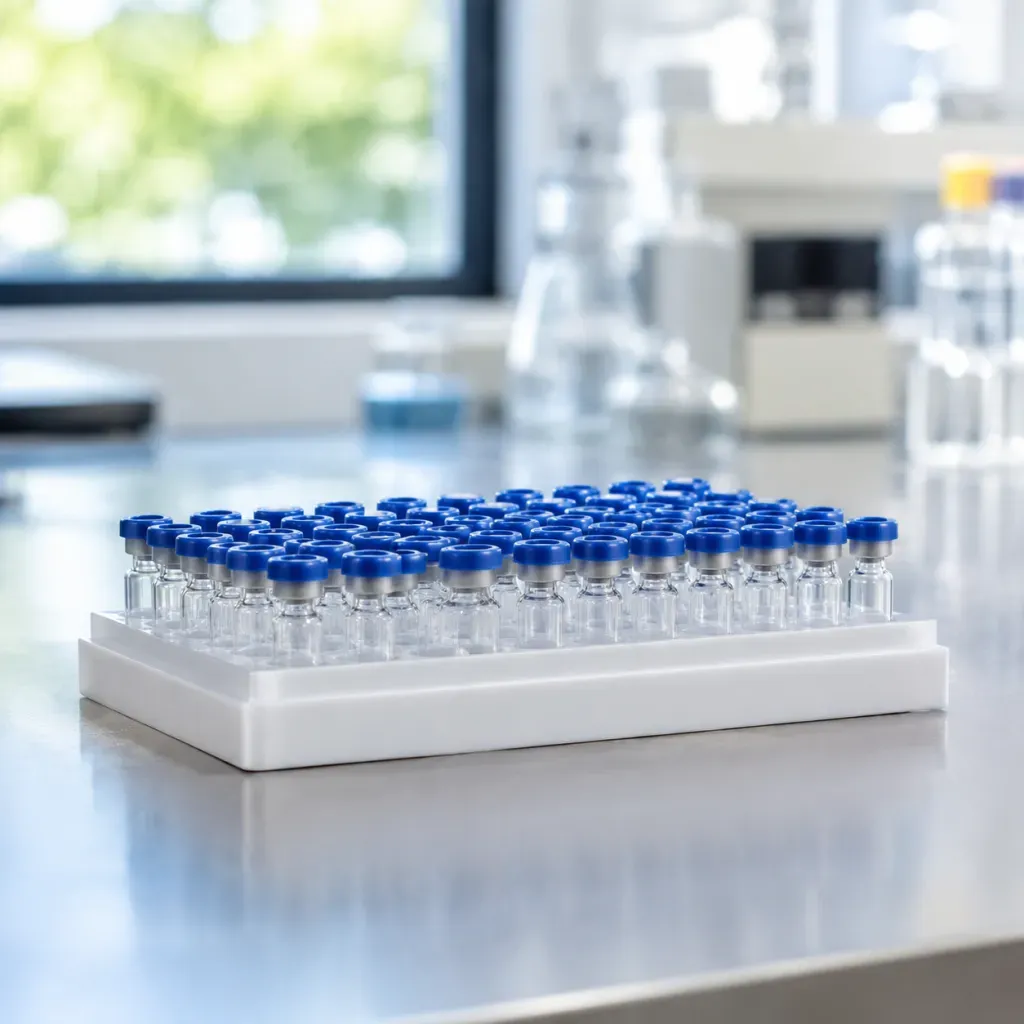
At our injection molding facility, we engineer every vial tray to eliminate line stoppages, sample mix-ups, and shattered glass. Whether running high-throughput screening or manual benchtop assays, our plastic vial trays for pharma lab storage and transport deliver structural stability and dependable handling.
Recessed Anti-Tipping Wells
Standard lab trays often suffer from loose tolerances that cause narrow 2ml vials to wobble or tip during rapid transport. We mold deep-pocket, contoured well bases that grip each container securely:
Base Stabilization: Snug cavity bases prevent 12x32mm vials from shifting or tilting during bench relocation.
Vibration Dampening: Molded pocket walls absorb vibration on conveyor systems and analytical shaker tables.
Liquid Spill Containment: Each well sits slightly recessed to catch minor condensation or micro-droplets without contaminating adjacent slots.
Interlocking Stacking Perimeter
Vertical space is critical in cold rooms, freezers, and cleanroom airlocks. Our precision 2ml vial tray designs feature a molded outer lip that interlocks securely with the tray above and below:
Non-Slip Stacking: Trays seat firmly on top of one another, eliminating shifting during cart transit.
Load-Bearing Ridges: Reinforced bottom ribs distribute weight across the perimeter, preventing lower-tier tray deflection under full load.
Space Optimization: Compact nested footprints maximize storage density inside ultra-low temperature freezers and lyophilization chambers.
Alphanumeric Grid Indexing
Tracking dozens of identical samples demands zero ambiguity. We mold bold, high-contrast alphanumeric indices directly into the tray surface:
Matrix Layout: Clear row markers (A–J) and column markers (1–10) streamline identification across 50-well and 100-well configurations.
Wear-Resistant Molded Text: Indented lettering won't fade, peel, or wipe off when exposed to alcohol wipes, solvents, or autoclaving.
Reduced Human Error: High-visibility coordinates keep manual pipetting runs accurate and verifiable.
Robotic Pick-and-Place Compatibility
Modern fill-finish operations and autosampler carousels demand exact dimensional repeatability. As an experienced china vial tray manufacturer, we design our molds for smooth robotic integration:
| Functional Feature | Mechanical Benefit | Operational Advantage |
|---|---|---|
| Flanged Edge Geometry | Standard robotic gripper engagement points | Prevents arm drop errors and gripper slips |
| Zero-Flash Pocket Finish | Ultra-smooth inner well walls | Zero friction during rapid vacuum or mechanical extraction |
| Rigid Molded Polypropylene | Minimal dimensional deflection (<0.1 mm) | Prevents robotic nozzle misalignments on automated filling lines |
| Chamfered Well Openings | Self-centering vial entry guides | Accelerates automated drop-in nesting without rim strikes |
Primary Industrial and Laboratory Applications for Vial Trays
Our trays are built for four primary operational environments:
- HPLC and GC Analytical Autosampler Staging: High-throughput chromatography labs cannot afford needle misalignments or tipped samples. We configure each 2ml vial tray with precise cell depths to secure standard 12x32mm sample vials, ensuring seamless robotic needle access during automated autosampler runs.
- Pharmaceutical Fill-Finish and Sterile Transport Nesting: Cleanroom filling lines require rigid stability and zero particle shedding. As an experienced china vial tray manufacturer, we design nests that reduce glass-to-glass contact during automated conveyance, integrating seamlessly with our vial nest and tub system for RTU aseptic fill-finish to maintain sterility from washing through capping.
- Ultra-Low Temperature Biobank and Cryogenic Storage: Standard plastics crack under deep-freeze conditions. We mold our cryogenic vial trays using modified medical-grade polypropylene that withstands temperatures down to -80°C, preventing embrittlement, base warping, and sample loss during long-term biorepository storage.
- Lyophilization Processing with Thermal-Drainage Wells: Freeze-drying requires uniform shelf contact and unhindered vapor escape. Our custom lyophilization tray vial designs incorporate open-bottom thermal wells, allowing the vial base to sit directly on freeze-dryer shelves for maximum heat transfer and rapid sublimation cycles.
OEM and ODM Capabilities at Our China Vial Tray Factory

We handle end-to-end manufacturing for custom vial trays, moving from initial concept to high-volume production. Whether you need a specific well count or a unique nest geometry, our in-house engineering team streamlines the custom vial packaging design process to match your exact vial dimensions. By controlling the entire mold development cycle, we eliminate communication gaps and ensure your specifications are met with precision.
Production Excellence and Material Selection
All production occurs within our Class 100,000 cleanroom to ensure our vial trays meet strict pharmaceutical purity and safety requirements. We offer a variety of specialized resins and surface finishes tailored to your specific application, whether it involves sterile filling or light-sensitive storage.
| Material Option | Key Feature | Primary Use Case |
|---|---|---|
| Optical Clear | High visibility | Visual inspection / Robotic vision |
| Frosted | Matte finish | Reduced surface friction |
| UV-Blocking Amber | UV protection | Photosensitive compounds |
Customization and Branding Options
We provide extensive branding services to ensure your supply chain reflects your corporate identity. Our customization capabilities include:
- Logo Engraving: Precision-molded logos directly on the tray frame for permanent identification.
- Private Labeling: Custom printed inserts and serialized packaging for retail or clinical distribution.
- Tailored Nesting: Custom-engineered well diameters to accommodate non-standard glass or plastic vial profiles.
- Rapid Prototyping: Quick-turn sample molding to validate design fit and functionality before full-scale manufacturing.
Our facility is optimized to support the rigorous demands of pharmaceutical and analytical labs, ensuring that every batch of custom-molded vial trays maintains consistent quality and structural integrity.
Quality Assurance and Compliance Testing Standards
Dimensional Tolerance Testing (±0.05 mm Accuracy)
Automated optical comparators and Coordinate Measuring Machines (CMM) inspect every cavity on our 2ml vial tray runs:
Well Diameter and Depth: Held to a strict ±0.05 mm tolerance to prevent robotic gripper misalignment.
Pitch Uniformity: Center-to-center distances are verified to ensure seamless transitions between robotic liquid handlers and analytical autosamplers.
Flatness Verification: Laser surface profiling ensures zero warping across 50-well and 100-well bases, preventing rocking on flat working decks.
Thermal Shock and Autoclave Validation
To guarantee structural integrity across extreme temperature swings, each production lot undergoes accelerated environmental cycling:
Repeated Autoclaving: Trays endure multiple 20-minute steam sterilization cycles at 121°C (15 psi) with zero dimensional distortion, shrinkage, or stress cracking.
Cryogenic Resistance: Batches are frozen down to -80°C for 72 hours, then immediately subjected to mechanical handling to verify that the polypropylene resin does not become brittle.
Integrity Consistency: Maintaining consistent cavity geometry is critical during high-stress procedures, complementing downstream sample validation such as a vial container closure integrity testing system without introducing mechanical stress to vial walls.
Drop-Test and Load-Bearing Analysis
We simulate real-world warehouse stacking and transit stress through standardized mechanical testing:
Drop Impact Resistance: Fully loaded vial trays undergo free-fall drop tests from a height of 1.2 meters onto solid concrete to ensure zero cracking and minimal vial displacement.
Compressive Top-Load Capacity: Each tray supports up to 45 kg of vertical static load, allowing safe multi-layer stacking during palletized shipping and cold room storage.
| Inspection Item | Testing Protocol | Factory Tolerance / Standard |
|---|---|---|
| Cavity Dimensions | Optical CMM Inspection | ±0.05 mm |
| Autoclave Resilience | 121°C Steam Cycle (x10) | Warpage < 0.2 mm |
| Cryogenic Stability | -80°C Storage (72 hrs) | Zero brittle fractures |
| Static Load Limit | Top-load compression | Up to 45 kg without deflection |
Regulatory Compliance and Material Safety
Our cleanroom injection molding lines use virgin, traceable medical-grade resins certified for sensitive laboratory operations:
ISO 9001 Certified: Strict quality management oversight from raw pellet intake to secondary packaging.
FDA 21 CFR 177.1520: Food and drug contact compliant materials ensuring zero leaching or chemical interference.
RoHS and REACH: Fully verified free of heavy metals, phthalates, and halogenated flame retardants.
Bulk Packaging and Global Export Logistics
When supplying high-quality vial trays to international laboratories and pharmaceutical facilities, we prioritize robust transit protection to prevent structural damage or warping. Our factory process begins with vacuum-sealed inner polybags, which effectively shield each unit from dust and contaminants before they are secured in reinforced, double-walled export cartons.
For large-scale shipments, we utilize fumigated pallet packaging designed to withstand the rigors of both air and sea freight. We work closely with global logistics partners to ensure the integrity of your vial tray order remains consistent from our warehouse to your facility. To simplify the procurement process, our China vial tray factory offers flexible trade terms—including FOB, CIF, and DDP—tailored to your specific regional requirements.
We maintain highly efficient factory lead times to ensure your production lines stay on schedule. Our team also prioritizes rapid physical sample turnaround, allowing you to verify material quality, dimensional accuracy, and nest compatibility before we initiate bulk production.
Frequently Asked Questions About Vial Trays
Our 2 ml vial tray designs strictly adhere to international standards for 12x32mm vials, providing the precise tolerances required for seamless operation within Agilent and Waters autosamplers. These polypropylene vial trays are constructed to withstand repeated high-temperature autoclaving at 121°C, ensuring they remain warp-free for sterile laboratory environments.
As a dedicated China vial tray factory, we typically require an MOQ of 5,000 units for custom-molded vial tray projects to ensure manufacturing efficiency and cost-effective production. To ensure our clients are fully satisfied before starting high-volume production, we provide rapid-turnaround pre-production samples for rigorous bench-top testing. By maintaining in-house mold production, we streamline the verification process for every new tray design we manufacture.