
Formula details
Product Details
Overview
Key Engineering Features of Sterile Pharmaceutical Trays
| Specification | Standard / Capability |
|---|---|
| Dimensional Tolerance | ±0.25 mm (critical cavity dimensions) |
| Flange Planarity | ≤0.38 mm across sealing surface |
| Surface Resistivity | 10⁹–10¹¹ Ω/sq (static dissipative) |
| Sealing Compatibility | Tyvek® 1059B, 1073B, 2FS; medical-grade foils; paper |
| Cleanroom Standards | ISO Class 7 and Class 8 thermoforming environments |
Contamination and Sub-Micron Particulate Control
We maintain particulate control through synchronized contamination prevention protocols:
Continuous Sub-Micron Monitoring: Inline airborne particle counters continuously measure sub-micron particulate loads during thermoforming and stacking.
Surface Ionization and Antistatic Chemistry: Topical and intrinsic electrostatic dissipation prevent airborne particulates from adhering to tray surfaces during transfer.
Controlled Packing Environments: ISO Class 7/8 cleanrooms ensure post-forming bioburden and particulate levels comply with USP <788> standards.
High-Precision Cavity Engineering (±0.25 mm)
Automated pick-and-place lines require tight dimensional stability. We engineer our thermoformed cavities with:
Tight Tolerances: Critical cavity dimensions held within ±0.25 mm to prevent robotic loader misalignment and component jamming.
Fluted Retention Lugs: Engineered undercut profiles and side-gripping ribs securely hold syringes, vials, or devices without generating friction particulate.
Controlled Draft Angles: Optimized cavity drafts facilitate smooth nesting and separation in automated tray denesting equipment.
Sterile Barrier System (SBS) Sealing Integrity
Sterile barrier performance depends directly on flange flatness and consistent wall thickness distribution:
Uniform Flange Geometry: Seal surfaces are held to a planarity of ≤ 0.38 mm to eliminate seal voids, localized pressure dropouts, and micro-channeling.
Optimized Heat Transfer: Precise flange thickness distribution enables uniform heat conduction during impulse or continuous heat-sealing processes.
Lidding Compatibility: Flange surfaces are tailored for porous and non-porous lidding, including coated Tyvek® and high-barrier medical aluminum foils, ensuring peelable seals that pass standard dye penetration (ASTM F1929) and bubble emission (ASTM D3078) integrity tests.
Material Specifications and Regulatory Standards for Sterile Pharmaceutical Trays
We select and process medical-grade thermoforming polymers formulated specifically to satisfy mechanical, chemical, and barrier requirements. Every resin lot is certified 100% virgin, fully traceable, and tested to ensure zero toxic leachables or optical defects.
Medical-Grade Polymer Matrix
Choosing the right resin is critical for maintaining structural rigidity and product compatibility throughout sterilization and shelf life. For glass drug containers, evaluating ampoule packaging materials for glass, plastic, and sterility helps match thermoformed polymer properties with secondary barrier requirements.
| Polymer | Key Characteristics | Sterilization Compatibility | Common Application |
|---|---|---|---|
| PETG (Eastar 6763) | Superior impact strength, optical clarity, easy heat sealing to Tyvek | EtO, Gamma, E-Beam | Heavy devices, prefilled syringes (PFS), combination products |
| APET | High clarity, cost-effective rigid barrier, good chemical resistance | EtO, Gamma | Standard pharmaceutical blister packaging trays, vial kits |
| HIPS (Medical Grade) | High impact toughness, opaque, uniform wall distribution, anti-static grades | EtO, Gamma (limited) | Diagnostic test kits, surgical instruments, opaque drug delivery sets |
| PP (Medical Polypropylene) | High thermal tolerance, low moisture vapor transmission, chemical inertness | Steam Autoclave, EtO, E-Beam | Autoclavable procedural trays, high-moisture drug protection |
| COC (Cyclic Olefin Copolymer) | Ultra-high moisture barrier, glass-like transparency, zero halogen | EtO, Gamma, Steam | Biologics, moisture-sensitive APIs, premium lyophilized drug formats |
Global Regulatory Compliance and Validation
Our sterile medical packaging trays are engineered to streamline your regulatory submissions across FDA, EMA, and NMPA jurisdictions. We maintain full documentation packs to validate process consistency and biological safety:
- ISO 13485:2016 Certified: Full quality management system coverage from tool design to cleanroom thermoforming.
- ISO 11607 Compliance: Fully validated under ISO 11607-1 and ISO 11607-2 for design, seal integrity, and rigid sterile barrier packaging performance.
- USP Class VI & ISO 10993: Comprehensive biological reactivity, cytotoxicity, and biocompatibility certification for all raw contact materials.
- FDA 21 CFR 177: Materials strictly comply with indirect food and drug additive safety standards.
- DMF Support: Type III Drug Master File (DMF) reference letters submitted directly to the FDA to accelerate your drug-device combination filing.
Sterilization Modality Compatibility Matrix for Sterile Pharmaceutical Trays

| Material | Ethylene Oxide (EtO) | Gamma Radiation (25–50 kGy) | E-Beam Radiation | Steam Autoclave (121°C / 134°C) | Key Properties |
|---|---|---|---|---|---|
| Medical-Grade PETG | Excellent | Fair (Yellowing risk) | Moderate | Not Recommended | High clarity, tough impact resistance |
| APET | Excellent | Poor (Embrittlement) | Poor | Not Recommended | Cost-effective, rigid barrier |
| Medical HIPS | Excellent | Good | Good | Not Recommended | High impact strength, opaque |
| Radiation-Stable PP | Good | Excellent (Formulated) | Excellent (Formulated) | Excellent (Up to 134°C) | Autoclavable, low density |
| COC (Cyclic Olefin) | Excellent | Good | Good | Good (Grade dependent) | Ultra-low moisture permeability |
Ethylene Oxide (EtO) Matching: PETG, APET, HIPS, and PP
EtO gas sterilization requires high gas permeability through porous lidding like Tyvek without warping the tray body. We manufacture EtO sterilization packaging trays using medical-grade PETG, APET, and HIPS with rigid, warp-resistant sealing flanges that withstand vacuum and pressure differentials inside EtO chambers. For automated filling environments, our nested tub and tray aseptic processing solutions ensure consistent gas circulation and efficient post-sterilization aeration to minimize residual gas levels.
Gamma and E-Beam Radiation-Stable Polymer Solutions
High-energy ionizing radiation can cause chain scission, discoloration, or polymer embrittlement if the wrong resin is selected:
Radiation-Stabilized Polypropylene (PP): Formulated with proprietary antioxidant packages to prevent radical degradation and retain impact strength past 50 kGy exposures.
Modified Copolyesters & HIPS: Optimized for electron-beam and gamma cycles where optical clarity and long-term drop resistance are critical for combination devices.
Low Bioburden Processing: Cleanroom thermoforming guarantees low initial bioburden, reducing the required radiation dosing threshold.
Steam Autoclave (121°C / 134°C) High-Temperature Polypropylene Trays
For high-heat moist sterilization, standard thermoforming plastics fail under thermal expansion. We engineer medical-grade, mineral-reinforced, and high-heat polypropylene trays designed specifically for standard 121°C gravity cycles and 134°C pre-vacuum steam autoclave runs. These high-heat trays feature thick structural ribs to prevent cavity deformation, sagging, and seal failures during intensive thermal cycles.
Pharmaceutical Packaging Applications and Formats

Prefilled Syringe (PFS) and Safety Device Nested Protection
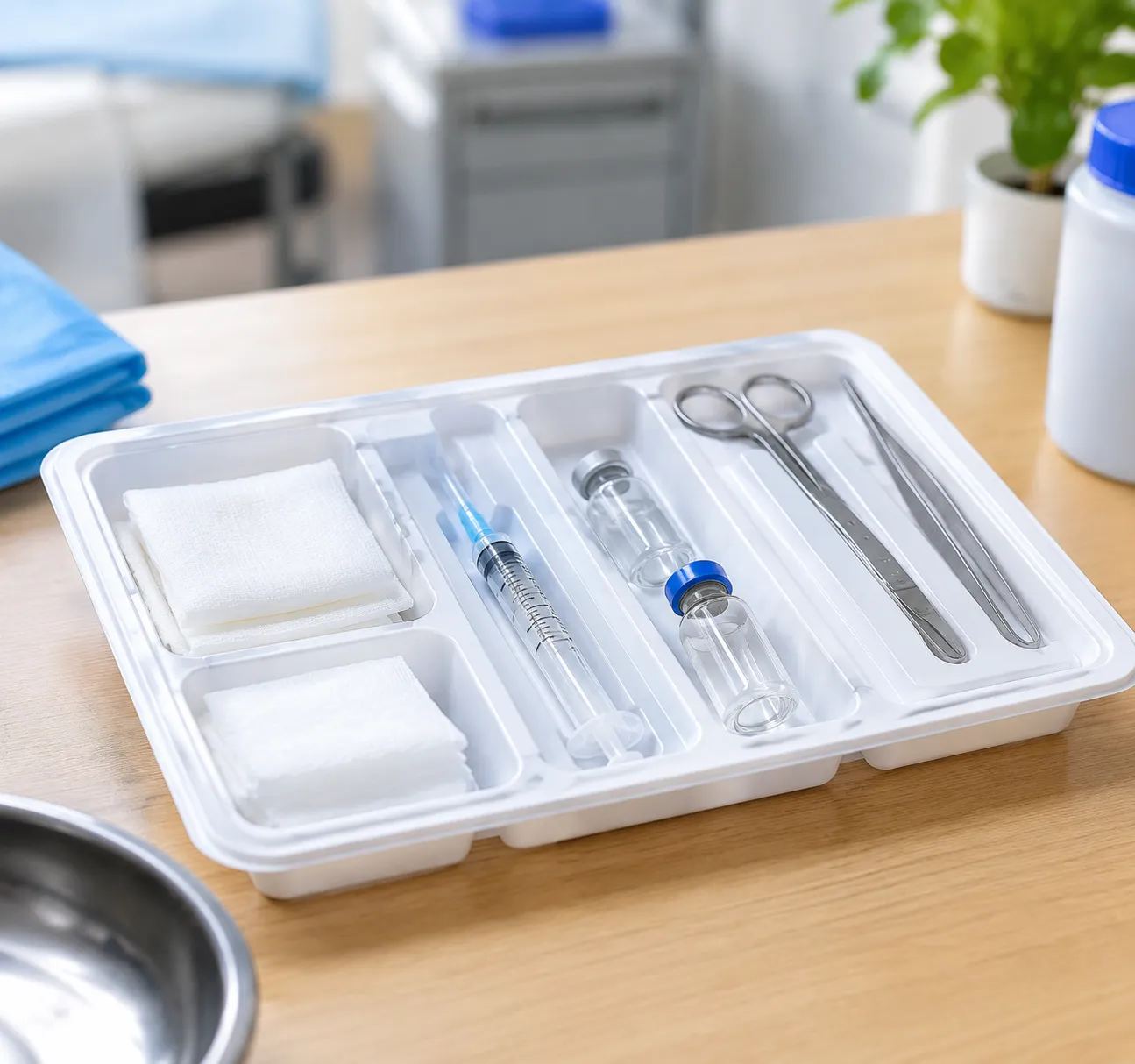
Our thermoformed trays feature precision-engineered nests that lock prefilled syringes, safety needles, and finger flanges securely in place.
Flange & Plunger Stabilization: Snug-fit undercut profiles prevent plunger stem movement and accidental drug discharge.
Tip Cap Protection: Recessed tip zones prevent physical contact with syringe caps, eliminating integrity failure risks during shipping.
Automated Line Handling: Standardized outer dimensions allow direct integration with high-speed automated loading and de-nesting equipment.
Vials, Cartridges, and Ampoules with Shock-Absorbent Fluted Cavities
To eliminate glass-to-glass contact and minimize breakage, we design custom fluted cavities and ribbed containment walls.
Side-Fluted Grip: Flexible side ribs absorb shock and vibration during distribution while holding containers firmly.
Ready-to-Use (RTU) Formats: We offer configurations matching standard nests and tubs, including our sterile RTU vial tray kit for biologics and pharmaceutical products.
Cartridge Systems: Dedicated nesting for dental, insulin, and infusion cartridges, compatible with our pharmaceutical cartridge nest and tub sterile packaging specifications.
Multi-Component Combination Products and Auto-Injector Custom Nests
We build multi-cavity thermoformed trays tailored to complex combination products, keeping all components segregated and sterile within a single barrier system:
Auto-Injectors and Pen Devices: Custom-contoured cavities provide full-body support for single-use autoinjectors and wearable pump systems.
Kitted Reconstitution Sets: Dedicated compartments for lyophilized vials, diluent prefilled syringes, transfer devices, and sterile wipes.
Ergonomic Removal: Integrated finger-access notches allow healthcare providers and patients to remove components effortlessly without compromising sterility.
Secondary Packaging for Biologics and Lyophilized Drug Delivery Systems
High-potency biologics, monoclonal antibodies, and lyophilized formulations require rigid secondary packaging that protects against impact, light degradation, and cold-chain temperature extremes.
Cold-Chain Durability: High-impact polymers maintain structural stability down to -80°C without cracking or becoming brittle.
Cleanroom Transfer Ready: Particulate-free nested trays facilitate smooth transfer into aseptic fill-finish and lyophilization isolator lines.
Custom Design and Cleanroom Manufacturing Process
We manufacture custom sterile pharmaceutical trays through an end-to-end engineering workflow built for strict medical compliance and high-speed fill-finish automation. Every project moves through five controlled phases to ensure dimensional accuracy, zero particulate contamination, and complete seal integrity.
[ DFM & 3D Modeling ] ➔ [ CNC Prototyping ] ➔ [ Production Tooling ] ➔ [ Cleanroom Thermoforming ] ➔ [ Quality & Double-Bagging ]
Step 1: DFM Analysis and 3D CAD Modeling
Our engineers evaluate your drug container, device geometry, and automated handling parameters. We optimize draft angles, undercut snaps, denest lugs, and perimeter sealing flanges to ensure reliable separation on pick-and-place lines.
Step 2: In-House CNC Rapid Prototyping and Fit Sampling
We machine prototype tooling directly from high-density tooling board or aluminum within 3 to 5 business days. This allows physical fit checks with your active vials, cartridges, or specialized prefilled syringe nest and tub for safe handling before cutting hard production molds.
Step 3: Multi-Cavity Production Tooling
Once prototypes are approved, we fabricate hardened aerospace-grade aluminum multi-cavity tooling. Tool designs incorporate dedicated vacuum channels, matched trim dies, and precision water-cooling circuits to maintain tight ±0.25 mm tolerances across high-volume runs.
Step 4: ISO Class 7/8 Cleanroom Thermoforming
All tray forming occurs inside certified ISO Class 7 and Class 8 cleanrooms. Continuous inline vision inspection systems check 100% of parts on the fly for:
Foreign matter and sub-micron particulates
Flange flatness and minimum seal width
Thin-spot wall distribution and perimeter trim accuracy
Step 5: Bioburden Testing, Particulate Validation, and Double-Bag Packaging
Finished cleanroom thermoformed trays undergo validated particulate counts per USP <788> and bioburden screening per ISO 11737. We vacuum double-bag and heat-seal the trays in cleanroom poly liners with lot-traceable particulate certificates, ready for immediate transfer into aseptic filling suites or secondary packaging lines using a compatible vial nest and tub system for RTU aseptic fill-finish.
| Stage | Critical Control Point (CCP) | Verification Method | Standard / Target |
|---|---|---|---|
| Design | Flange width & denest clearance | 3D CAD simulation & FEA | Seal margin ≥ 5.0 mm |
| Tooling | Cavity depth & pocket dimensions | CMM dimensional verification | ±0.25 mm tolerance |
| Forming | Particulate & surface cleanliness | In-line 100% optical vision | ISO Class 7/8 compliant |
| Release | Sterile barrier & bioburden load | USP <788> / ISO 11737 testing | Lot-specific CoC / CoA |
Frequently Asked Questions About Sterile Pharmaceutical Trays
Can sterile pharmaceutical trays integrate into automated form-fill-seal (FFS) lines?
Yes. We engineer our sterile pharmaceutical trays with tight de-nesting lugs, continuous flat perimeter flanges, and strict cavity tolerances of ±0.25mm. These design elements ensure smooth mechanical pickup, zero jamming in feeding magazines, and seamless compatibility with high-speed automated robotic pick-and-place and heat-sealing equipment. Our precision-molded prefilled syringe trays for safe medical packaging are specifically optimized for automated handling.
Which lidding materials provide the strongest seal for sterile trays?
The ideal lidding material depends on your chosen sterilization method and polymer substrate:
DuPont™ Tyvek® (1073B, 1059B, 2FS): The industry benchmark for Ethylene Oxide (EtO) and Gamma irradiation. It pairs with heat-seal-coated PETG and APET to form a fiber-free peel and robust sterile barrier system (SBS).
Medical-Grade Aluminum Foils: Best for products requiring total moisture and oxygen barriers, typically sealed to polypropylene (PP) or cyclic olefin copolymer (COC) bases.
Coated Medical Papers: A cost-effective option for standard EtO-sterilized packaging formats.
How is static and particulate accumulation prevented during shipping?
We control particulate and ESD contamination through a multi-stage defense strategy:
Permanent Antistatic Additives: We thermoform using medical polymers treated to achieve surface resistivities between 10⁹ and 10¹¹ ohms/sq, preventing electrostatic charge from attracting airborne particulates.
Inline De-ionization: Ionized air knives purge all static and loose particles immediately before packaging.
Double Cleanroom Bagging: All trays are nested, capped, and double-bagged inside our ISO Class 7/8 cleanrooms using validated medical polyethylene liners to prevent contamination during handling and transport.
What regulatory compliance documentation is provided for drug filings?
Every batch of our custom thermoformed medical trays for sterile devices comes with a comprehensive regulatory compliance package ready for FDA, EMA, and global health authority dossiers:
Certificate of Analysis (CoA) and Material Traceability Records (raw resin lot tracking)
ISO 11607 (Part 1 and Part 2) compliance data for sterile packaging validation
ISO 13485 quality management certifications
USP Class VI biological reactivity and USP <661> physicochemical test reports
FDA 21 CFR 177 compliance statements and Drug Master File (DMF) access letters upon request
What are the standard MOQs and custom tooling lead times?
We support both development-phase verification lots and high-volume commercial production:
Rapid Prototyping (CNC Aluminum/Resin Tooling): 3 to 5 business days for functional fit-check samples.
Production Multi-Cavity Tooling: 2 to 3 weeks for full hardened-aluminum cleanroom production molds.
Minimum Order Quantities (MOQ): Standard pilot runs start at 5,000 to 10,000 units, while automated commercial supply agreements are scaled to multi-million unit deliveries annually.
Custom Engineering Consultations and Ordering Specifications
We engineer custom sterile pharmaceutical trays to exact device geometry and automated line requirements. Our engineering team works directly with your B2B packaging and quality teams to streamline DFM reviews, validate barrier performance, and meet tight commercial launch windows.
Submitting CAD Data, Critical Dimensions, and Tolerance Requirements
To initiate rapid tooling and feasibility analysis, provide your 3D component files and technical constraints:
- File Formats: STEP, IGES, SolidWorks (.sldprt), or native CAD models.
- Critical Dimensions: Exact product profiles, auto-injector dimensions, nested vial heights, and critical grip points for pick-and-place automation.
- Tolerance Standards: We machine standard cavities within ±0.25 mm and high-precision nest features down to ±0.12 mm.
- Draft Angles & Undercuts: Minimum 2° to 5° draft angles for clean automated denesting and snap-fit retaining tabs.
Selecting Polymer Grades, Barrier Properties, and Material Thickness
Optimizing tray rigidity and optical clarity starts with our specialized material selection guidelines for medical-grade thermoforming polymers:
| Polymer Grade | Thickness Range (Gauge) | Barrier & Physical Properties | Primary Sterilization Fit |
|---|---|---|---|
| Medical-Grade PETG | 0.50 mm – 1.50 mm (20–60 mil) | Superior impact strength, optical clarity, low particulate generation | EtO, Gamma, E-Beam |
| Medical APET | 0.40 mm – 1.20 mm (16–48 mil) | Cost-effective rigidity, high transparency, standard barrier | EtO, Gamma |
| Medical PP | 0.50 mm – 1.50 mm (20–60 mil) | Chemical inertness, moisture barrier, high heat tolerance | Steam Autoclave, EtO |
| Medical HIPS | 0.50 mm – 1.80 mm (20–70 mil) | Opaque, high-impact nesting, anti-static coated options | EtO, Gamma |
Matching Batch Volumes, Sterilization Methods, and Project Timelines
We balance scalable multi-cavity tooling against your validation phases to guarantee on-time delivery from pilot runs to high-volume commercial packaging.
- Prototyping & Sampling: Single-cavity CNC aluminum prototype tools delivered within 1 to 2 weeks for fit validation and stability testing.
- Production Tooling: Multi-cavity hardened aluminum tooling built in 3 to 5 weeks for ISO Class 7/8 cleanroom production lines.
- Batch Flexibility: Scalable batch quantities supporting small clinical validation runs up to multi-million unit commercial supply contracts.
- Sterilization Compatibility: Pre-validated flange geometry engineered for uniform heat-sealing with Tyvek or medical foil lidding across EtO, radiation, or autoclave sterilization cycles.