Formula details
Product Details
Overview
Vial Nest & Tub System: High-Density RTU Packaging
Core Value & Engineering Performance
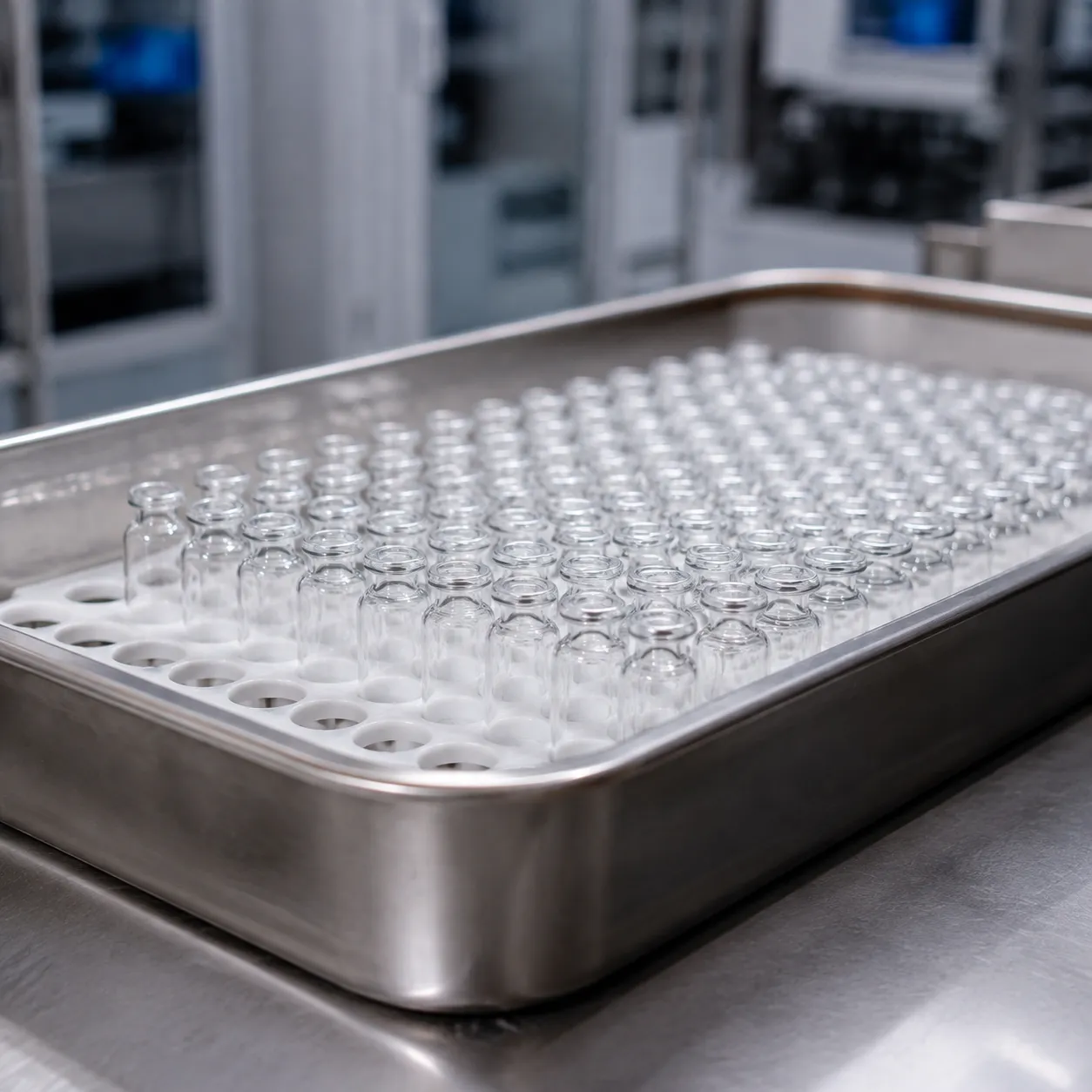
- Zero Glass-to-Glass Contact Packaging: Individual alveolar matrix cells isolate each vial entirely. This zero-contact design prevents surface scratches, cosmetic defects, particle generation, micro-cracks, and vial breakage during transport and automated handling.
- Robotic Line Integration: Dimensionally optimized for high-speed aseptic fill-finish nest and tub processing, isolator systems, and multi-format combi-filling machinery. Standardized geometries ensure exact position retention for automated de-nesters and pick-and-place grippers.
- Reduced Total Cost of Ownership (TCO): Bypass energy-intensive in-house washing, depyrogenation tunnels, and autoclave sterilization. Our depyrogenated nested sterile vial system drops directly into your filling line, significantly cutting cleanroom utility consumption and processing footprint.
Operational Advantage
| Processing Metric | Bulk Glass Vials | Our RTU Vial Nest & Tub System |
|---|---|---|
| Vial Protection | Random collision / friction | Zero-contact matrix isolation |
| Preparation Steps | Wash, depyrogenate, sterilize | Direct-to-fill (Bypasses prep steps) |
| Line Integration | High mechanical stress | Robotic pick-and-place compatible |
| Particulate Risk | Elevated from surface abrasion | Ultra-low particle generation |
Key Engineering Features of Our Vial Nest & Tub System
By replacing traditional tray handling with an advanced alveolar nest for sterile vials, we protect container integrity while maximizing processing throughput.
| Engineering Feature | Operational Advantage | Target Metric / Standard |
|---|---|---|
| Zero-Contact Matrix Architecture | Individual cell compartments isolate each vial to eliminate glass-to-glass contact, micro-cracks, and cosmetic flaws. | Zero wall friction or glass particulate generation |
| High-Speed Automation Compatibility | Standardized ISO footprints enable smooth interaction with robotic end-effectors, pick-and-place grippers, and de-nesters. | ISO 11040-7 / ISO 8362-1 compliant design |
| Optimized Cleanroom Footprint | Compact matrix layout maximizes vial density per tray, cutting lyophilizer loading times and storage footprint. | Reduced cold-chain and shipping volume |
| Controlled Bioburden Levels | Precision-molded under cleanroom conditions to ensure strict particle and microbial control. | USP <788> and Ph. Eur. compliant |
| Cryogenic & Thermal Resistance | Performs reliably from ultra-low temperature storage to ambient room temperature operations. | Stable across deep-cold and room-temp cycles |
Operational Advantages on the Filling Line
- Zero Glass-to-Glass Contact: Our nested vial system anchors each container by the neck and body. This zero-contact barrier stops side-wall friction, cosmetic scratching, and vial breakage during high-speed transport.
- Seamless Robotic Handling: Configured as a robotic pick-and-place packaging matrix, dimensional consistency prevents gripper misalignment, mechanical jams, and suction dropouts during filling and stoppering.
- Cleanroom Efficiency: Every cleanroom injection-molded vial tub lowers bioburden risk and streamlines entry into isolator systems. For specialized fill-finish setups, explore our sterile RTU vial tray kit for biologics and pharmaceutical processing.
- Thermal Range Performance: Built with high-purity medical polymers, the matrix maintains structural rigidity through freeze-drying (lyophilization) cycles and deep cold-chain logistics without cracking or deformation.
System Components & Structural Design
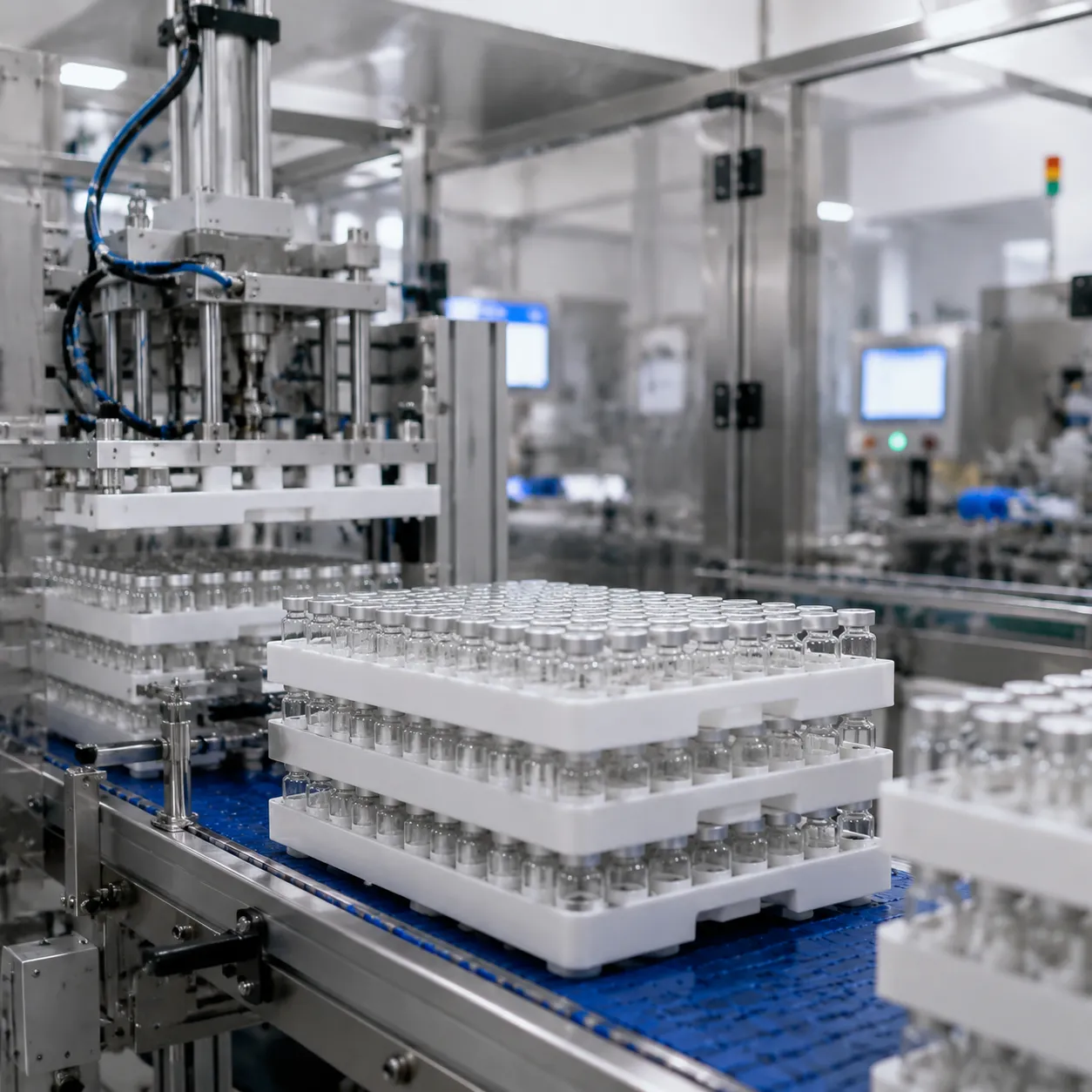
We engineer every Vial Nest & Tub System as a cohesive, multi-layered protective architecture built for demanding automated environments. Our structural design relies on four precision-molded components:
- Outer Sterile Barrier (Tub): A high-impact, injection-molded secondary container providing mechanical stability and an airtight environmental seal during transit and robotic handling.
- Precision Nest (Grid Plate): A dimensional matrix plate holding containers in strict positioning. Built with specialized bottom clearance, it allows instant optical scanning and fill verification within nested tub and tray aseptic processing solutions.
- Protective Tyvek Cover & Liner: A breathable, microbial-barrier Tyvek lid that maintains sterile integrity, supports Ethylene Oxide (ETO) gas sterilization, and enables clean, particulate-free peeling on automated filling lines.
- Base Cushion & Anti-Static Shield: A supplemental protective base designed to absorb vertical shock, eliminate bottom impact, and neutralize static buildup during high-speed robotic pick-and-place operations.
This complete containment structure works seamlessly with our line of pre-sterilized RTU vials and modular vial systems, guaranteeing zero container-to-container contact throughout the filling lifecycle.
Technical Specifications & Material Matrix
By combining medical-grade polymers with tight manufacturing tolerances, our nested packaging protects fragile RTU vials throughout handling, gas sterilization, and cold-chain storage.
| Specification Parameter | Standard Technical Details |
|---|---|
| Compatible Containers | 2R, 4R, 6R, 8R, 10R, 15R, 20R, 30R Standard ISO Vials |
| Material Composition | Medical-Grade Polypropylene (PP), COP, COC, PETG (USP Class VI) |
| Cleanroom Manufacturing | Produced in ISO Class 7 (Class 10,000) & ISO Class 8 (Class 100,000) Cleanrooms |
| Dimensional Tolerance | Precision injection molding within ±0.02 mm |
| Sterilization Options | Ethylene Oxide (ETO) / Gamma Irradiation Ready |
| Compliance Standards | USP <661>, USP <788>, ISO 8362-1, ISO 11040-7, cGMP |
| Unit Traceability | Laser-etched batch numbering & 2D DataMatrix code integration |
Compliance & Quality Highlights
- Precision Engineering: Our automated injection molding relies on continuous closed-loop monitoring to guarantee tolerances within ±0.02 mm, preventing robotic pick-and-place misalignment or denesting jams.
- Advanced Material Options: We utilize USP Class VI compliant resins, offering customized material selection from COP and COC to specialized polymers used in custom PETG medical trays based on optical clarity and thermal requirements.
- Traceability & Particle Control: Every lot undergoes sub-visible particulate testing per USP <788> standards with endotoxin levels validated under <0.25 EU/mL. Laser-etched 2D DataMatrix codes enable full lifecycle monitoring from raw resin to final delivery.
Automated Fill-Finish Operational Integration
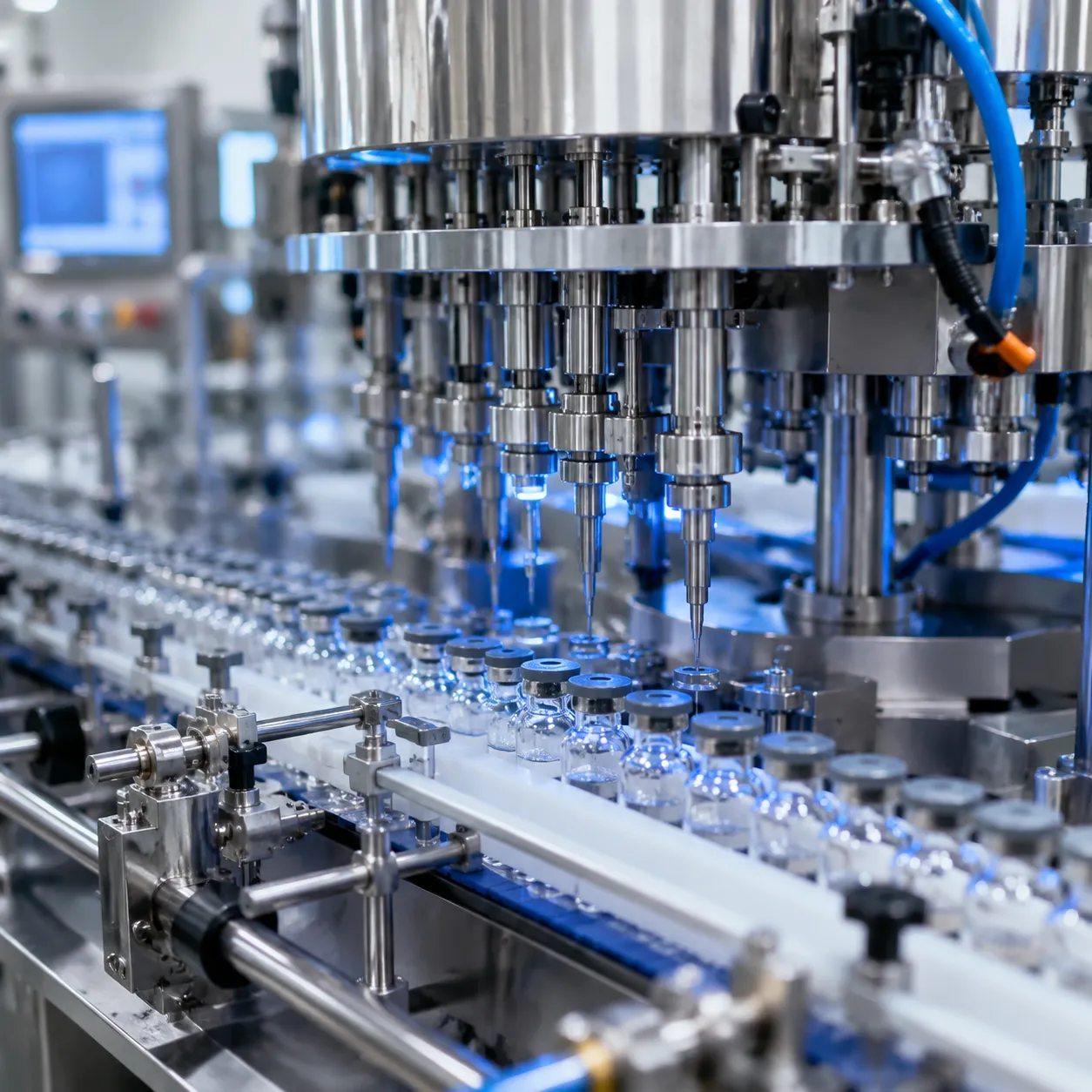
Our Vial Nest & Tub System integrates seamlessly into high-speed robotic fill-finish lines, isolators, and RABS suites. By maintaining continuous container positioning within a secure grid plate, our automated fill-finish nest and tub architecture eliminates glass-to-glass contact, prevents tipping, and maximizes production line yield.
5-Stage Automated Line Workflow
- Stage 1: De-Bagging & Surface Sanitization
Automated de-baggers remove the outer barrier bags before transferring the sterile tub into the cleanroom isolator or RABS without compromising cleanroom bioburden limits. - Stage 2: Lid Peeling & Tub Infeed
Robotic peel-off tools execute clean, particulate-free Tyvek lid removal. For early-stage developments using identical container standards, explore our RTU pharma kits for clinical fill-finish. - Stage 3: In-Nest Dosing
High-precision liquid or powder filling nozzles dose directly into vials secured within the RTU vial nest and tub. Vials stay stationary, eliminating line jams and sloshing. - Stage 4: Simultaneous Stoppering
Matrix stoppering tooling inserts stoppers across the full container array in a single motion, reducing cycle times and eliminating individual vial manipulation. - Stage 5: Denesting & Capping
Robotic end-effectors lift fully stoppered vials from the grid plate and transfer them smoothly to final aluminum or flip-off capping stations and packaging trays.
- Stage 1: De-Bagging & Surface Sanitization
Quality Assurance & Regulatory Compliance for Vial Nest & Tub Systems
When you deploy a vial nest & tub system on sterile fill-finish lines, zero-defect quality and strict regulatory compliance are non-negotiable. We back every single lot with rigorous testing and full documentation to ensure complete safety across your entire supply chain:
- Comprehensive Batch Certification: Every shipment includes complete Certificates of Analysis (CoA) and Certificates of Conformance (CoC). Check our complete pharmaceutical quality certifications to review our compliance standards and audit readiness.
- Particulate & Extractable Testing: Every lot undergoes strict testing for sub-visible particulate counts according to USP <788> standards, protecting high-value biologicals and parenteral formulations.
- Bioburden & Endotoxin Management: Validated non-pyrogenic processing keeps endotoxin levels strictly below <0.25 EU/mL, meeting international pharmacopeial limits.
- Full Lifecycle Traceability: End-to-end resin batch monitoring tracks raw materials from initial polymer verification all the way through cleanroom molding to final customer delivery.
Custom OEM/ODM Engineering Services for Vial Nest & Tub Systems
We deliver tailored engineering solutions for non-standard container geometries and specialized fill-finish lines. When off-the-shelf formats do not meet your exact robotic automation needs, we design and produce custom vial nest and tub solutions matched to your exact line specifications.
From initial 3D CAD design through mass production, our team leverages dedicated mold development capabilities to ensure strict dimensional tolerances and reliable performance across automated filling suites.
| OEM/ODM Service | Engineering Capability & Turnaround |
|---|---|
| Tailored Nest Geometry | Custom matrix layouts, cavity spacing, wall thicknesses, and pocket clearance for non-standard vial profiles or custom end-effectors |
| In-House Tooling | Proprietary mold engineering with dedicated customer mold ownership, full maintenance coverage, and strict batch repeatability |
| Rapid Prototyping | Custom CAD design within 48 hours; functional physical prototypes in 2–4 weeks (7–10 days for standard evaluation samples) |
| Material Selection | Resin selection support across COP, COC, and medical-grade PP based on chemical compatibility, transparency, and thermal needs |
Core OEM/ODM Integration Capabilities
- Custom Cavity & Pitch Layouts: We modify matrix cell counts, gripper clearance zones, and nest heights to fit proprietary fill-finish platforms and robotic pick-and-place systems.
- Proprietary Mold Ownership: We design, build, and maintain customer-dedicated tooling under controlled conditions to ensure long-term mold stability and zero cross-contamination.
- Streamlined Validation Testing: Accelerate fill line trial phases with rapid CAD turnarounds and functional physical samples engineered for physical testing and line integration.
- Application-Specific Polymers: We evaluate your formulation and cold-chain requirements to select optimal USP Class VI materials—ensuring high transparency, low extractables, and resistance to cryogenic temperatures.
Primary Target Applications for Vial Nest & Tub Systems
We engineered our Vial Nest & Tub System to protect high-value therapeutics and streamline complex aseptic fill-finish operations across demanding pharmaceutical environments.
- High-Value Biologics & Gene Therapies: Eliminates glass-to-glass contact to safeguard delicate monoclonal antibodies (mAbs), novel cell and gene therapies, and biologic formulations where particulate contamination or micro-cracks result in critical batch loss.
- Lyophilized (Freeze-Dried) Parenterals: Delivers precise container stability and alignment during high-speed transfer into freeze-dryers, ensuring consistent thermal transfer across standard peptide vial sizes.
- Potent Compounds & Vaccines: Purpose-built for barrier isolation systems and RABS, enabling safe, automated processing of oncology drugs, HPAPIs, and vaccines with minimal operator intervention.
- Contract Manufacturing (CMOs & CDMOs): Offers maximum operational agility for flexible, multi-product fill-finish suites that require rapid turnover and standardized RTU secondary packaging across various batch sizes.
Technical Evaluation FAQ: Vial Nest & Tub System
We engineered our Vial Nest & Tub System to integrate directly into high-speed robotic fill-finish operations. Below are key technical evaluations regarding automation, compatibility, and custom tooling:
| Technical Question | Engineering Solution | Operational Impact |
|---|---|---|
| Robotic Line Precision | Closed-loop monitored injection molding maintains tolerances within ±0.02 mm. | Eliminates pick-and-place misalignment and nesting jams. |
| Combi-Filling Integration | Manufactured strictly to ISO 11040-7 and ISO 8362-1 standard formats. | Delivers seamless plug-and-play use with major filling machinery. |
| Custom Container Fits | Full OEM/ODM tooling for custom matrix spacing, tub depth, and gripper clearance. | Accommodates non-standard container shapes without line delays. |
Automation & Compatibility Details
- Dimensional Consistency for Robotics: We utilize automated injection molding equipped with continuous closed-loop monitoring to hold dimensional tolerances within ±0.02 mm. This strict precision prevents robotic gripper misalignment and keeps your high-speed line running without downtime.
- Combi-Filling Machinery Support: All Jiahua Package systems strictly conform to standard ISO formats (ISO 11040-7/ISO 8362-1). You can deploy our vial nest and tub systems directly onto major combi-filling equipment platforms with zero retrofit delays.
- Custom Nest Tooling: When working with unique container profiles, our in-house engineering team provides complete OEM/ODM tooling services. We modify cell matrix spacing, tub depths, and clearance zones to fit your specific robotic end-effectors. For additional setup guidelines, review our technical FAQ resource.