
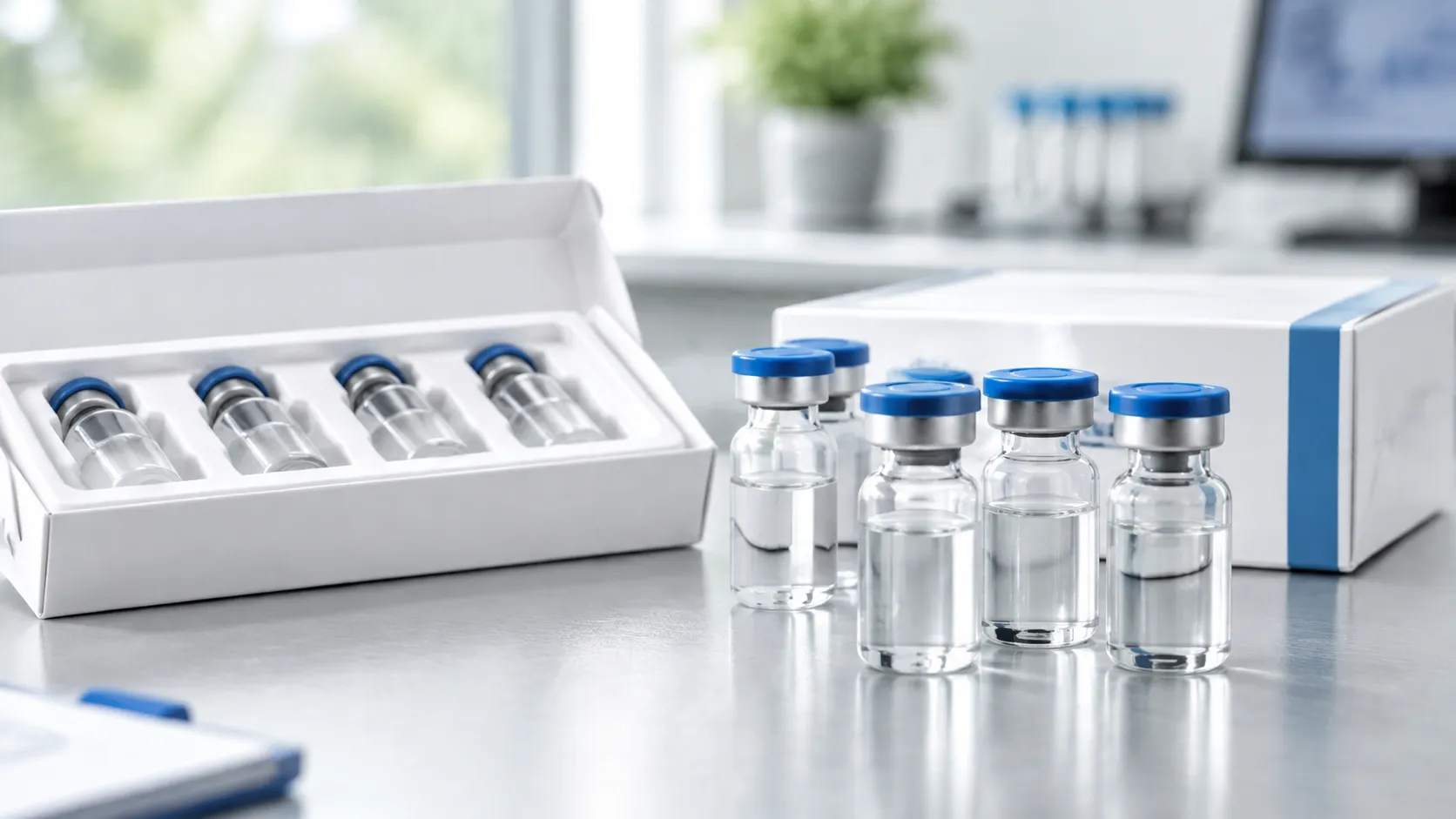
Formula details
Product Details
Overview
Complete Injection Vial Packaging Systems
Integrated Container-Closure Components
- Pharmaceutical Glass Vials (Clear and Amber): Manufactured from USP Type I neutral borosilicate glass. Clear vials offer high optical clarity for inline particulate inspection, while amber vials provide light-filtering protection for photo-sensitive compounds (absorbing UV light between 290 nm and 450 nm).
- Tubular and Molded Glass Options:
- Tubular glass vials (2R–30R): Feature uniform wall thickness, tight dimensional tolerances, and optimal flat bottoms for uniform heat transfer during lyophilization.
- Molded glass vials (5 ml–100 ml+): Provide thick-walled chemical and mechanical durability, ideal for large-volume parenterals and high-pressure sterilization cycles.
- Elastomeric Closures (Bromobutyl and Chlorobutyl): Available in 13 mm and 20 mm standard neck sizes. Bromobutyl offers low gas permeability and high chemical purity; chlorobutyl provides excellent resistance to aqueous solutions. Configurations include igloo and 2-leg designs for freeze-dried drugs, and straight-plug designs for liquid parenterals.
- Aluminum Crimp Caps and Flip Seals: Available in smooth aluminum crimp designs, flip-off plastic/aluminum buttons, and complete tear-off formats for clear tamper evidence.
- Ready-to-Use (RTU) Formats: Pre-washed, depyrogenated, and gamma-sterilized vials delivered in nested tubs and trays to integrate into modern gloveless isolator lines.
| Component | Standard Materials | Size / Geometry Options | Primary Function |
|---|---|---|---|
| Glass Vials | Type I Borosilicate (Clear / Amber) | 2 ml to 100 ml (Tubular & Molded) | Chemical neutrality, hydrolytic resistance, UV shielding |
| Rubber Stoppers | Bromobutyl / Chlorobutyl (PTFE-coated available) | 13 mm, 20 mm, 32 mm (Serum & Lyophilization) | Seal integrity, minimal extractables/leachables, low coring |
| Crimp Seals | Aluminum / Polypropylene flip button | 13 mm, 20 mm, 32 mm (Multiple colors) | Tamper evidence, mechanical retention of closure compression |
| Packaging Format | Cleanroom bulk packs or RTU sterile nests | Standard ISO configurations | Direct automated line feeding, reduced washing prep |
Our engineered injection vial packaging systems maintain verified container-closure integrity (CCI), protecting formulations against moisture ingress, oxygen degradation, and particulate contamination.
Injectable Vial Packaging Configurations
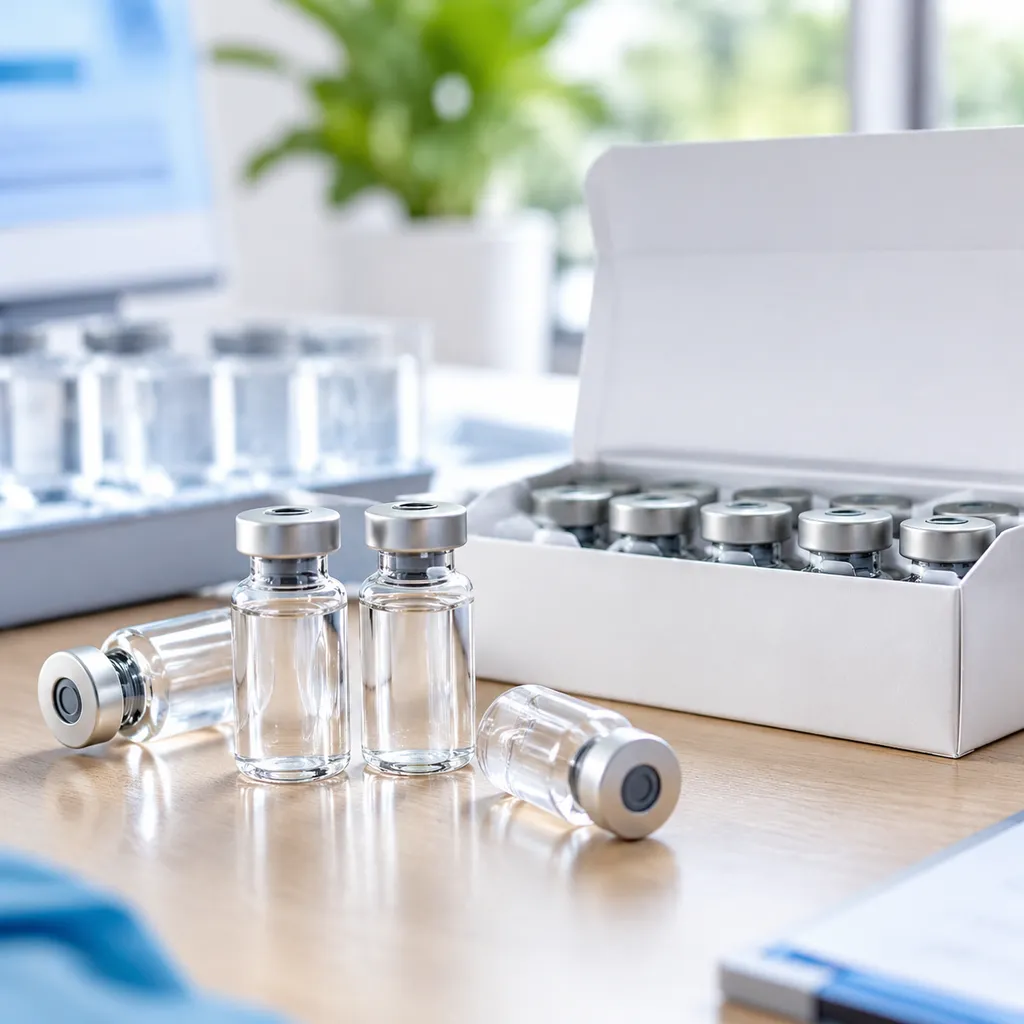
Standard Glass Vial, Rubber Stopper, and Aluminum Crimp Cap Combinations
For common liquid parenterals, we configure integrated three-piece sets designed for immediate production compatibility:
Vials: Clear Type I borosilicate glass vials (2 ml to 100 ml) with uniform wall thickness and standard 13 mm or 20 mm crimp necks.
Elastomers: High-purity bromobutyl and chlorobutyl rubber stopper closures with low moisture absorption and low extractable profiles.
Seals: Standard aluminum crimp seals or smooth-edge aluminum flip-off caps that give operators clear visual evidence of tampering.
For operations requiring tailored component dimensions or high-volume runs, explore our custom glass vial packaging options for bulk orders to streamline procurement.
Lyophilization Vial Packaging with Vented Stoppers and Vacuum Seals
Freeze-dried biologics and powder formulations require components built for extreme thermal shifts and sub-ambient pressures:
Blowback Neels: Vials manufactured with European or American blowback neck designs to lock stoppers firmly in position during high-speed vacuum cycles.
Vented Stoppers: Single-leg or two-leg lyophilization stoppers engineered to vent water vapor freely in the chamber without popping loose before final stoppering.
Hermetic Vacuum Holding: Precise dimensional matching ensures immediate, leak-free vacuum retention when the freeze-dryer shelves collapse the stoppers into place.
| Packaging Type | Primary Vial Material | Stopper Style | Seal Type | Typical Application |
|---|---|---|---|---|
| Standard Liquid | Clear Type I Borosilicate | Straight-plug / Flanged | Flip-Off Aluminum | Vaccines, antibiotics, small-molecule injectables |
| Lyophilization | Low-expansion Borosilicate | Single / Two-leg Vented | Tear-off Aluminum Crimp | Freeze-dried proteins, peptides, diagnostic reagents |
| Light-Sensitive | Amber Type I Glass | Chlorobutyl / Bromobutyl | Tamper-evident Crimp | Photosensitive APIs, vitamins, oncological drugs |
Amber Glass Vial Packaging Systems for Light-Sensitive Formulations
Direct light exposure degrades delicate active pharmaceutical ingredients (APIs). Our amber borosilicate glass vials block harmful ultraviolet and blue-spectrum radiation below 500 nm while keeping hydrolytic resistance uncompromised. Paired with inert rubber formulations, these complete injectable vial packaging solutions protect sensitive liquids against photo-oxidation and active ingredient breakdown throughout shelf life.
Tailored Container-Closure Sets Matched for Automated Filling Lines
Machine stoppages and bent crimps drive up production costs. We balance every container-closure system to tight dimensional tolerances:
Height & Flange Calibration: Uniform vial lips prevent crimper head scraping and uneven seal skirts.
Lubrication Options: Low-particulate, siliconized, or fluoropolymer-coated stoppers deliver reliable feeding through bowl sorters and pick-and-place tracks.
Validated Crimp Compression: Vial neck depths and stopper flange thicknesses are engineered to hit target seal compression with repeatable crimping force.
Technical Specifications for Injection Vial Packaging
Consistent dimensions and strict material standards prevent machine downtime on high-speed fill-finish lines. We manufacture our injection vial packaging components to tight dimensional tolerances, meeting ISO 8362 standards to ensure seamless integration across sorting, washing, depyrogenation, and capping operations.
Standard Dimensional Ranges and Nominal Fill Capacities
Our injectable vial packaging solutions cover standard small-volume parenterals (SVP) and large-volume formats. We supply both tubular glass vials for tight weight limits and uniform wall thickness, and molded glass vials for higher impact resistance.
| Nominal Fill | Neck Finish (ISO) | Outer Diameter (mm) | Total Height (mm) | Recommended Stopper Size | Glass Construction |
|---|---|---|---|---|---|
| 2 ml (2R) | 13 mm (Crimp) | 16.0 ± 0.15 | 35.0 ± 0.5 | 13 mm Serum / Lyo | Tubular Type I (5.0 / 7.0) |
| 4 ml (4R) | 13 mm (Crimp) | 16.0 ± 0.15 | 45.0 ± 0.5 | 13 mm Serum / Lyo | Tubular Type I (5.0 / 7.0) |
| 6 ml (6R) | 20 mm (Crimp) | 22.0 ± 0.20 | 40.0 ± 0.5 | 20 mm Serum / Lyo | Tubular Type I (5.0 / 7.0) |
| 10 ml (10R) | 20 mm (Crimp) | 24.0 ± 0.20 | 45.0 ± 0.5 | 20 mm Serum / Lyo | Tubular Type I (5.0 / 7.0) |
| 20 ml (20R) | 20 mm (Crimp) | 30.0 ± 0.25 | 55.0 ± 0.5 | 20 mm Serum / Lyo | Tubular / Molded Type I |
| 50 ml - 100 ml | 20 mm / 32 mm | 42.5 – 51.6 ± 0.5 | 73.0 – 94.5 ± 0.8 | 20 mm / 32 mm Serum | Molded Type I / II |
For automated aseptic lines requiring pre-sterilized formats, these vials can be integrated directly into a vial nest and tub system for RTU aseptic fill-finish to eliminate onsite washing and depyrogenation cycles.
Type I Borosilicate Glass Chemical Durability and Hydrolytic Ratings
We utilize premium borosilicate glass formulations engineered to minimize glass-drug surface interactions:
- Hydrolytic Class: Class 1 (ISO 719 / ISO 720, USP <660>, EP 3.2.1), delivering superior resistance to alkali leaching.
- Thermal Expansion Coefficients: Neutral 5.0 expansion glass (ideal for lyophilization and rapid temperature drops) and economical 7.0 expansion glass.
- Chemical Stability: Excellent acid, neutral, and water resistance, preventing delamination and glass flake formation during long-term storage of sensitive biologics and alkaline drug products.
Rubber Stopper Formulation Grades, Coatings, and Puncture Specs
Our rubber stopper closures maintain airtight integrity while offering clean, predictable needle penetration.
- Elastomer Chemistry: High-purity bromobutyl and chlorobutyl compounds with low extractable and leachable profiles.
- Surface Barrier Coatings: Available with fluoropolymer, PTFE, or B2-coatings to prevent formulation absorption and eliminate silicone-oil shedding.
- Functional Mechanics: Compliant with ISO 8871-5 for fragmentation resistance (less than 3 fragments per 12 punctures) and low penetration force (< 10 N using standard 21G needles).
- Form Factors: 2-leg and 3-leg slotted configurations for freeze-drying escape paths, alongside single-flange flat stoppers for liquid fills.
Aluminum Seal Dimensions, Crimp Heights, and Flip-Off Color Coding
A secure seal relies on precise dimensional coordination between the vial crown, stopper thickness, and the aluminum skirt.
- Cap Diameters: 13 mm, 20 mm, and 32 mm outer collar diameters.
- Skirt Height Profiles: 6.3 mm to 9.5 mm skirt lengths, calibrated to provide repeatable crimp tightness under standard vertical loading forces.
- Seal Variations: Flip-off tear-off seals (for total destruction/recycling) and flip-off push-up caps (exposing the stopper puncture zone while retaining the aluminum skirt).
- Visual Identification: Over 30 standard opaque and translucent button colors available for quick line identification, with custom Pantone color-matching and embossed anti-counterfeit warnings (e.g., "FLIP OFF", "PARALYZING DRUG").
Container-Closure Compatibility and Seal Integrity
A secure seal depends on how well the glass vial, elastomeric stopper, and aluminum crimp cap work together as a single unit. In our injectable vial packaging solutions, we match these components to eliminate leaks, maintain sterility, and protect product potency throughout processing and shelf life.
Glass Chemical Resistance and Thermal Stability
Our Type I borosilicate glass vials withstand high-heat sterilization cycles—including autoclaving at 121°C and depyrogenation up to 300°C—without flaking, thermal shock breakage, or glass delamination. High hydrolytic resistance prevents alkali leaching into sensitive formulations, keeping the pH stable over extended storage.
Low Extractables and Leachables (E&L)
Drug formulations react poorly to inferior elastomers. We supply high-purity bromobutyl and chlorobutyl rubber stopper closures engineered for minimal chemical migration:
- Low volatile profiles: Minimal additives mean lower risk of organic volatiles interacting with aqueous solutions or lyophilized cakes.
- Functional barrier coatings: Optional fluoropolymer coatings (like PTFE or ETFE) block chemical absorption and eliminate silicone oil contamination.
- Coring resistance: Formulations are tested to ensure clean needle punctures without shedding elastomeric fragments into the drug.
Calibrated Crimp Force and Container-Closure Integrity
Even premium components fail if the crimping force is off. An incomplete crimp permits gas bypass, while over-crimping cuts into the stopper flange and causes microscopic stress cracks at the vial neck.
| Parameter | Operational Target | Risk of Deviation |
|---|---|---|
| Flange Compression | 25% – 35% residual seal force | Under-crimp causes liquid bypass; over-crimp damages stopper rim |
| Crimp Skirt Tension | Uniform 360° skirt curl under vial bead | Loosening during cold-chain thermal contraction |
| Vacuum Retention | Stable negative pressure for lyyo vials | Premature seal failure and oxygen degradation |
We run our designs through verified vial container-closure integrity testing systems using helium leak detection and high-voltage leak detection (HVLD) to confirm physical barrier performance.
Preventing Microbial Ingress and Leakage
Maintaining a strict sterile barrier stops contamination before it starts. Precision tolerances between the vial lip and stopper land eliminate gaps that cause microbial ingress, sub-ambient pressure loss, or liquid leakage during air transit and deep-freeze logistics. Every component set in our injection vial packaging systems is engineered to hold a stable seal down to -80°C storage environments.
Quality Control and Regulatory Documentation for Injection Vial Packaging
Every batch of our injection vial packaging undergoes automated inspection and laboratory testing before dispatch.
Dimensional Consistency Across Vial Components
Automated high-speed fill-finish lines require strict tolerances to prevent line stoppages, breakage, and crimping failures. We verify critical dimensions across every production run:
- Total Vial Height & Body Diameter: Calibrated against ISO specifications to prevent jams in line starwheels and guide rails.
- Wall Thickness & Push-Up: Controlled distribution across sidewalls and base ensures uniform thermal transfer during lyophilization and depyrogenation.
- Neck Finish & Lip Bore: Measured precisely to ensure reliable stopper insertion and consistent crimp tension across all units.
- Secondary Packaging Fit: Standardized sizing allows seamless transfer into automated cartoning systems or our sterile RTU vial tray kit for biologics and pharmaceutical handling.
| Metric | Target Specification | Inspection Method |
|---|---|---|
| Bore Diameter | ISO 8362-1 standard (±0.15 mm) | Go/No-Go plug gauges & optical sensors |
| Wall Uniformity | Ratio ≥ 0.65 minimum-to-maximum | Non-contact ultrasonic gauge |
| Verticality / Tilt | Deviation < 1.0 mm | Rotational dial indicator |
| Crimp Lip Height | Exact ISO flange profile | Automated camera vision system |
Visual Inspection Standards for Glass and Closures
Our inline optical systems screen each component for cosmetic and structural flaws according to strict AQL (Acceptable Quality Limit) levels:
- Glass Imperfections: Immediate rejection of check cracks, stones, air bubbles (seeds), or stress fractures.
- Particulate Control: Cleanroom handling to prevent airborne fiber, dust, and sub-visible particulate contamination inside tubular and molded glass.
- Surface Defects: Screening for scratches, tool marks, and finish asymmetry that compromise vial durability.
- Elastomer & Cap Deformities: Inspection for trimming flashes, mold voids, cap denting, and plastic button misalignment.
Container-Closure Integrity (CCI) and Batch Traceability
A secure seal prevents microbial ingress and product leakage throughout shelf life. We evaluate complete injectable vial packaging solutions using standard integrity verification protocols:
- Helium Leak Detection & Vacuum Decay: Verifies micro-leak thresholds on matched vial, stopper, and crimp cap configurations.
- Dye Ingress Testing: Confirms physical liquid containment under differential pressure cycles.
- Lot Traceability: Every production pallet carries unique batch identifiers linking directly to raw material lot numbers, machine logs, and cleanroom operator shift data.
Material Certificates and Release Documentation
We supply comprehensive regulatory paperwork with every commercial shipment to streamline your QA auditing and incoming release processes:
- Certificate of Analysis (CoA): Batch-specific verification of dimensional measurements, hydrolytic resistance, and surface chemistry.
- Compendial Conformity (USP / EP / JP): Proof of Type I borosilicate classification, meeting USP <660>, EP 3.2.1, and JP 7.01 standards.
- Elastomer Documentation: Extraction profiles and biocompatibility data conforming to USP <381> for elastomeric closures.
- Cleanroom Declarations: Statements of particulate classification and environmental monitoring during final shrink-wrapping.
Custom Injectable Vial Packaging Services
Off-the-shelf packaging does not fit every drug profile or high-speed automated line. We engineer tailored injectable vial packaging solutions built around specific fill volumes, formulation viscosities, and brand requirements. Working directly with our engineering team gives you complete control over dimensional tolerances, closure coatings, and exterior branding.
Custom Vial Dimensions, Neck Finishes, and Glass Tinting
Whether modifying outer diameters to fit specialized freeze-drying shelves or matching custom filling line pucks, we fabricate glass to your exact operational parameters:
- Dimensional Alterations: Custom heights, wall thicknesses, and base profiles for tubular and molded formats. Review standard options in our peptide vial sizes guide for baseline comparisons.
- Neck Finishes: Standard 13mm and 20mm crimp necks, screw-thread hybrids, and blowback finishes (European and American styles) designed to prevent rubber stopper pop-up during lyo cycles.
- Glass Tinting & Coatings: High-transmission clear Type I glass, UV-blocking amber tinting, and external silicone coatings to minimize glass-to-glass friction on sorting tables.
Tailored Stopper Designs for Specific Formulations
Different active ingredients and reconstitution methods demand specific elastomeric geometry. We configure rubber stopper closures to match drug chemistry and delivery hardware:
- Elastomer Selection: High-purity bromobutyl and chlorobutyl compounds tailored to resist volatile solvents, low pH ranges, and oxidation.
- Functional Geometries: 2-leg and 3-leg vented designs for rapid freeze-drying, thin injection targets for multi-dose puncture durability, and low-fragmentation cores for fine-gauge reconstitution needles.
- Barrier Coatings: Fluoropolymer and PTFE-faced options that eliminate silicone migration and minimize chemical absorption.
Custom Cap Branding, Color Coding, and Embossed Logos
Seal components serve critical clinical and anti-counterfeit functions. We supply fully customized aluminum flip-off caps and crimp seals that integrate seamlessly into your packaging identity:
| Customization Option | Available Specifications | Primary Advantage |
|---|---|---|
| Plastic Button Color | Custom Pantone matching, matte, gloss, or translucent | Instant dose/strength visual identification |
| Embossing & Debossing | Custom text, logos, "FLIP OFF", or dosing arrows | Tamper evidence and brand authenticity |
| Aluminum Skirt Finishes | Lacquered, anodized, printed, or bare aluminum | Clean crimping without flaking particulates |
| Tamper Indicators | Total tear-off tabs vs. standard flip-tear skirts | Regulatory compliance across clinical trials |
Step-by-Step Sampling, Compatibility Testing, and Approval
Taking a custom container-closure system from design to production requires zero guesswork. Our structured process keeps projects on track and prevents costly filling line delays:
- CAD Modeling & Print Sign-Off: We deliver comprehensive 2D/3D technical drawings covering neck ID, lip thickness, and stopper leg clearances within 48 hours.
- Pilot Tooling & Prototyping: Small-batch molds are cut to manufacture physical glass, stopper, and seal prototypes for preliminary bench testing.
- Line Compatibility & Machinability Trials: We provide physical sample sets to run across your sorting bowls, washing stations, and capping tracks to dial in crimper head pressure.
- CCI & Extractable Screening Support: Test units are supplied with lot-traceable raw material certs for container-closure integrity (CCI) evaluation, helium leak detection, and autoclave stress testing.
- Final Technical Sign-off & Commercial Scale-Up: Production begins only after dimensional tolerances, sealing parameters, and quality control thresholds are fully documented and approved.
Applications Across Sterile Injectables
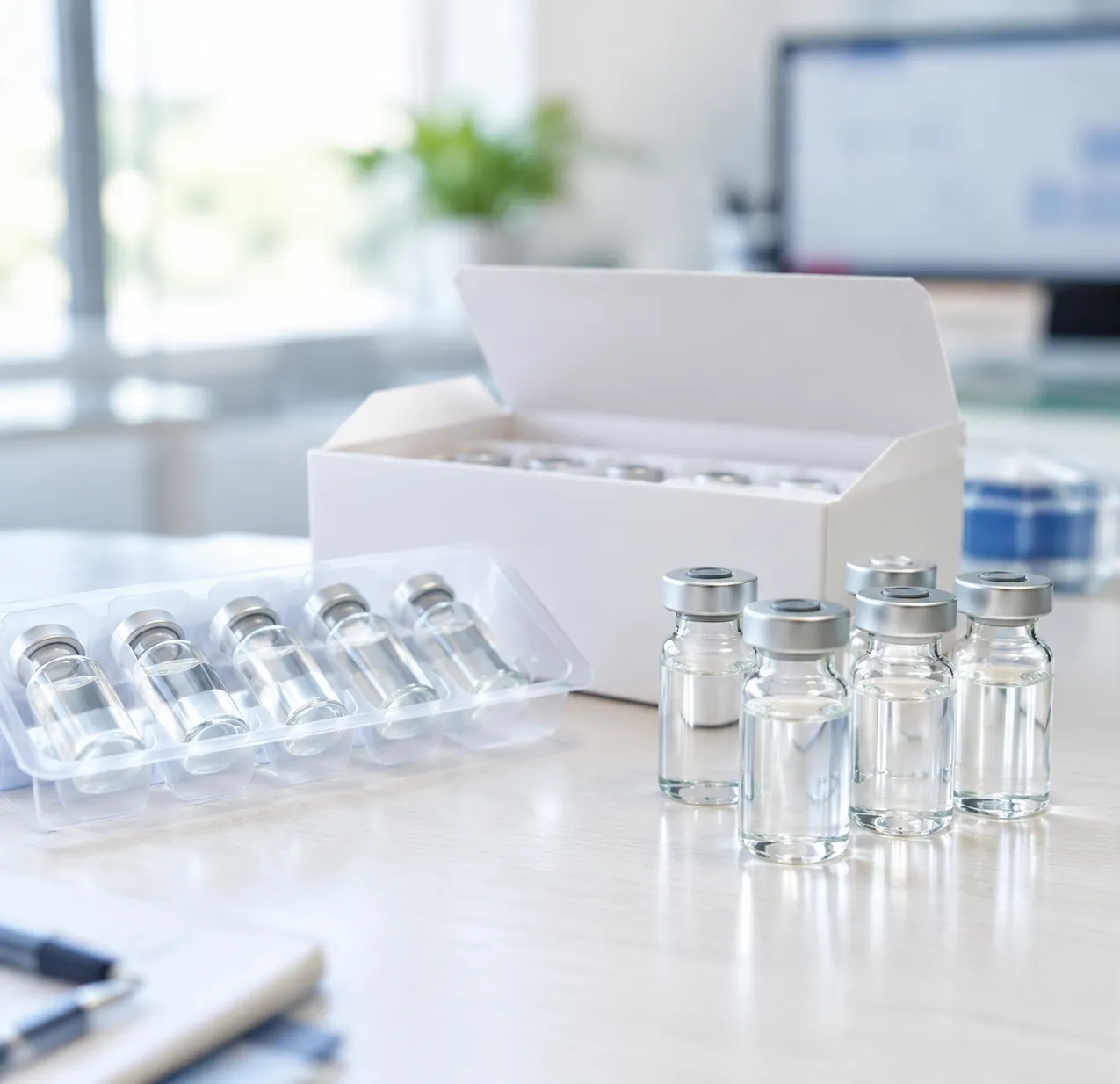
Liquid Parenterals and Antibiotic Solutions
Liquid injectables require exceptional surface inertness to prevent glass delamination and minimize chemical leaching over extended shelf lives.
- Compatibility: Type I borosilicate glass vials pair with chemically inert chlorobutyl or fluoropolymer-coated rubber stoppers to prevent compound degradation.
- Format Evaluation: When evaluating ampoule vs vial container formats for antibiotics and high-volume parenterals, our injection vials provide the multidose access and flexible crimp-seal reliability required for automated hospital dispensing.
- Fit: Ideal for small-volume parenterals (SVPs), intravenous solutions, and sensitive anti-infective suspensions.
Vaccines and Cold-Chain Biologics Packaging
Biologics and mRNA or protein-based vaccines require strict integrity across ultralow temperatures.
- Sub-Zero Seal Integrity: Low-extractable bromobutyl rubber stopper closures maintain elasticity down to -80°C, stopping vacuum loss and seal relaxation.
- Uniform Wall Dimensions: Precision-drawn tubular glass walls distribute thermal shock evenly during rapid freezing cycles, preventing microcracking.
- Aseptic Compatibility: Pre-sterilized components seamlessly integrate with modern nested tub and tray aseptic processing solutions on high-speed filling lines.
Lyophilized Powders and Freeze-Dried Formulations
Freeze-dried active pharmaceutical ingredients (APIs) require packaging that facilitates efficient sublimation and reliable post-drying vacuum sealing.
- Vented Stopper Designs: Single-leg and two-leg lyophilization stoppers seat reliably in the pre-capping position during sublimation without slipping.
- Thermal Transfer: Flat, consistent base geometries on our tubular vials ensure direct contact with freeze-dryer shelves for uniform heat distribution.
- Atmospheric Protection: Instant collapse of stoppers under chamber vacuum seals the drug chamber before aluminum crimp caps lock out ambient moisture.
| Application Type | Recommended Vial Substrate | Stopper Configuration | Closure Mechanism |
|---|---|---|---|
| Liquid Parenterals | Type I Clear/Amber Borosilicate | Serum Flanged Chlorobutyl | Standard Aluminum Flip-Off Cap |
| Biologics & Vaccines | High-Purity Neutral Borosilicate | Low-Leachable Bromobutyl | Tamper-Evident Flip Tear-Off Seal |
| Lyophilized Powders | Tubular Type I Glass | 2-Leg Vented Lyophilization Stopper | Deep-Skirt Crimp Seal |
| Diagnostic Reagents | Molded or Tubular Glass | Pure Butyl Formulation | Color-Coded Crimp Seal |
Diagnostic Reagents, Diluents, and Laboratory Solutions
Precision testing platforms rely on non-reactive packaging to maintain reagent calibration and shelf stability.
- Chemical Neutrality: High hydrolytic resistance prevents alkaline shift in aqueous reagents, buffer solutions, and reconstitution diluents.
- Custom Color Identification: Color-coded flip-off tops allow immediate functional separation of reagents, diluent solutions, and active controls on the bench.
- Controlled Headspace: Consistent inner neck bores ensure leak-free seal engagement and clean needle penetration for automated testing equipment.
How to Choose the Right Injection Vial Packaging
Selecting the correct injection vial packaging setup protects drug stability, prevents filling line downtime, and guarantees regulatory compliance. We evaluate five core parameters to match your drug product with the right container-closure components:
- Drug Formulation Sensitivity: Assess pH levels, active ingredient reactivity, and light sensitivity. High-alkaline or sensitive biologic drugs demand high-hydrolytic-resistance Type I borosilicate glass vials to prevent glass delamination.
- Fill Volume and Headspace: Calculate exact fill volume, liquid expansion limits, and needle clearance. Leaving proper headspace avoids stopper push-out during autoclaving and maintains pressure balance during reconstitution.
- Tubular vs. Molded Glass: Pick tubular glass vials for small-volume parenterals requiring thin, uniform walls and rapid heat transfer during lyophilization. Choose molded glass vials when high mechanical impact resistance, chemical volume, and heavy handling durability are required.
- Elastomer and Closure Performance: Match bromobutyl or chlorobutyl rubber stopper closures with low extractables/leachables to your drug matrix. Pair them with precise aluminum flip-off caps designed to run smoothly at high crimping speeds without bending or generating particulates.
- Supply Format: Weigh non-sterile bulk packaging against pre-washed, depyrogenated, ready-to-use options. Implementing pre-sterilized RTU vials and modular vial systems eliminates cleanroom washing lines, cuts capital expenses, and accelerates fill-finish timelines for clinical and commercial runs.
Technical Decision Matrix for Injectable Vial Packaging Solutions
| Packaging Parameter | Evaluation Metric | Recommended Selection |
|---|---|---|
| Glass Type | Chemical resistance & thermal stability | Type I clear or amber borosilicate glass |
| Vial Structure | Freeze-drying efficiency vs. drop impact strength | Tubular glass (lyophilization) / Molded glass (large volume) |
| Stopper Elastomer | Gas permeability & chemical inertness | Bromobutyl (general liquid/powder) or Chlorobutyl (specific pH profiles) |
| Seal Crimp Profile | Line speed matching & tamper evidence | Aluminum-plastic flip-off seals with tight skirt tolerances |
| Delivery State | Upfront processing vs. direct machine feed | Nested RTU (sterile) or bulk-packed trays (terminal sterilization) |
Our engineering team works directly with your formulation data to verify container-closure integrity, optimize dimensional clearances, and provide validated injectable vial packaging solutions tailored to your automated filling systems.
Why Partner with Jiahua Package for Injectable Vial Packaging Solutions
Sourcing components from multiple vendors often leads to dimensional mismatches, line stoppages, and compliance headaches. We eliminate those risks by engineering and delivering fully synchronized injection vial packaging systems under one roof.
Coordinated Single-Source Supply
We supply matched sets of Type I borosilicate glass vials, chlorobutyl and bromobutyl rubber stoppers, and aluminum flip-off seals. By engineering the complete container-closure system together, we guarantee immediate dimensional compatibility, eliminating crimping failures, vacuum loss, and neck-finish mismatch during filling.
Operational Advantages with Jiahua Package
| Operational Parameter | Fragmented Sourcing | Jiahua Package Integrated Supply |
|---|---|---|
| Component Matching | High risk of dimensional tolerance stack-up | Factory-tested vial, stopper, and seal fits |
| Documentation | Multiple disconnected COAs and dossiers | Consolidated lot documentation and test reports |
| Filling Performance | Frequent downtime on automated crimpers | Optimized for high-speed pharmaceutical lines |
| Supply Lead Time | Complex, multi-vendor shipping schedules | Unified logistics with single-point tracking |
Strict Batch-to-Batch Consistency
Consistency protects your filling yields. Our manufacturing processes adhere to rigid quality standards:
Automated Dimensional Checks: Continuous optical camera inspection across total vial height, outer diameter, wall thickness, and flange profile.
Controlled Particulates: Cleanroom washing, depyrogenation preparation, and low-particulate packaging that simplify your cleanroom validation.
Integrity Validation: Every production lot undergoes container-closure integrity testing to verify airtight, sterile seals under dynamic storage conditions.
Flexible Scalability for CDMOs and Pharma Brands
Whether you are qualifying an early-stage biologic, running small pilot batches, or operating continuous commercial fill-finish campaigns, our production scales with your volume requirements. If your operations focus on targeted therapies, our team can help you navigate how to select an RTU supplier for small-batch biologics to keep your runs flexible and cost-effective. We support contract development and manufacturing organizations (CDMOs) with low-minimum pilot lots, and we provide reliable container shipping schedules for high-throughput generic and brand manufacturers.
Hands-On Technical Support from Day One
Our engineering team works directly with your packaging engineers from benchtop development to full-scale automated runs. We review your line setup, recommend optimal crimping profiles using our comprehensive vial packaging process guide for pharmaceutical lines, and provide fast-turn functional sample kits for compatibility trials and stability testing.
Protective Packaging, MOQ, and Export Shipping for Injection Vial Packaging
Shock-Absorbent and Dust-Free Packaging Formats
To prevent glass-to-glass friction and surface abrasion, we pack all clear and amber borosilicate glass vials into cleanroom-compatible formats before crating:
- Polypropylene Trays with Partitions: Precision-molded plastic nests hold each vial individually to eliminate glass clashing during transit.
- Heat-Shrink Wrapped Modules: Tight shrink film secures each tray to lock out airborne dust, particulate matter, and moisture.
- Cleanroom-Ready Double Bagging: Inner bags are sealed within cleanroom environments, allowing safe wipe-down transfer directly into your sterile handling zones.
- Secondary Outer Protection: Corrugated outer cartons feature heavy test ratings, edge protectors, and foam lining. For clinical trials and lab shipments, we also integrate compact vial packaging boxes for secure sample storage to protect individual containers during handling.
Minimum Order Quantities (MOQ) and Turnaround Timelines
We balance accessibility for emerging biotech runs with the capacity required by commercial pharmaceutical brands:
| Component Type | Standard MOQ | Pilot / Trial Run MOQ | Standard Production Lead Time |
|---|---|---|---|
| Tubular Glass Vials (Clear/Amber) | 50,000 pcs | 10,000 pcs | 3–4 Weeks |
| Molded Glass Vials (Type I / II) | 30,000 pcs | 5,000 pcs | 3–4 Weeks |
| Bromobutyl / Chlorobutyl Stoppers | 50,000 pcs | 10,000 pcs | 2–3 Weeks |
| Aluminum Flip-Off Crimp Seals | 50,000 pcs | 10,000 pcs | 2–3 Weeks |
| Custom Printed / Branded Caps | 100,000 pcs | 20,000 pcs | 4–5 Weeks |
Stock components and standard neck finishes ship within 5 to 7 business days.
Palletization, Commercial Compliance, and Worldwide Logistics
Every export batch undergoes rigid palletization designed for sea, air, and multimodal freight:
- Heat-Treated Pallets: Fumigated, ISPM-15 compliant wooden and heavy-duty plastic pallets built to standard international footprints (1200×800 mm and 1200×1000 mm).
- Structural Corner Boards and Strapping: High-strength corner boards protect carton edges, secured with poly strapping and automated stretch wrapping to prevent load shifts.
- Full Shipping Dossier: Every consignment includes batch release certificates, Certificates of Analysis (COA), packing lists with net/gross weights, and clear customs declaration documentation.
- Flexible Incoterms: We manage global shipping under EXW, FOB, CIF, and DDP terms, coordinating directly with your chosen freight forwarders or handling door-to-door delivery.
Frequently Asked Questions About Injection Vial Packaging
What components are included in a complete injectable vial packaging solution?
A complete system includes three essential primary packaging components engineered to maintain a hermetic seal and product sterility:
- Primary glass vial: Type I borosilicate glass vials (tubular or molded) in clear or amber formats.
- Elastomeric closure: High-purity bromobutyl or chlorobutyl rubber stopper closures engineered for low extractables.
- Tamper-evident seal: Pharmaceutical vial seals, typically aluminum crimp seals or plastic-aluminum flip-off caps.
Can Jiahua package supply pre-matched vial, stopper, and cap sets?
Yes. We supply coordinated, pre-tested component sets where the vial neck finish, stopper flange thickness, and aluminum crimp cap skirt height are matched to standard ISO tolerances. This eliminates container-closure mismatch, prevents crimping line jams, and guarantees container-closure integrity (CCI).
What is the difference between tubular and molded injection vials?
| Feature | Tubular Glass Vials | Molded Glass Vials |
|---|---|---|
| Manufacturing Method | Drawn from glass tubing; cut and formed | Blown or pressed directly in molds |
| Wall Consistency | Extremely uniform wall thickness and flat bottom | Heavier, thicker walls with slight base variation |
| Thermal Transfer | Superior heat transfer for lyophilization cycles | Slower heat transfer due to thicker base |
| Impact Resistance | Standard mechanical strength | High resistance to external impact and high fill volumes |
| Typical Volumes | 1 ml to 30 ml (small-volume parenterals) | 10 ml to 500 ml (large-volume parenterals/infusions) |
Are sterile and ready-to-use vials available for bulk order?
Yes. In addition to non-sterile bulk configurations, our team supplies pre-washed, depyrogenated, and pre-sterilized ready-to-use vials. These arrive nested in sterile tubs and secondary packaging, allowing your team to feed containers directly into aseptic isolators or automated fill-finish suites without upfront washing and autoclaving.
Which rubber stopper formulation is best for liquid vs lyophilized drugs?
- Liquid injectables: Bromobutyl or chlorobutyl stoppers configured with straight plugs or single-flange designs. Bromobutyl provides low gas and moisture permeability, making it well suited for liquid medicine containers and oxidation-sensitive formulas.
- Lyophilized drugs: Two-leg, three-leg, or igloo vented stoppers. These designs allow solvent vapor to escape during freeze-drying and securely seat into the vial neck under chamber vacuum. Low-moisture-absorbing formulations prevent post-drying moisture transfer back into the cake.
What specifications are required to receive a fast, accurate quote?
To receive a detailed quote and packaging specification sheet, provide the following parameters:
- Vial details: Target fill volume (such as standard 2ml, 5ml, 10ml, or specialized 3ml vial packaging solutions), glass grade (clear or amber Type I), and tubular or molded format.
- Neck size: ISO standard crimp finish (typically 13 mm, 20 mm, or 32 mm).
- Stopper type: Formulation (bromobutyl or chlorobutyl), configuration (liquid injection or lyo vented), and coating requirement (such as fluoropolymer film).
- Cap design: Full-tear-off, tear-off flip seal, or standard aluminum flip-off cap with custom color specifications.
- Order volume: Planned pilot or commercial batch quantities.
Can we get functional product samples before placing a bulk order?
We ship functional component sample packs for technical evaluation. Engineering teams use our samples to test dimensional fit, verify automated track feeding, dial in vial crimping supplies on filling lines, and run preliminary container-closure integrity (CCI) dye ingress tests before commercial order sign-off.