
Formula details
Product Details
Overview
2ml–3ml Tubular Glass Vial Containers for 3mg Formulations
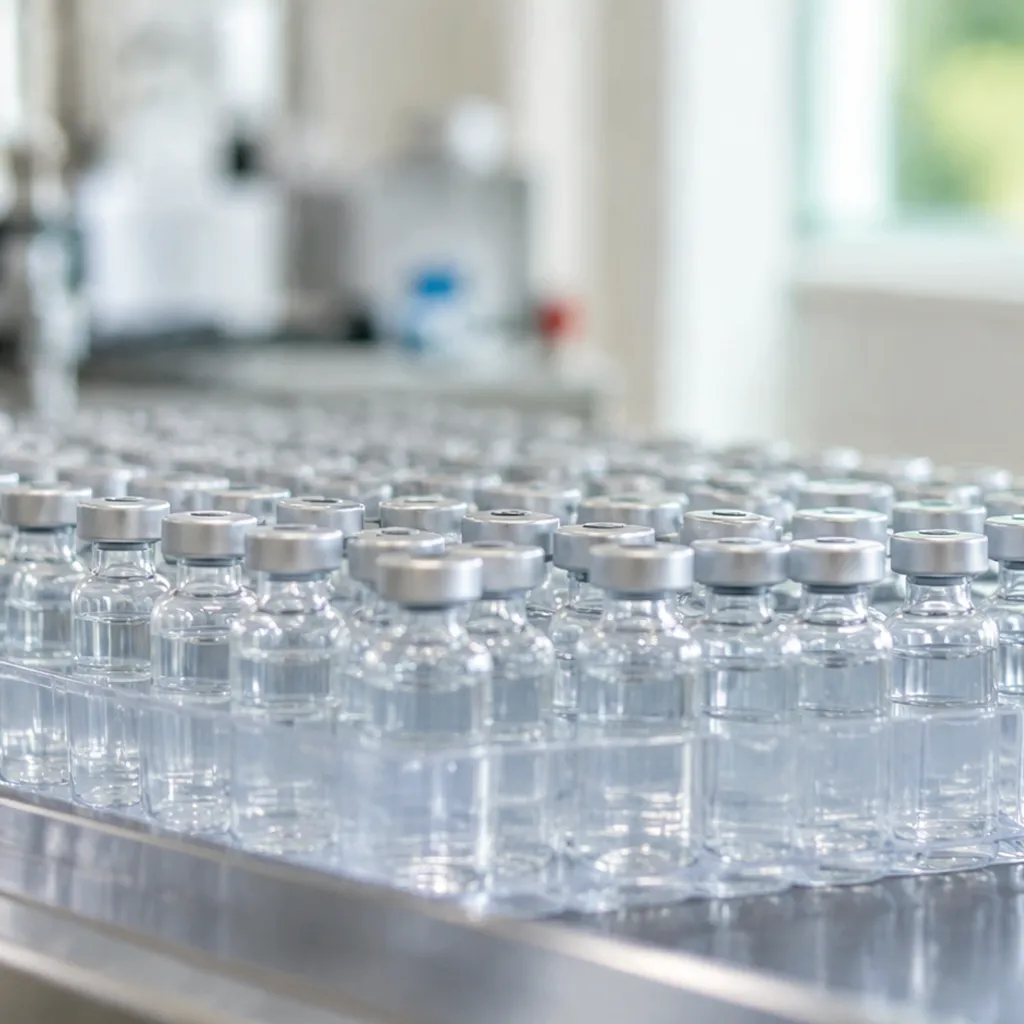
At NTJH Package, we manufacture precision tubular glass vials engineered to meet USP, EP, and ISO 8362 standards for injection containers. As a direct factory vial container store, we produce uniform, GMP-compliant primary packaging designed for pharmaceutical, diagnostic, and laboratory applications.
USP Type I Neutral Borosilicate Glass Specs
Our 2ml and 3ml vials are drawn from neutral borosilicate glass (USP Type I) to protect sensitive drug formulations from chemical interaction.
- Hydrolytic Resistance: High resistance against acid and water leaching to maintain formulation stability.
- Thermal & Mechanical Strength: Uniform wall thickness and high thermal shock resistance for reliable filling and processing.
- Cleanroom Production: Manufactured in GMP-compliant cleanrooms with automated visual inspection systems.
2ml to 3ml Nominal Volume for 3mg Fills
Standard 2ml and 3ml tubular vials serve as the industry-standard 3mg vial container for small-dose liquid therapeutics and lyophilized powders. These compact dimensions provide adequate headspace for freeze-drying cycles and reconstitution while minimizing product waste.
13mm Crimp Finish in Clear and Amber Glass
Every 2ml–3ml vial features a standard 13mm outer crimp neck finish designed for leak-tight container-closure integrity (CCI) when paired with our matching butyl rubber stoppers and aluminum-plastic flip-off seals.
- Clear Glass: Full visual clarity for automated inspection and routine monitoring.
- Amber Glass: Protects light-sensitive compounds from UV degradation.
| Parameter | Specification |
|---|---|
| Material | Neutral Borosilicate Glass (USP Type I) |
| Nominal Volume | 2ml, 3ml |
| Neck Finish | 13mm Crimp Top |
| Color Options | Clear, Amber |
| Compliance | USP, EP, ISO 8362, GMP Cleanroom |
Factory-Direct Pricing Tiers and Case MOQs
Because we manufacture directly from raw glass tubing to finished closures without middleman markups, our vial container price scales with your production volume.
- Bulk Case Packaging: Vials are tray shrink-wrapped inside corrugated export cases for cleanroom handling and damage-free transit.
- Tiered Wholesale Rates: Unit costs depend on glass type, closure pairing, and total vial container case volume.
- Flexible MOQs: Lower minimum order quantities apply to in-stock 2ml–3ml clear and amber vials, while higher MOQs apply to custom glass colors, surface treatments, or custom cap printing.
Direct Quotations and Verification Samples
Procurement and engineering teams can submit a Request for Quotation (RFQ) with target case volumes and closure requirements to receive tiered factory pricing. Physical sample kits are available for compatibility testing, crimping verification, and line trials before bulk ordering.
Technical Specifications and Dimensional Blueprint
| Parameter | 2ml Standard (ISO 8362-1) | 3ml Extended Capacity |
|---|---|---|
| Nominal Volume | 2.0 ml | 3.0 ml |
| Brimful Capacity | 3.6 ml ± 0.2 ml | 4.5 ml ± 0.2 ml |
| Outer Diameter (OD) | 16.00 mm ± 0.15 mm | 16.00 mm ± 0.15 mm |
| Total Height | 35.00 mm ± 0.50 mm | 40.00 mm ± 0.50 mm |
| Wall Thickness | 1.00 mm ± 0.04 mm | 1.00 mm ± 0.04 mm |
| Crimp Neck Finish | 13mm Crimp (ISO standard) | 13mm Crimp (ISO standard) |
| Bore Inner Diameter (ID) | 7.00 mm ± 0.20 mm | 7.00 mm ± 0.20 mm |
| Glass Type | Neutral Borosilicate (USP Type I) | Neutral Borosilicate (USP Type I) |
Detailed dimensional references can also be reviewed in our 10ml and 2ml vial box dimensions guide for complete line planning.
Capacity Tolerances and Wall Uniformity
- Brimful vs. Nominal Fill Limits: The expanded overflow capacity prevents liquid expansion during freeze-drying cycles and avoids meniscus overflow during high-speed automated dispensing.
- Tight Wall Thickness Control: Continuous online laser gauging keeps wall variations within ±0.04 mm. This uniformity eliminates hot and cold spots during freezing and promotes rapid, even heat transfer across every run.
- Precision 13mm Crimp Finish: Strict neck geometry and inner bore tolerances prevent stopper blow-outs during lyophilization chamber depressurization and maintain a hermetic seal under continuous vacuum.
Chemical Durability and Thermal Limits
- Hydrolytic Resistance (Class HGB 1): We use Type I neutral borosilicate glass to meet USP <660> and EP 3.2.1 hydrolytic extraction thresholds, preventing alkali release into formulation solutions.
- Thermal Shock Resistance: Designed to withstand rapid temperature swings exceeding Δ121°C without micro-fracturing or structural failure.
- Depyrogenation Endurance: Capable of enduring continuous dry-heat sterilization tunnels at 250°C to 300°C with zero dimensional warping.
- Leaching Barrier Protection: Excellent chemical inertness resists acidic and basic drug interactions, protecting active compounds, reducing ion exchange, and removing delamination risks in high-potency parenteral fills.
Application Focus for 3mg Lyophilization and Small-Dose Injections
Headspace and Surface-Area Ratio for Freeze-Drying Cakes
Small-dose lyophilization depends on the right balance between fill depth and open space. We form our lyophilization vial containers with consistent body diameters so your lyophilized cake stays thin, porous, and intact.
Controlled headspace: Leaves enough room for vapor flow during primary and secondary drying without wasting shelf space.
Even heat transfer: Uniform wall thickness conducts cold and heat evenly across the freeze-dryer shelf for consistent batch cycles.
Flat Uniform Inner Bottom for Maximum Drug Recovery
High-value biologics and micro-dosed formulas leave zero room for leftover liquid. Unlike heavier molded bottles, our 2ml 3ml crimp top vials are drawn from precision glass tubing with a flat, level inner base.
Minimal residual volume: Lets standard needles draw out nearly all of the reconstituted medication.
Clear visual checks: Smooth, distortion-free walls make it easier for automated cameras and lab techs to inspect the final cake and liquid clarity.
Packaging Peptides, Biologics, and Diagnostic Standards
Pharmaceutical teams and testing labs rely on our borosilicate glass vials across several core applications:
Lyophilized peptides and biological reagents: Widely used as reconstitution peptide vials and small-dose biologic containers, with options to pair them in sterile RTU vial tray kits for biologics for streamlined aseptic filling.
Diagnostic controls and calibration standards: Tight dimensional consistency supports accurate sampling in laboratory vial packaging, particularly when organized inside plastic vial trays for pharma and lab storage.
Eliminating Delamination Risks for High-Potency APIs
Surface leaching or pH shifts can compromise sensitive formulations over time. We manufacture our USP Type I glass containers from neutral borosilicate tubing with high hydrolytic and chemical resistance against acid and water attack. Tightly controlled forming temperatures on our cleanroom lines help prevent glass delamination, keeping high-potency APIs stable across every vial container case we deliver.
Container Closure Integrity and Matching Accessories
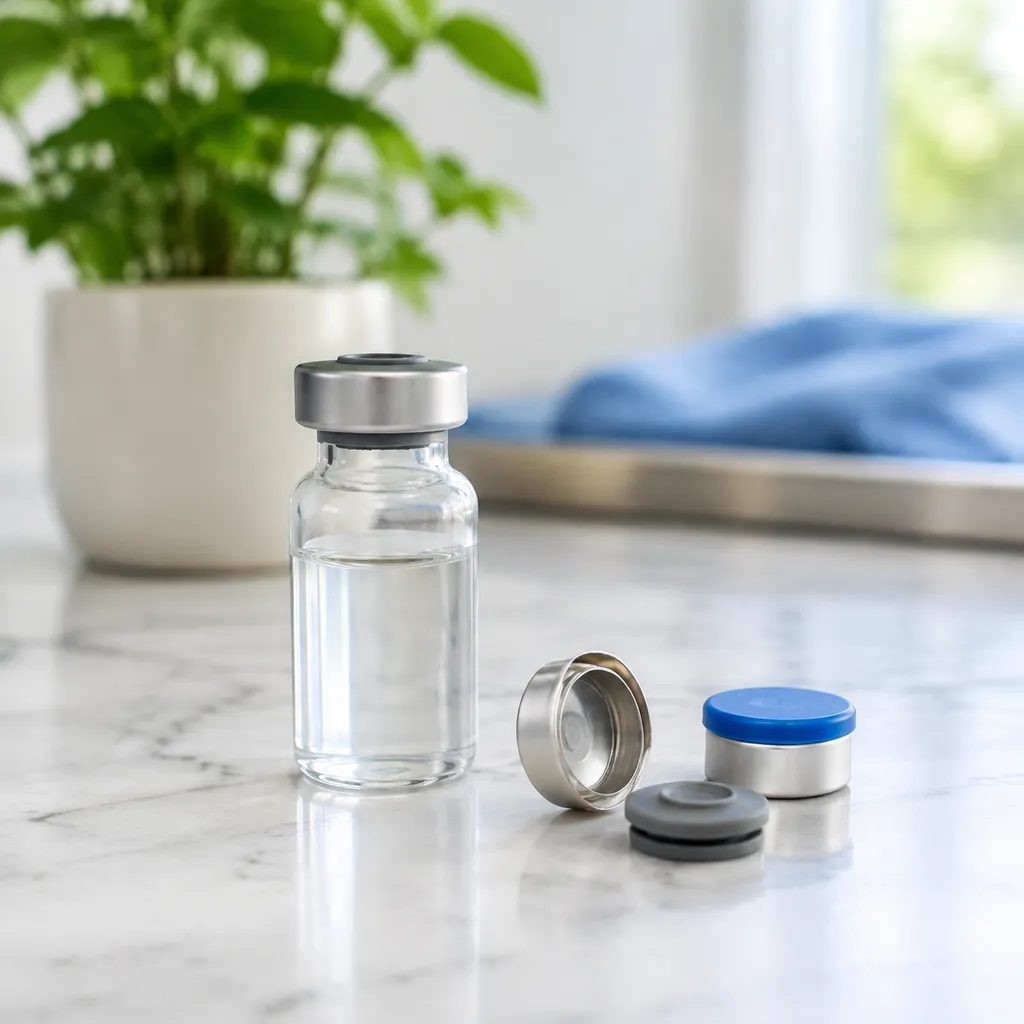
Achieving a leak-proof seal on a 3mg vial container depends entirely on the precision fit between the glass crown, the elastomeric plug, and the crimped aluminum band. In our manufacturing facility, we engineer our tubular glass vials alongside matching closure systems to guarantee Container Closure Integrity (CCI) under deep vacuum, sub-zero storage, and long-term transit conditions. Understanding proper vial container types and sealing configurations prevents costly batch leaks and moisture ingress.
13mm Chlorobutyl and Bromobutyl Rubber Stoppers
We supply pharmaceutical-grade 13mm elastomeric stoppers formulated for low gas permeability, ultra-low extractables, and exceptional resealing performance during needle puncture:
- Bromobutyl Formulations: Best suited for aqueous solutions, sensitive biologicals, and reconstitution peptide vials requiring the lowest moisture uptake.
- Chlorobutyl Formulations: High resistance to chemical attack, ideal for aggressive liquid reagents and diagnostic standards.
- Autoclave and Gamma Stability: Formulated to withstand standard sterilization runs at 121°C without deformation or tackiness.
2-Leg and 3-Leg Freeze-Drying Stoppers
For lyophilized drug cycles, vapor must vent freely before final stoppering inside the freeze-dry chamber:
- Venting Geometry: Engineered with 2-leg or 3-leg slotted flutes that seat reliably in the vial neck during the sublimation phase without premature pop-out.
- Low Sticking Formulations: Specially treated elastomeric surfaces prevent stoppers from adhering to the freeze-dryer shelves after hydraulic stoppering.
- Vacuum Retention: Once pushed down, the sealing rings form a hermetic barrier that protects lyophilized cakes from ambient humidity.
13mm Aluminum-Plastic Flip-Off Tamper-Evident Seals
Our flip-off caps combine a smooth plastic button with an aluminum skirt to deliver visible tamper evidence and secure crimping:
- Clean-Edge Tear Technology: Burr-free, clean-edge aluminum skirts prevent metal particle generation during manual or automated crimping.
- Color-Coding Options: Available in standard and custom colors to separate batch lots, dosages, or formulation types on filling lines.
- Sterile Barrier Protection: Shields the injection target area from dust and contaminants right up to the moment of point-of-use reconstitution.
Crimping Tools and Packaging Accessories
To support operations from early-stage compounding up to industrial batching, our vial container store provides tested capping machinery:
- Manual Handheld Crimpers: Ergonomic 13mm hand crimpers with adjustable stop blocks for consistent pressure on pilot runs and lab test batches.
- Manual Decappers: Clean removal tools that strip aluminum collars without fracturing the glass vial neck finish.
- Benchtop Pneumatic Crimping Units: Semi-automated tabletop crimpers connected to clean compressed air lines, delivering uniform torque, calibrated crimp heights, and repeatable seal compression across every single vial container case.
Case Packaging Architecture and Cleanliness Levels
Nest Trays and Master Shipping Case Specs
Our inner packs utilize vacuum-formed polypropylene (PP) plastic nest trays sealed with cleanroom-grade shrink wrap film. These inner modules fit directly into heavy-duty 5-layer double-wall corrugated master shipping cases, tested to endure sea, air, and ground transport without crushing.
| Packaging Parameter | 2ml / 3ml Tubular Glass Format | 5ml / 10ml Standard Format |
|---|---|---|
| Inner Packaging | Sealed cleanroom PP nest tray | Sealed cleanroom PP nest tray |
| Tray Capacity | 100 to 200 vials / tray | 80 to 100 vials / tray |
| Vials Per Master Case | 2,000 to 3,000 units / vial container case | 1,000 to 1,500 units / case |
| Gross Weight per Case | Approx. 11.5 – 13.5 kg | Approx. 12.0 – 14.5 kg |
| Master Case Dimensions | 480 mm × 380 mm × 260 mm | 500 mm × 400 mm × 300 mm |
| Stacking Integrity | Double-wall (BC-flute) 5-ply corrugated | Double-wall (BC-flute) 5-ply corrugated |
For larger procurement runs, we pack cases onto standard fumigated heat-treated export pallets wrapped in water-resistant stretch film with heavy-duty corner boards. If your compounding lab or diagnostic filling operation requires complete outer boxing configurations, you can evaluate our serum vial packaging wholesale glass vials and boxes for secondary distribution.
Cleanroom Tiers: Bulk, RTS, and RTU
We supply glass containers in distinct cleanliness grades to match your facility's operational workflow:
- Standard Cleanroom Bulk: Molded and tubular vials are packed directly inside our ISO Class cleanroom environment into sealed trays. Suitable for operations running dedicated offline washing and depyrogenation tunnels.
- Ready-to-Sterilize (RTS): Pre-washed vials packed in double-sealed pharmaceutical bags, ready for on-site autoclave or dry-heat depyrogenation cycles.
- Ready-to-Use (RTU): Fully washed, depyrogenated, and pre-sterilized glass nestled in sterile tub configurations, built along the same operational philosophy as our pharmaceutical cartridge nest and tub sterile packaging systems to load directly into aseptic robotic filling lines without cleanroom pre-treatment.
Whether purchasing single-case validation packs from our direct factory vial container store or ordering full pallets, our standardized packaging keeps the vial container price low by minimizing product scrap, transit loss, and incoming QA rejection rates.
Vial Container Price Breakdown and Wholesale Purchasing Guide
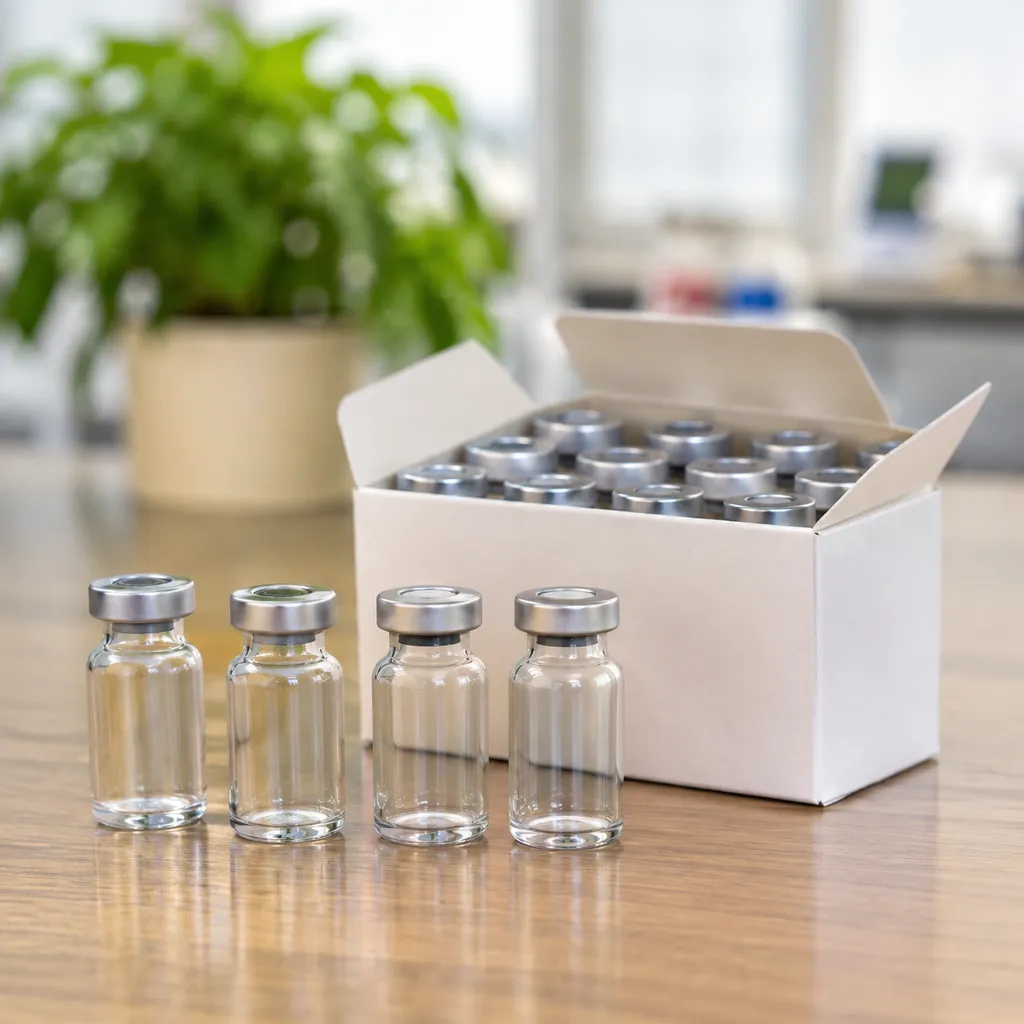
Direct factory pricing removes distributor markups and lets you scale from lab trials to full commercial fills with predictable costs. When sourcing from our vial container store, your final unit cost depends on glass grade, tubing color, and order volume per carton.
Glass Grade and Color Cost Variables
- Glass Composition: High-hydrolytic 5.0 neutral borosilicate glass (USP Type I) carries a higher material cost than low borosilicate or soda-lime formulations due to its superior thermal shock stability and chemical resistance for critical APIs.
- Tubing Color: Standard clear flint glass provides the most economical base price. Amber tubular glass includes a slight cost premium due to the metallic oxide additives required for UV light filtering.
- Matched Component Bundling: Sourcing complete sets—pairing each tubular vial with certified 13mm chlorobutyl stoppers and flip-off seals—unlocks our integrated procurement discount compared to buying separate closure lines.
Tiered Wholesale Pricing Structures
We structure our tiered factory-direct quotes around standardized master cartons to ensure safe shipping and predictable freight rates:
- Pilot Runs & Lab Trials (1–5 Cases): Ideal for formulation testing, stability assays, and small-batch lyophilization. While unit costs are higher at this tier, we keep standard clear and amber 2ml–3ml sizes in stock to eliminate custom tooling fees. For specialized validation needs, evaluate our peptide vial sizes guide before locking in case quantities.
- Commercial Production (10–50 Cases): Standard volume tier for compounding labs and contract manufacturers. Secures significant volume discounts per vial container case with prioritized cleanroom production runs.
- Enterprise Logistics & Full Container Loads (FCL): Maximum volume discounts for large-scale pharmaceutical operations. FCL purchases qualify for tailored delivery schedules, customized pallet configurations, and dedicated freight coordination.
Every baseline vial container price quotation reflects exact case quantities, raw tubing choices, and your closure configurations to ensure leak-tight container closure integrity across your entire fill run.
Quality Control, Testing, and Compliance Documentation
We back every production batch with strict in-line inspection and complete regulatory paperwork. Because we operate as a direct factory rather than a generic reseller or middleman vial container store, our inspection lines are built directly into our cleanroom manufacturing workflow to protect your formulations.
Automated In-Line Defect and Dimensional Inspection
Every single tubular glass vial passes through our automated optoelectronic inspection system before final packing:
Optoelectronic Camera Screening: High-speed 360-degree cameras check 100% of vials for cosmetic and structural flaws, eliminating bubbles, scratches, inclusions, checks, and glass chips.
Continuous Laser Gauging: Laser sensors perform real-time verification of outer diameter, lip profile, inner bore diameter, and wall thickness uniformity.
Strict Fit Tolerances: Precise dimensional control guarantees consistent stopper insertion and leak-proof crimp closure on your automated fill-finish lines for every standard 3mg vial container.
Regulatory Standards and Compendial Testing
Our manufacturing processes and materials comply fully with worldwide standards for pharmaceutical glass containers:
ISO 9001 & ISO 15378 Compliance: Certified quality systems govern our cleanrooms to ensure good manufacturing practice (GMP) consistency across all primary packaging for vials.
USP <660> & EP 3.2.1 Testing: Our neutral borosilicate glass is regularly tested for surface hydrolytic resistance, water leaching limits, and grain release, meeting the highest USP Type I and EP Type I classifications.
ISO 8362-1 Dimensional Integrity: Standard crimp neck dimensions match global capping equipment without requiring machine recalibration.
DMF Access and Lot Documentation
- Drug Master File (DMF) Support: We provide access to registered packaging DMF documentation to accelerate your submission and audit procedures.
- Case-Level CoA Traceability: Each sealed vial container case carries a dedicated production lot number tied directly to its physical and chemical testing data.
- Complete Audit Dossier: Every shipped order includes a comprehensive Certificate of Analysis (CoA) detailing glass composition, dimensional metrics, and hydrolytic resistance test results.
This rigorous quality verification directly protects your final product while maintaining an optimal vial container price for commercial supply.
Custom OEM Capabilities and Surface Treatments
Standard catalog containers do not always match the physical mechanics of specialized filling equipment or specific brand identity requirements. As a direct factory manufacturer, we engineer custom tubular glass modifications directly from the forming line, offering end-to-end tooling and secondary finishing for every 3mg vial container format we produce.
Our factory delivers high-precision OEM options and exterior surface engineering tailored to pharmaceutical lines, analytical labs, and diagnostic kit manufacturers seeking verified custom glass vial packaging options for bulk orders:
- Ceramic Silkscreen Printing & Graduation Lines: We apply high-temperature ceramic inks baked directly into the glass matrix. These markings resist depyrogenation cycles (up to 350°C), autoclave sterilization, and isopropyl alcohol wipes without flaking or particle shedding. We print precise fill-line graduations, batch demarcation lines, single-color logos, and regulatory labeling.
- External Frosted & Amber Color Coating: For light-sensitive active ingredients needing extra photoprotection, we provide uniform external matte frosting and colored thermal spray coatings. All surface colorants are strictly applied to the container exterior, ensuring zero drug-contact surface contamination.
- Anti-Static External Treatments: High-speed automated de-nesting and filling machinery can suffer from static buildup that causes small glass units to tip. We offer specialized external anti-friction and anti-static surface treatments to ensure smooth conveyance across high-throughput sorting belts and star wheels.
- Custom Dimensional Tooling: If standard ISO 8362-1 specifications do not fit your lyophilizer shelf spacing or nested tray cavities, we adjust tubing cut lengths, base thickness, neck bore diameters, and crimp lip profiles. Custom tooling runs are integrated seamlessly into our production schedule with transparent vial container price quotes calculated directly against order volume.
Whether ordering pilot validation lots or regular supply by the vial container case, our engineering team provides complete technical drawings, prototype mold samples, and dimensional tolerance reports prior to full production runs.
Frequently Asked Questions About 3mg Vial Containers
Why is a 2ml–3ml vial container ideal for 3mg lyophilized formulations?
A standard 3mg active ingredient formulation typically requires reconstitution with 1ml to 2ml of diluent. Using our 3ml vial packaging solutions for secure storage provides the optimal surface-area-to-depth ratio needed during the freeze-drying process:
Sublimation efficiency: A balanced diameter allows uniform vapor escape without boiling or cake collapse.
Reconstitution headspace: Leaves adequate headspace for sterile diluent injection and rapid vortex mixing without liquid reaching the stopper seal.
Maximum retrieval: Flat, uniform tubular bottoms minimize residual liquid holdup, ensuring high dose recovery.
How do you ensure Container Closure Integrity between vials, stoppers, and caps?
We engineer and supply vials, stoppers, and crimp caps as matched sets. Container-closure integrity (CCI) is maintained through:
Precision neck dimensions: Strict adherence to ISO 8362 specifications for 13mm crimp neck finishes prevents dimensional mismatch.
Matched elastomeric compression: Our 13mm chlorobutyl and bromobutyl rubber stoppers are calibrated to provide 25% to 35% controlled compression under an aluminum-plastic seal.
Helium leak and dye ingress testing: Factory batch testing confirms our assembled sets prevent gas exchange, moisture ingress, and microbial contamination.
What is the packaging density per case to protect against transit breakage?
Every vial container case is packed to pharmaceutical cleanroom standards for export safety:
Inner pack: Vials are positioned upright in nested polypropylene trays (typically 100 to 200 units per tray) and shrink-wrapped to eliminate glass-to-glass abrasion.
Master carton: Trays are layered inside heavy-duty, 5-layer double-wall corrugated export cases lined with shock-absorbing foam.
Carton yield: A standard shipping case holds between 1,500 and 3,000 units depending on tray design, keeping tare weight manageable and freight costs optimized under our vial packaging for pharmaceuticals secure transit protocol.
What are the lead times for in-stock cases versus custom production runs?
Lead times vary based on standard inventory versus tailored specifications:
Standard stock items: Clear and amber 2ml–3ml borosilicate glass vials, standard 13mm gray butyl stoppers, and plain flip-off caps ship within 3 to 7 business days.
Custom production runs: Custom tubing dimensions, silkscreen graduation lines, or custom-embossed flip-off seals require 20 to 30 business days following tooling and sample sign-off.
Direct quoting: As an integrated factory, we operate as a direct B2B vial container store, offering tiered wholesale pricing by the case or full pallet with instant quotes on demand.
Can you provide lot-specific CoAs and compliance dossiers for audits?
Yes. Every production batch is backed by comprehensive regulatory documentation:
Lot Certificate of Analysis (CoA): Shipped with every order, detailing dimensional tolerances, hydrolytic resistance (USP Type I, EP 3.2.1), and chemical composition.
Regulatory documentation: We provide complete compliance files including ISO 9001 and ISO 15378 certifications, particulate cleanliness reports, and technical drawings for regulatory filings and quality audits.