Formula details
Product Details
Overview
What Is RTU Pharmaceutical Cartridge Packaging?
Understanding Ready-to-Use (RTU) Sterile Cartridge Systems
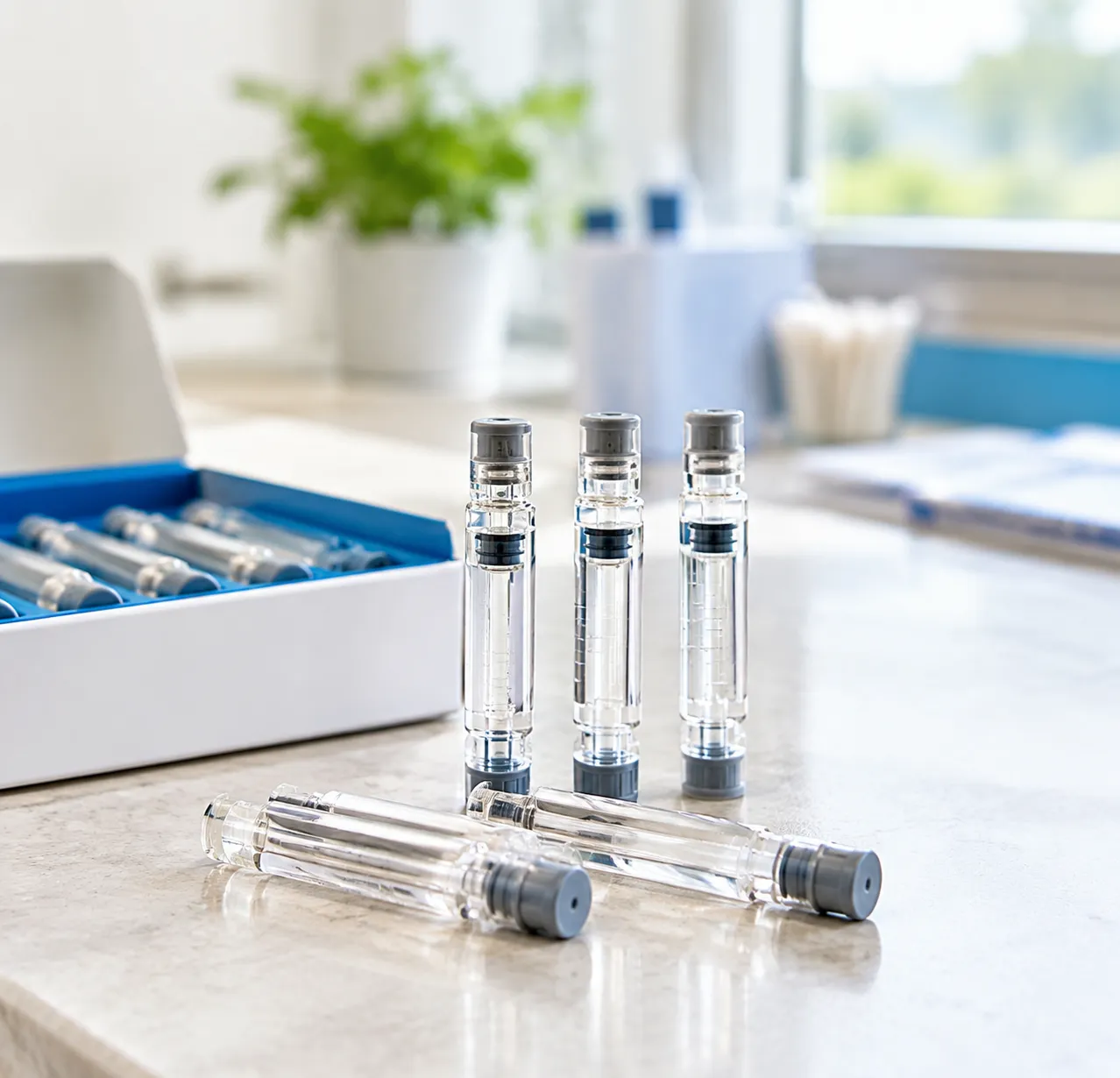
RTU pharmaceutical cartridge packaging provides pre-washed, depyrogenated, and pre-sterilized primary containment units delivered ready for direct aseptic filling.
Core Components of RTU Cartridges
- Primary Barrel: Formed from high-grade Type I borosilicate glass or advanced cyclic olefin polymer (COP) for break-resistant durability and low surface interaction.
- Elastomeric Rubber Plunger: Formulated with low-particulate halobutyl elastomer, optimized for consistent breakout and gliding forces in auto-injectors.
- Aluminum Crimp Cap: Fitted with an elastomeric liner (bromobutyl/chlorobutyl) to seal the crimp neck securely.
- Surface Lubrication: Controlled baked-on silicone or silicone-free inner coating to prevent sub-visible particulate contamination and ensure smooth actuation.
Nest and Tub Packaging Configuration
Our nested cartridge packaging uses industry-standard plastic tubs sealed with breathable Tyvek lids and protective header bags.
- Zero Glass-to-Glass Contact: Cartridges sit suspended in matrix nests, preventing cosmetic scratches, chipping, and micro-cracks during transit.
- Robotic Compatibility: Designed to integrate seamlessly with automated debagging, lid-peeling, and robotic filling needles.
- Sterility Maintenance: Gas-permeable dual barriers support validated EtO or E-beam sterilization protocols while maintaining an extended sterile shelf life.
Standard Sizes and Specifications
| Nominal Volume | Outer Diameter (OD) | Overall Length | Common Applications |
|---|---|---|---|
| 1.0 mL | 8.15 mm | 57.0 mm | Dental anesthetics, concentrated biologics |
| 1.5 mL | 8.65 mm – 9.65 mm | 57.0 mm – 65.0 mm | Pediatric auto-injectors, peptide therapeutics |
| 3.0 mL | 11.60 mm | 64.0 mm | Insulin delivery pens, GLP-1 agonists, wearable pumps |
Key Benefits of RTU Cartridges in Modern Fill-Finish Operations
Eliminating In-House Preparation
Traditional bulk cartridges require extensive washing, depyrogenation tunnels, and in-house sterilization cycles. Ready-to-use cartridges arrive fully washed, siliconized, and sterilized—ready to load directly into the isolator or RABS.
- Zero Water-for-Injection (WFI) usage for container washing.
- No depyrogenation validation headaches for high-temperature heat tunnels.
- Immediate readiness directly out of the sterile barrier bag.
Minimizing Cleanroom Footprint and Overhead
Running complete washing and depyrogenation lines consumes massive cleanroom real estate and utility power. By integrating nested vial nest and tub systems for RTU aseptic fill-finish and matching cartridge setups, we significantly reduce facility footprints.
- Downsizes Class A/B cleanroom footprint requirements by up to 40%.
- Lowers HVAC, utility, and equipment maintenance costs.
- Cuts cleanroom capital expenditures (CapEx) and long-term operating costs (OpEx).
Preventing Glass-to-Glass Contact
In high-speed bulk lines, glass-to-glass contact causes scratches, micro-fissures, and cosmetic defects. RTU sterile glass cartridges sit securely held in honeycomb nests, ensuring containers never touch during transit or filling.
| Operational Factor | Traditional Bulk Cartridges | RTU Nested Cartridge Packaging |
|---|---|---|
| Surface Scratches & Breakage | Moderate to high risk | Near-zero due to isolated nest cavities |
| Particulate Contamination | Variable; dependent on washing lines | Ultra-low sub-visible particles (USP/EP compliant) |
| Line Changeover Time | 4 to 8 hours | Under 45 minutes |
| Capital Equipment Needs | Washers, tunnels, autoclaves | Robotic de-bagging and filling unit only |
Accelerating Batch Changeovers for Biologics
Modern biopharmaceutical manufacturing often requires smaller, multi-product batches for personalized therapies, peptides, and GLP-1 drugs. Nested pre-sterilized pen cartridges allow our lines to pivot rapidly between different container formats without re-validating cleaning cycles, dramatically shortening time-to-market for critical biologics.
Material Options and Barrier Technologies in RTU Cartridge Packaging
Selecting the right materials for RTU pharmaceutical cartridge packaging directly impacts drug stability, delivery forces, and shelf life. We engineer our cartridge systems to handle sensitive biologics, peptides, and standard small-molecule drugs by combining high-purity materials with advanced barrier coatings.
Type I Borosilicate Glass vs. Advanced Polymers (COP/COC)
We provide both traditional glass barrels and high-performance cyclic olefin polymer (COP/COC) solutions to match specific drug formulation requirements.
| Feature / Metric | Neutral Type I Borosilicate Glass | Cyclic Olefin Polymer (COP / COC) |
|---|---|---|
| Chemical Resistance | High hydrolytic resistance, standard for most drugs | Inert surface, zero delamination risk |
| Breakage Resistance | Moderate (requires careful handling) | Virtually unbreakable under high mechanical force |
| Gas Barrier (O₂ / CO₂) | Excellent impermeability | Good barrier properties; enhanced with secondary packaging |
| Extractables & Leachables | Low (potential alkali ion release at high pH) | Ultra-low ion extractables, ideal for high pH APIs |
| Transparency | Clear optical clarity | Glass-like transparency with low birefringence |
Controlled Siliconization: Baked-On Silicone vs. Silicone-Free Systems
Plunger glide force consistency is critical for multi-dose pen injectors and auto-injectors. We apply optimized lubrication technologies based on drug sensitivity:
- Baked-On Silicone (Thermal Fixation): Cures a micro-thin silicone layer directly to the inner surface of the Type I borosilicate cartridge. This significantly reduces free sub-visible silicone oil droplets in liquid formulations while maintaining consistent gliding performance.
- Silicone-Free Polymer Systems: Utilizes inherently lubricious cyclic olefin polymer RTU cartridge materials or specialized fluoropolymer coatings to eliminate silicone oil entirely, making it the preferred choice for aggregation-prone biologics.
Fluoropolymer-Coated Plungers and Elastomeric Closures
To safeguard against extractables and leachables (E&L), our ready-to-use elastomeric plungers and crimp seals feature advanced fluoropolymer barrier films (such as ETFE or PTFE coatings).
- Zero Direct Drug-Rubber Contact: Eliminates chemical migration of curing agents, zinc, and antioxidants into the product.
- Reduced Friction: Enables smooth, non-stick movement without requiring excessive liquid silicone lubrication.
- Low Breakout Force: Delivers predictable initial injection forces for auto-injectors.
Container Closure Integrity (CCI) and Gas Barrier Protection
Maintaining robust container closure integrity (CCI) across deep-freeze, refrigerated, and ambient storage is non-negotiable. Our precision-machined cartridge necks and rigid dimensional tolerances ensure a micro-tight crimp seal with the rubber septa. Integrating these cartridges into nested tub and tray aseptic processing solutions maintains sterile barrier security from automated filling to final point of care, keeping sensitive biopharmaceuticals free from microbial ingress and oxidative degradation.
Primary Drug Delivery Applications for RTU Cartridge Packaging

| Application Area | Standard Format | Key Performance Requirement |
|---|---|---|
| Insulin Pens & Wearable Pumps | 1.5 ml / 3.0 ml Glass Barrel | Low break-loose & steady glide force |
| GLP-1 & Peptide Therapeutics | 1.0 ml / 3.0 ml RTU System | Ultra-low silicone & zero leachables |
| Emergency Auto-Injectors | 1.0 ml / 2.25 ml High-Resist Barrel | High burst pressure & instant firing |
| Dental Anesthesia | 1.8 ml / 2.2 ml Depyrogenated Glass | Precise dosing & leak-proof crimp |
Insulin Delivery Pens and Wearable Pumps
Chronic disease management requires reliable daily micro-dosing. Our 3ml insulin cartridge RTU systems integrate seamlessly into reusable and disposable multi-dose pens as well as wearable patch pumps:
- Consistent Gliding Performance: Baked-on or cross-linked silicone layers prevent plunger stalling during low-increment dosing.
- Precise Inner Bore Diameters: Uniform internal barrel dimensions guarantee that every dial click delivers the exact prescribed unit.
- Vibration and Impact Resistance: Built to handle daily patient transport without risking container failure or seal disruption.
GLP-1 Receptor Agonists and Peptide Therapeutics
Formulations for weight management, diabetes, and targeted peptide therapies are highly sensitive to surface interactions and silicone oil droplet migration. Similar to evaluating peptide drug delivery packaging specifications, selecting the right pre-sterilized pen cartridges requires strict control over the drug-contact layer:
- Inert Barrier Chemistry: Fluoropolymer-coated plungers and low-extractable Type I glass eliminate chemical interactions with delicate peptide chains.
- Pre-Washed and Depyrogenated: Ready-to-fill nested formats eliminate in-house preparation risks, preserving protein stability throughout shelf life.
- Sub-Visible Particulate Control: Manufactured under strict cleanroom conditions to prevent therapeutic aggregation and immunogenicity.
Emergency Auto-Injectors and Dual-Chamber Bypass Systems
In emergency response situations involving epinephrine or pain management, auto-injector cartridge packaging must perform instantaneously under extreme mechanical stress:
- High Breakout Force Tolerance: Engineered barrels withstand high-rate spring release mechanisms without cracking or delaminating.
- Dual-Chamber Reconstitution: Bypass RTU cartridges isolate lyophilized powder from liquid diluent until the moment of injection, enabling rapid reconstitution for unstable active ingredients.
- Extended Sterile Shelf Life: Nested packaging barriers preserve sterile integrity across multi-year ambient and field storage cycles.
Dental Local Anesthetic Cartridges
Dental procedures demand rapid turnover and fail-safe dosing. We supply depyrogenated dental cartridges ready for high-speed aseptic fill-finish lines:
- Standardized 1.8 ml and 2.2 ml Formats: Fully compliant with standard dental aspirating syringes and motorized injection handles.
- Secure Diaphragm Crimping: Elastic rubber diaphragms ensure clean needle puncture with zero coring and instant self-resealing.
- Thermal Shock Resistance: Cartridge glass resists terminal handling stresses, ensuring patient safety during chairside administration.
Quality Standards and Regulatory Compliance for RTU Cartridges
Meeting strict global regulations is critical when manufacturing RTU pharmaceutical cartridge packaging. We design our pre-sterilized pen cartridges to satisfy international pharmacopeias and ISO requirements, ensuring patient safety, drug compatibility, and seamless regulatory filings.
Key Regulatory Standards and Pharmacopeial Frameworks
Every batch of our ready-to-use cartridges adheres to strict dimensional, mechanical, and chemical benchmarks across major international markets:
- ISO 11040-4 & ISO 13926: Sets precise dimensional tolerances, flange geometry, and plunger stopper interfaces for reliable integration with auto-injectors and pen delivery systems.
- USP <660>, EP 3.2.1, & JP 7.01: Validates hydrolytic resistance and chemical durability for Type I glass containers, preventing surface delamination.
- USP <381> & EP 3.2.9: Governs elastomeric closures, seal integrity, and extractable/leachable profiles.
Quality and Sterilization Specifications
We validate our sterile barrier systems to provide a ready-to-fill solution straight out of the box. Our pharmaceutical cartridge nest and tub sterile packaging undergoes rigorous bioburden testing and particulate control.
| Regulatory Parameter | Standard / Benchmark | Quality Threshold |
|---|---|---|
| Sterilization Validation | ISO 11135 (EtO) / ISO 11137 (Gamma / E-beam) | Sterility Assurance Level (SAL) 10⁻⁶ |
| Bacterial Endotoxins | USP <85> / EP 2.6.14 | < 0.25 EU/mL (Depyrogenated state) |
| Sub-visible Particulates | USP <788> / EP 2.9.19 | ≥ 10 µm: < 6,000/container; ≥ 25 µm: < 600/container |
| Bioburden Control | ISO 11737-1 | Zero viable organisms post-sterilization |
| Container Closure Integrity (CCI) | USP <1207> | High-voltage leak detection / vacuum decay compliant |
Validated Sterilization Methods
- Ethylene Oxide (EtO): The standard method for tub and nest configurations with Tyvek liners, ensuring thorough gas penetration and low residue levels.
- E-Beam / Gamma Irradiation: Applied for specialized polymer barrels and high-throughput processing lines requiring immediate terminal processing.
Integration with Automated Fill-Finish Lines
Integrating RTU pharmaceutical cartridge packaging into modern high-speed filling lines eliminates mechanical jams, minimizes particle generation, and ensures smooth manufacturing from de-nesting to final assembly.
RTU Nest & Tub ──► Robotic De-bagging ──► Vacuum Dosing & Stoppering ──► In-Line AOI & Checkweighing
Robotic De-Bagging and De-Nesting
Our pre-sterilized nest and tub cartridge packaging is engineered for seamless drop-in compatibility with leading robotic aseptic filling systems:
- Contactless Transfer: Robotic arms safely de-nest glass or polymer barrels directly into filling stations, eliminating glass-to-glass contact.
- Standardized Footprints: Formats align with global cleanroom automation standards, working alongside secondary storage solutions like plastic vial trays for pharma lab storage and transport to keep cleanroom staging organized.
- Low Particulate Generation: Clean-peel Tyvek lids and sterile bags open cleanly without shedding fibers.
Precise Dosing and Vacuum Stoppering
Handling high-potency biologics and peptides requires tight volume control and complete elimination of headspace air:
- Micro-Dosing Accuracy: Compatible with rotary piston pumps and peristaltic systems to ensure dosing accuracy within ±0.5%.
- Vacuum Stoppering: Placing rubber plungers under precise vacuum conditions eliminates air bubbles, avoids product oxidation, and positions the stopper with sub-millimeter precision.
- No Venting Tubes Required: Vacuum insertion prevents stopper deformation and preserves container closure integrity.
In-Line Inspection and Process Control
| Quality Inspection Stage | Technology Used | Target Parameter Monitored |
|---|---|---|
| Gross / Tare Weight | High-speed load cells (100% IPC) | Fill volume accuracy |
| Particle Inspection | Automated Optical Inspection (AOI) | Sub-visible particulates & fibers |
| Stopper Position | Laser sensor / Vision systems | Precise seating depth & tilt |
| Crimping Integrity | 360° visual camera checks | Flange alignment & seal tightness |
Preserving Consistent Gliding and Breakout Forces
Automated delivery devices such as auto-injectors and smart pens depend entirely on predictable mechanical movement. We protect this performance throughout the entire filling line:
- Silicone Layer Protection: Vacuum stoppering techniques prevent the wiper ribs from wiping away the silicone layer during insertion.
- Stable Injection Breakout Forces: Controlled siliconization prevents the rubber stopper from adhering to the barrel wall during shelf life.
- Consistent Gliding Force: Uniform interior coating ensures smooth, repeatable drug delivery across every production batch.
How to Select the Right RTU Pharmaceutical Cartridge Supplier
Critical Supplier Evaluation Criteria
| Evaluation Factor | Industry Standard Requirement | Key Operational Impact |
|---|---|---|
| Dimensional Tolerances | Tight outer diameter and total length control (ISO 11040-4) | Eliminates jamming in high-speed auto-injectors and pen devices |
| Cosmetic Quality | Low AQL (Acceptable Quality Limit) for visual defects | Prevents false rejects during high-speed automated optical inspection |
| Manufacturing Environment | ISO Class 5 to Class 7 cleanrooms | Guarantees ultra-low bioburden and sub-visible particulate loads |
| Regulatory Support | Active Type III Drug Master Files (DMF) & CoAs | Streamlines global regulatory filings with the FDA, EMA, and NMPA |
Dimensional Precision and Cosmetic Defect Control
RTU cartridges must fit flawlessly into autoinjectors and multi-dose pen systems. We require suppliers to maintain strict statistical process control (SPC) for:
Flange and neck geometry: Prevents crimping failures and seal integrity leaks.
Bore concentricity and wall thickness: Ensures smooth, uniform plunger travel with zero sudden force spikes.
AQL standards: Near-zero tolerance for air bubbles, glass inclusions, surface scratches, and particulate contamination.
Supply Chain Security and Batch Traceability
Reliable drug manufacturing demands unbroken supply chain security and total component traceability:
100% laser-etched matrix coding: Individual tub and nest serialization for end-to-end batch tracking.
Cleanroom control: Certified automated manufacturing and robotic tub-packaging processes that prevent human touch.
Dual-sourcing strategies: Backup sterilization and glass conversion facilities to protect against supply disruptions.
Custom Nest and Tub Configurations for Injector Devices
Standard packaging does not fit every delivery mechanism. We collaborate with engineering teams to develop nest and tub systems tailored to specific automated fill-finish lines and non-standard device formats.
When your delivery device requires specialized geometries, we supply custom pharmaceutical cartridges for injectable drugs with matched nest layouts, optimized bypass zones, and validated barrier properties.
Comprehensive Regulatory Documentation
A qualified supplier must provide complete documentation to accelerate your market entry:
Drug Master Files (DMF): Validated Type III filings registered with the US FDA and international health authorities.
Certificates of Analysis (CoA): Detailed batch-specific test results verifying endotoxin levels (<0.25 EU/ml), sterility validation, particulate counts, and baked-on silicone distribution.
Change Control Protocols: Formal notification agreements before any changes in raw materials, glass tubing, or manufacturing lines occur.
Frequently Asked Questions About RTU Cartridge Packaging
What is the difference between bulk cartridges and RTU cartridges?
Bulk cartridges require dedicated on-site washing lines, depyrogenation tunnels, offline siliconization, and high-temperature sterilization before filling. In contrast, RTU pharmaceutical cartridge packaging arrives pre-washed, depyrogenated, pre-siliconized, and sterilized in ready-to-fill nest and tub configurations. This transition to standardized RTU packaging removes massive machinery overhead and eliminates glass-to-glass contact throughout the processing chain.
| Feature | Bulk Cartridges | RTU Sterile Cartridges |
|---|---|---|
| Preparation Needed | Washing, depyrogenation, autoclaving | None (Ready for direct filling) |
| Packaging Format | Corrugated boxes / trays | Nested tubs with Tyvek lids |
| Particulate & Scuff Risk | Higher due to line friction | Minimal via individual nest pockets |
| Line Footprint | Requires extensive prep areas | Compact robotic fill-finish footprint |
How long is the sterile shelf life of RTU nested cartridges?
Our ready-to-use cartridge packaging systems maintain a validated sterile shelf life of up to 5 years. Sterile integrity depends on intact double-bagged packaging sealed with medical-grade Tyvek lids under recommended ambient warehouse conditions (15°C to 25°C, protected from direct sunlight and excessive humidity).
Can RTU cartridges withstand low-temperature storage for biologics?
Yes. Both neutral Type I borosilicate glass cartridges and cyclic olefin polymer (COP) RTU cartridges perform reliably in cold-chain environments ranging from -20°C down to -80°C. When paired with specialized fluoropolymer-coated elastomer stoppers, the assembly prevents seal shrinkage, maintaining robust container closure integrity (CCI) without loss of vacuum or gas ingress during ultra-low temperature storage.
How do RTU cartridges help reduce plunger gliding force variability?
RTU cartridges utilize highly controlled baked-on siliconization or advanced cross-linking methods rather than sprayed liquid silicone oils. This process creates an ultra-thin, uniform lubricating layer permanently bonded to the inner barrel surface:
Consistent Breakout Force: Prevents the plunger from adhering to the barrel wall during extended shelf-life storage.
Smooth Injection Travel: Eliminates sudden force spikes, guaranteeing smooth dose delivery in auto-injectors and pen systems.
Sub-Visible Particle Reduction: Minimizes free silicone droplets migrating into sensitive peptide and monoclonal antibody formulations.
What testing is required to validate RTU cartridges for combination drug products?
Validating RTU cartridges within automated drug delivery pens requires rigorous testing protocols in accordance with global regulatory frameworks:
ISO 11040-4 & ISO 13926 Compliance: Dimensional tolerance verification, flange strength, and burst pressure testing.
Functional Force Profiles: Break-loose force, dynamic gliding force, and delivery time testing inside final auto-injector devices.
Container Closure Integrity (CCI): High-voltage leak detection (HVLD), vacuum decay, and helium mass spectrometry testing.
Particulate and Purity Profiles: USP <788> sub-visible particulate counts, endotoxin testing (LAL test), and extractables/leachables (E&L) screening.