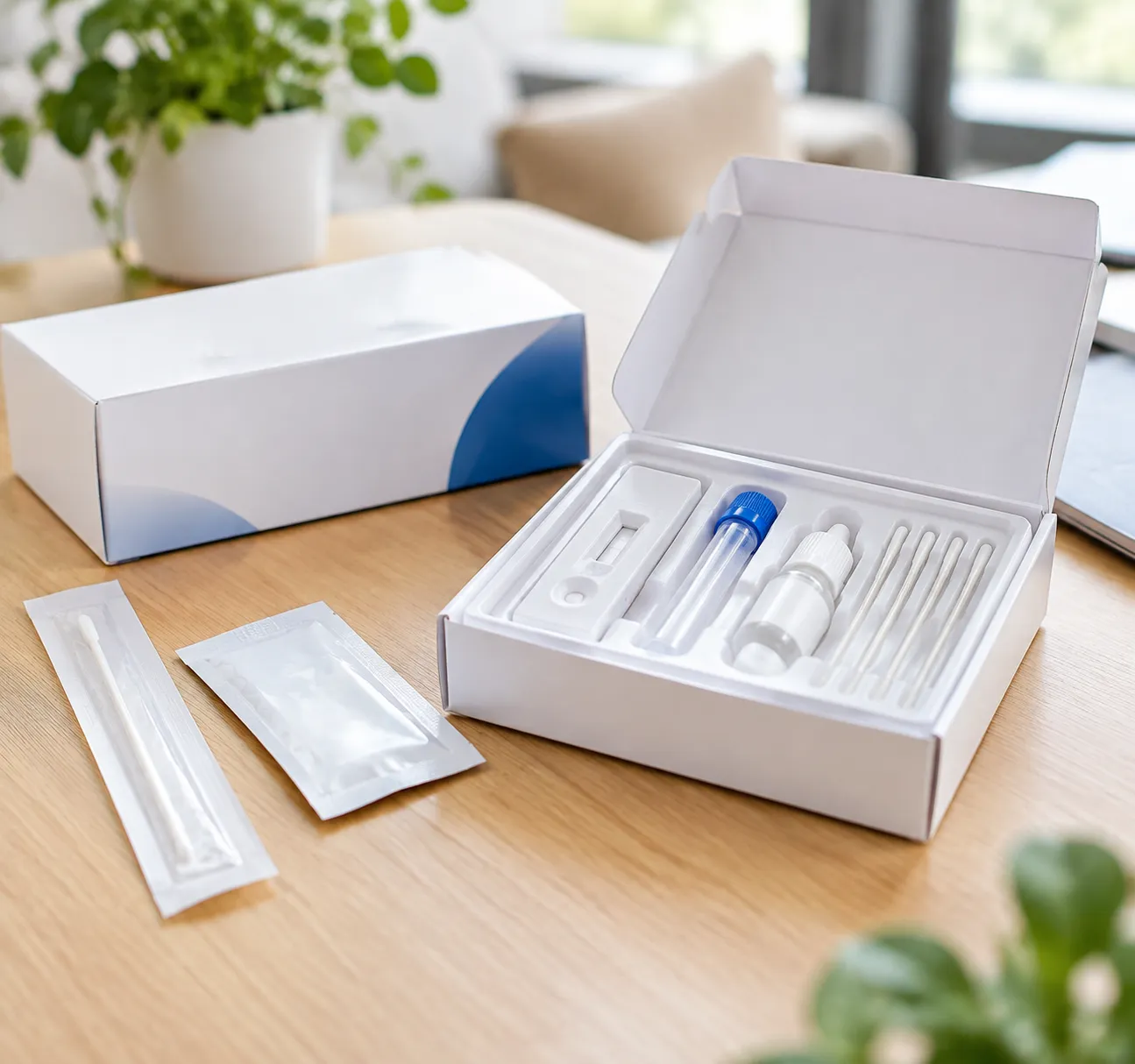
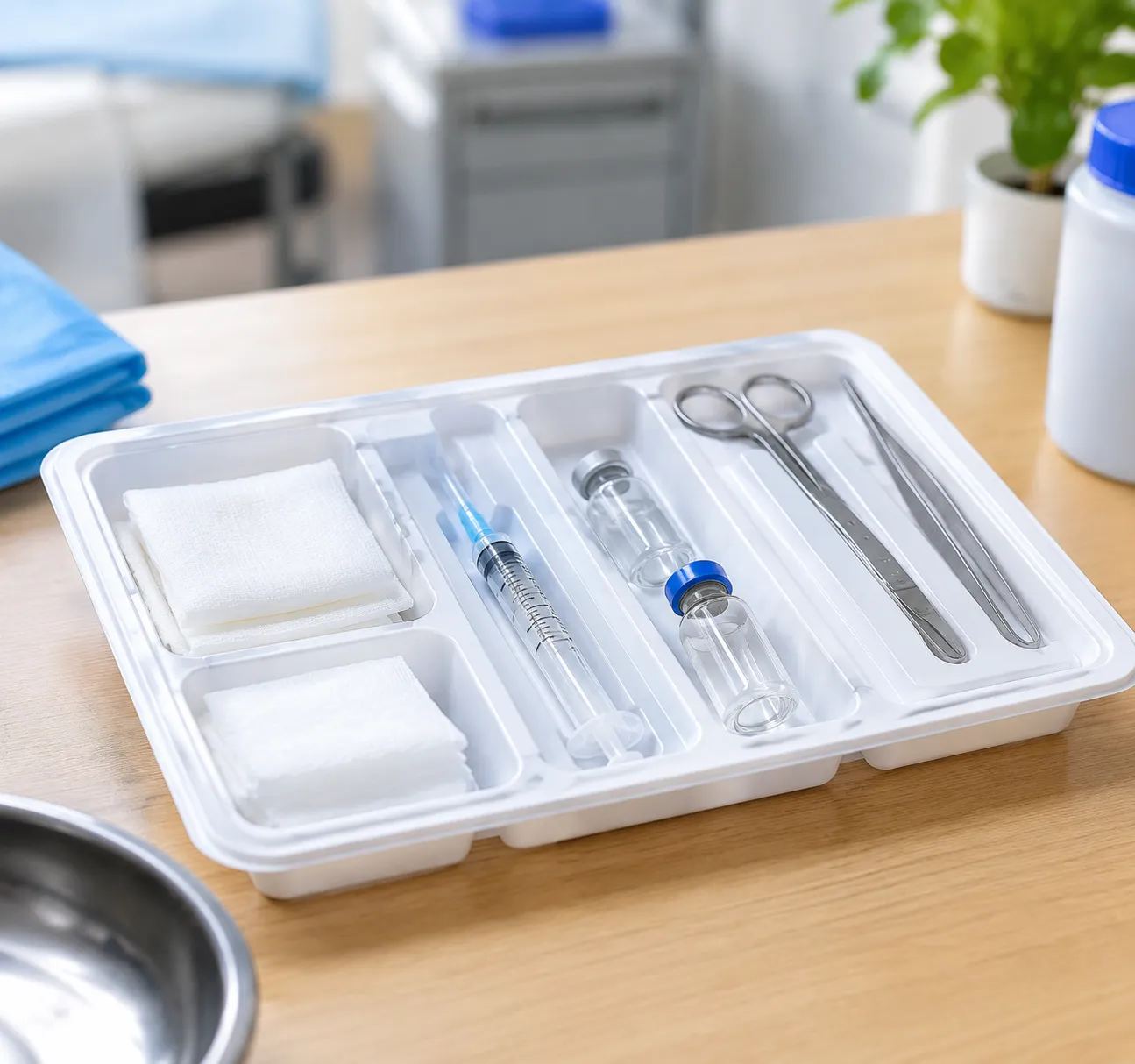
Formula details
Product Details
Overview
Custom Thermoformed Medical Trays: Concept to Commercialization
We engineer custom thermoformed medical trays tailored to the exacting geometry and functional demands of Class I, II, and III medical devices.
Device-Specific Cavity Engineering & Retention Mechanics
Precise cavity architecture is essential to prevent product migration, surface abrasion, and packaging failure during transit and aseptic transfer.
- Engineered Snap-Fits and Locking Undercuts: We design precise mechanical retention features that secure implants, sharp surgical tips, and delicate instruments firmly in place without compromising sensitive drug-eluting, silicone, or hydrophilic coatings.
- Integrated Denesting Lugs: Continuous-stack denest features prevent tray interlock, ensuring reliable single-tray separation on high-speed automated assembly lines and manual packaging stations.
- Ergonomic Finger-Access Recesses: Anatomically placed extraction points facilitate smooth, intuitive, and aseptic device presentation within the sterile surgical field, preventing glove snagging and particulate generation.
Rapid Prototyping & Multi-Cavity CNC Tooling
Our tooling infrastructure is built for speed, dimensional precision, and repeatable forming performance.
- In-House 3D CAD & DFM Analysis: We evaluate raw geometry, optimal draw ratios, draft angles, and localized thinning risks using advanced finite element modeling before cutting tool steel or aluminum.
- Functional Fit-Check Prototypes: We deliver 3D printed molds and high-density polyurethane prototype samples within 3 to 5 business days, allowing device development teams to perform real-world fit, drop, and transit testing early.
- Precision CNC Aluminum Tooling: Production tools are machined from premium-grade 6061-T6 aluminum with dedicated, multi-zone water temperature regulation. This thermal control ensures balanced material distribution, uniform nominal wall thicknesses, and flat, defect-free seal flanges across every cavity.
Biocompatible Medical Plastics & Sterilization Profiles
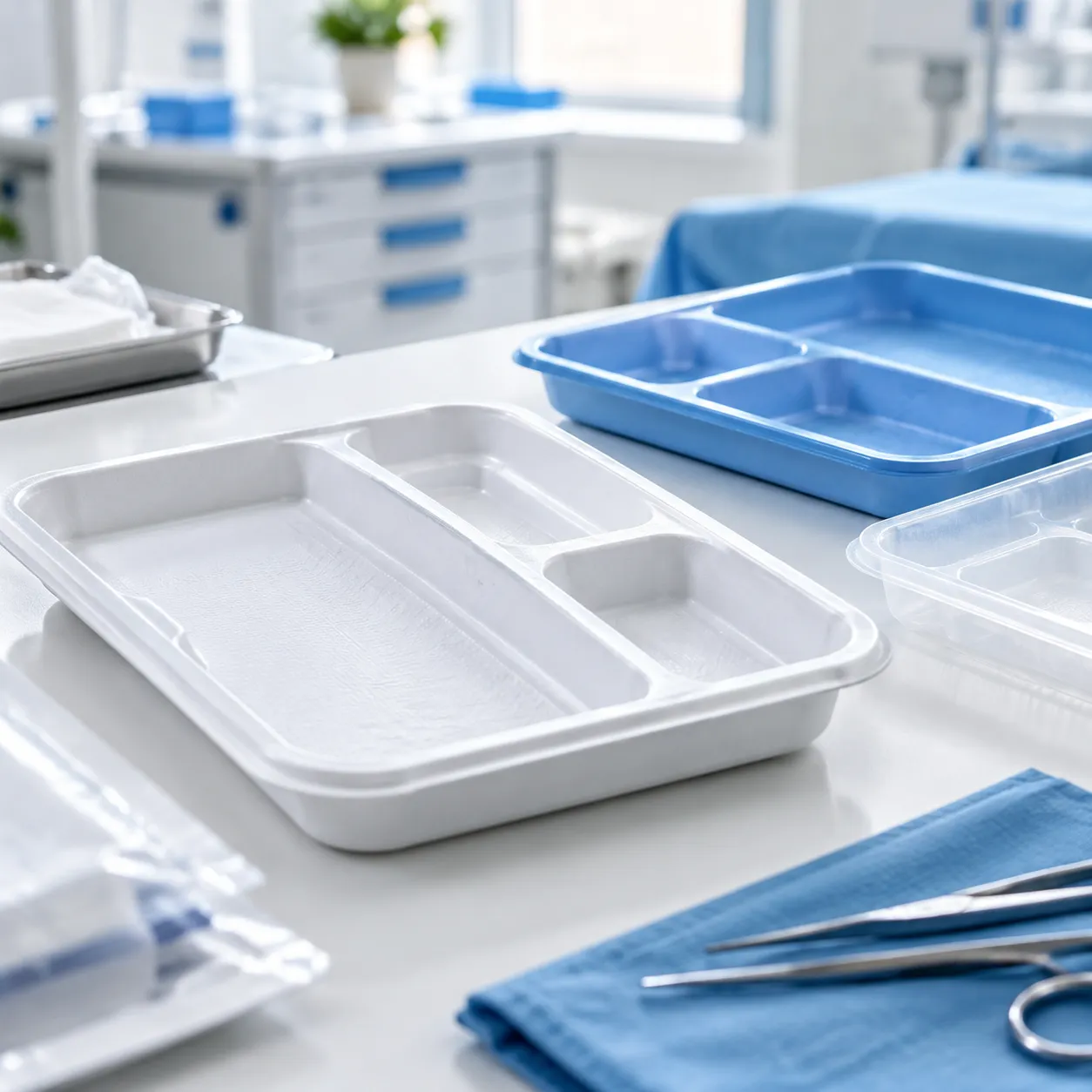
Medical-Grade Thermoplastic Substrates
- PETG (Polyethylene Terephthalate Glycol): The standard substrate for rigid medical packaging and medical grade PETG trays. Offers superior impact toughness, high clarity, low-temperature crack resistance, and consistent heat-sealing integrity against Tyvek lidding.
- APET (Amorphous Polyethylene Terephthalate): Cost-effective, high-clarity alternative tailored for diagnostic kits, labware, and non-implantable surgical tools.
- HIPS (High Impact Polystyrene): Excellent rigidity and moldability. Available in anti-static, static-dissipative, and conductive grades to protect electronic diagnostic components and fabricated pharmaceutical trays, such as specialized plastic vial trays for pharma lab storage and transport.
- Polycarbonate (PC) & Polypropylene (PP): PC provides ultra-high impact resistance and thermal stability, while medical PP offers superior chemical resistance and flexibility for parts requiring repeat steam sterilization.
Sterilization Compatibility Matrix
| Material Substrate | Ethylene Oxide (EtO) | Gamma / E-Beam Radiation | Steam Autoclave (121°C–134°C) | Primary Application Strengths |
|---|---|---|---|---|
| Medical PETG | Excellent | Compatible (Radiation-grade) | Not Recommended | High clarity, tough impact resistance, clean peel seals |
| APET | Excellent | Limited | Not Recommended | Rigid diagnostic kits, cost-efficient packaging |
| HIPS | Excellent | Good (Radiation-grade) | Not Recommended | Anti-static electronics packaging, opaque parts |
| Polypropylene (PP) | Excellent | Radiation-stabilized only | Excellent | Autoclavable procedural trays, living hinges |
| Polycarbonate (PC) | Excellent | Good | Excellent | Heavy orthopedic kit housings, extreme impact durability |
- Ethylene Oxide (EtO): We optimize tray flanges and venting geometries to ensure uniform gas penetration and rapid degassing when paired with porous Tyvek heat-seal barriers.
- Gamma & E-Beam Radiation: We specify radiation-stabilized resin formulations to prevent polymer embrittlement, color shifting, or stress cracking post-irradiation.
- Autoclave & Steam: Our high-heat PP and PC custom thermoformed medical trays maintain tight dimensional tolerances, rib integrity, and snap-fit engagement after repeated high-temperature steam cycles.
Sterile Barrier System (SBS) Configurations
We engineer custom thermoformed medical trays to maintain absolute sterility from final sealing through operating room presentation. Our sterile barrier system trays protect critical medical devices against dynamic transit stress, bioburden ingress, and seal degradation.
Single & Double Sterile Barrier Systems
High-risk applications require redundant protection to facilitate aseptic transfer directly into the sterile field. We design nested double sterile barrier trays specifically for orthopedic implants, cardiovascular catheters, and precision surgical instruments.
- Inner Tray (Primary Barrier): Features precision snap-fits and pocket geometry to lock the sterile device in place, eliminating micro-motion and abrasive particulate generation.
- Outer Tray (Secondary Barrier): Encloses the inner unit with dedicated clearance zones, protecting primary seals from mechanical shock and drops during global logistics.
- Aseptic Presentation: Integrated lift tabs and intuitive thumb notches allow circulating nurses to deliver the inner sterile unit cleanly to scrub personnel without surface contact breaches.
| Configuration | Typical Application | Key Functionality | ISO 11607 Compliance Benefit |
|---|---|---|---|
| Single SBS | Diagnostic kits, disposable surgical tools | Single rigid tray with die-cut Tyvek lid | Streamlined footprint, cost-effective terminal seal |
| Double SBS | Spinal implants, prosthetic joints, vascular delivery | Nested inner/outer tray combination | Safe OR transfer, dual aseptic protection zone |
Tyvek Lidding & Heat-Seal Optimization
A dependable seal prevents microbial ingress while ensuring smooth, clean peels without particulate shedding or substrate delamination. We match our rigid medical packaging designs with high-performance pharmaceutical cartridge nest and tub sterile packaging systems and heat-sealable lidding materials.
- Flange Geometry: Precision-machined, flat-surface sealing flanges maintain uniform heat distribution and consistent seal contact width across all cavity profiles.
- Material Compatibility: Optimized for heat-sealing with Tyvek 1073B (heavy/rigid devices), Tyvek 1059B (standard profile devices), and Tyvek 2FS (high-volume diagnostic packaging).
- Validated Seal Integrity: Engineered seal widths (typically 3.0mm to 6.0mm) achieve consistent peel-strength values (1.5 N/15mm to 3.5 N/15mm) to eliminate fiber tears, channel leaks, and sterile breaches during opening.
Cleanroom Manufacturing, Quality Control & Validation
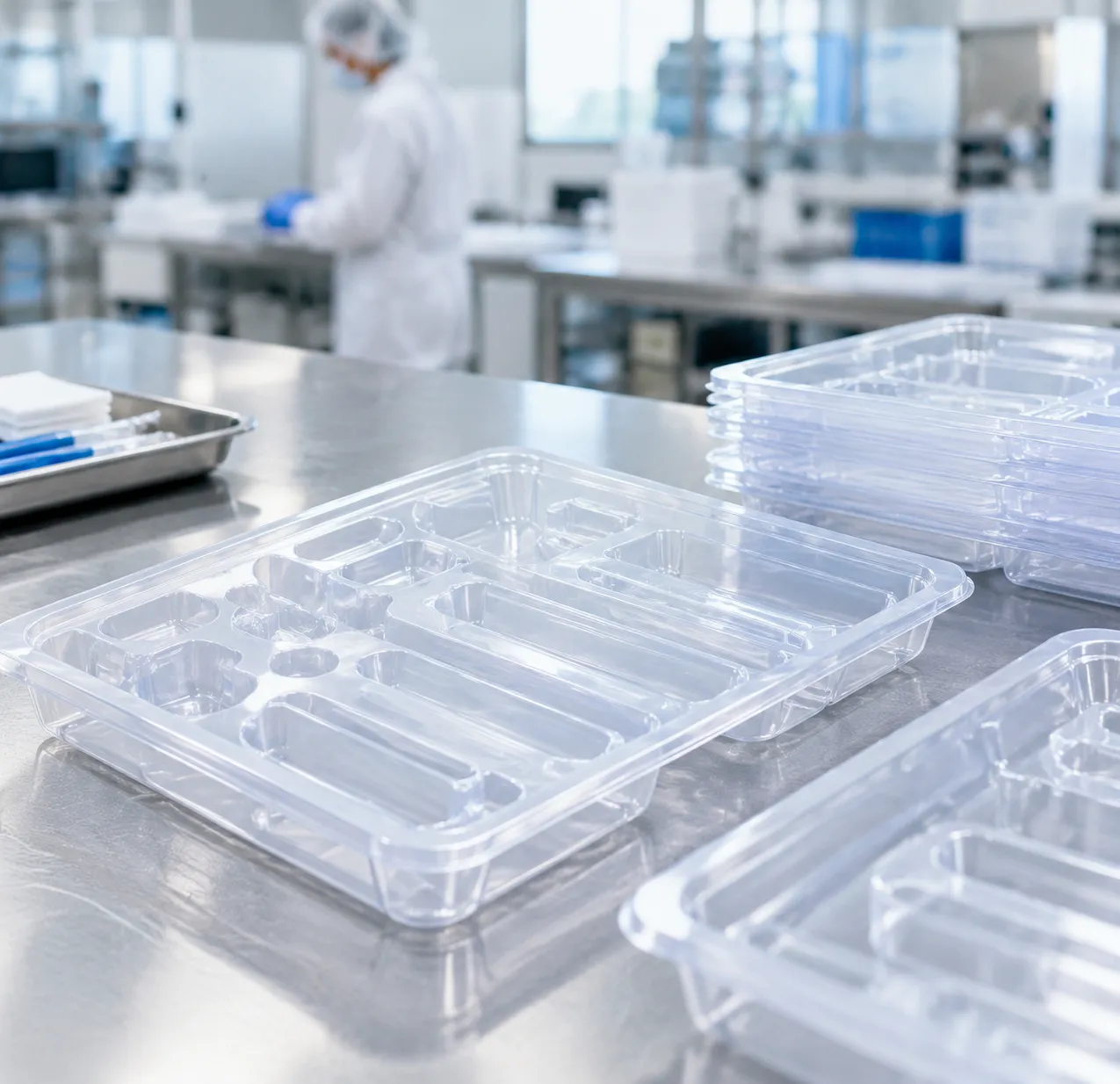
Controlled Environment Manufacturing
Our production infrastructure is built specifically for high-purity medical and pharmaceutical packaging:
- Certified Cleanrooms: Continuous thermoforming within certified ISO Class 7 and Class 8 cleanroom environments.
- Environmental Controls: Continuous real-time airborne particulate monitoring and positive pressure management.
- Bioburden Minimization: Validated sanitization routines and strict personnel gowning protocols minimize initial bioburden loads on all cleanroom thermoformed trays.
- Clean Utilities: Class-0 oil-free compressed air systems and automated particulate extraction prevent foreign material transfer during forming and trimming.
Quality Assurance & Regulatory Validation
We maintain an ISO 13485 quality management framework, ensuring full alignment with ISO 11607 standards for terminally sterilized medical packaging.
| Validation Parameter | Execution Standard & Method |
|---|---|
| Equipment & Tooling (IQ/OQ/PQ) | Validated Installation, Operational, and Performance Qualification packages for tools, sealers, and forming lines. |
| Inline Inspection | Automated high-resolution optical vision systems for critical flange width, cavity depth, and particulate screening. |
| Traceability & Materials | 100% complete resin lot traceability with certified raw material Certificates of Analysis (CoA) for every production lot. |
| Barrier Integrity Support | Dimensional verification ensuring consistent seal margins for primary sterile barrier systems and secondary assemblies like a vial box with inserts. |
Our bioburden-controlled plastic trays give medical device manufacturers the verifiable data and process consistency required for direct FDA 510(k), PMA, and CE mark regulatory submissions.
Custom Thermoformed Medical Trays: Industry Applications
We engineer custom thermoformed medical trays to meet the structural, sterile, and geometric requirements of sensitive medical products across specialized sectors.
Orthopedic & Spinal Implants
- Puncture-Resistant Geometries: Heavy-gauge medical grade PETG trays designed with reinforced walls and thickened corners to prevent sharp screws, fixation plates, and spinal rods from breaching the sterile barrier.
- Double Sterile Barrier Integration: Precision inner and outer tray nesting protects sterile fields during operating room transfers while keeping heavy titanium or PEEK implants locked in place.
Cardiovascular & Endovascular Devices
- Long-Format Catheter Trays: Extended footprint designs featuring continuous, snag-free winding tracks that hold coiled delivery systems, catheters, and guide wires without crimping.
- Low-Friction Retention: Custom snap-fits and channel profiles immobilize fragile balloon catheters and stent delivery systems without abrading drug-eluting or hydrophilic surface coatings.
Surgical & Diagnostic Instruments
- Multi-Cavity Procedural Organizers: Compartmentalized layouts for single-use surgical kits, trocar sets, biopsy punches, and ophthalmic instruments.
- Aseptic Presentation: Integrated finger-access recesses and ergonomic layout planning allow surgical staff to quickly extract instruments in high-pressure clinical environments.
Pharmaceutical & Drug Delivery Systems
- Syringe & Auto-Injector Nests: High-precision cavity tolerances engineered for automated pick-and-place lines, utilizing specialized prefilled syringe trays that eliminate glass-to-glass contact and flange damage.
- Vial Blisters & Cartridges: Stable, denesting-capable trays built to streamline the vial packaging process for vaccines, biologics, and diagnostic reagents requiring particulate-controlled handling.
Technical Specifications Guide for Custom Thermoformed Medical Trays
We manufacture custom thermoformed medical trays engineered to meet precise mechanical, dimensional, and regulatory criteria. From lightweight diagnostic inserts to heavy-duty orthopedic packaging, our material selection process aligns raw resin properties with device geometry, barrier requirements, and downstream sterilization cycles.
Material Resin Selection and Property Comparison
We process standard and medical-grade polymers in starting gauge thicknesses ranging from 0.25 mm to 2.0 mm (0.010" to 0.080"), providing uniform material distribution and structural rigidity across complex draw depths.
| Material Resin | Starting Gauge Range | Optical Clarity | Impact Resistance | Rigidity Rating | Sterilization Profile Compatibility |
|---|---|---|---|---|---|
| PETG | 0.38 mm – 1.80 mm | Crystal Clear (90%+ light trans.) | High (Puncture Resistant) | High | EtO, Gamma, E-Beam |
| APET | 0.25 mm – 1.20 mm | High Clarity | Moderate | High | EtO, Gamma (Low Dose) |
| HIPS (Anti-Static/Conductive) | 0.50 mm – 2.00 mm | Opaque (White, Black, Blue) | High (Tough) | Very High | EtO, Gamma, E-Beam |
| Polycarbonate (PC) | 0.50 mm – 2.00 mm | Clear / Transparent | Superior | Extreme | Steam Autoclave, EtO, Gamma |
| Polypropylene (PP) | 0.30 mm – 1.50 mm | Translucent / Semi-Clear | High | Moderate to High | Steam Autoclave, EtO, E-Beam |
Key Mechanical and Processing Parameters
- Gauge Control & Wall Thickness: Optimized tool venting and pressure-assist thermoforming maintain critical corner wall thicknesses above 40% of nominal starting gauge, eliminating thin spots around sharp device contours.
- Aseptic Handling Integration: Tray configurations can be paired with nested tub and tray aseptic processing solutions to streamline robotic pick-and-place automation, minimize particulate generation, and preserve sterile barrier performance.
- Optical Clarity vs. Sterility Compatibility: While PETG delivers exceptional optical clarity for operating room identification under EtO and radiation cycles, PC and medical-grade PP provide thermal resilience without warping during high-temperature steam autoclaving up to 121°C–134°C.
- Static Dissipation & Cleanliness: HIPS blends offer surface resistivity ratings from $10^9$ to 10¹¹ Ω/sq for electro-medical assemblies, preventing particulate attraction during automated loading.
The Custom Thermoformed Medical Trays Manufacturing Advantage
We deliver end-to-end engineering and production capabilities for rigid medical packaging, minimizing project lead times while ensuring strict regulatory compliance. Our team bridges the gap between complex device geometry and scalable commercial thermoforming.
Engineering & Tooling Capabilities
- Dedicated Packaging Engineers: In-house DFM (Design for Manufacturability) analysis to optimize draft angles, undercut retention, and uniform wall distribution.
- Rapid Prototyping: Functional 3D-printed and CNC sample tooling delivered within 3 to 7 business days for dimensional fit-checks and drop testing.
- Scalable Production Volumes: Seamless transition from pilot-run clinical batches to automated high-volume runs for complex products like custom PETG medical trays and diagnostic kit packaging trays.
- Turnkey Packaging Integration: Comprehensive matching of custom thermoformed medical trays with die-cut Tyvek lidding, including predefined heat-sealing temperature, pressure, and dwell parameters.
Manufacturing & Support Comparison
| Capability | Rapid Prototyping Stage | Full-Scale Commercial Production |
|---|---|---|
| Lead Time | 3–7 business days | 2–4 weeks from tool sign-off |
| Tooling Material | High-density polyurethane / RenShape / 3D resin | Precision multi-cavity CNC 6061-T6 aluminum |
| Environment | Engineering lab / Pilot clean space | Certified ISO Class 7 / Class 8 Cleanrooms |
| Batch Flexibility | 10 to 500 units for clinical trials | 10,000 to 1,000,000+ units per production run |
| Quality Deliverables | Initial CMM inspection & fit-check reports | Full IQ/OQ/PQ support, bioburden test reports, CoA |
Frequently Asked Questions About Custom Medical Trays
What materials are most recommended for heavy or sharp surgical instruments?
For heavy orthopedic implants, sharp cutting tools, or dense surgical hardware, we recommend high-gauge PETG (Polyethylene Terephthalate Glycol) or Polycarbonate (PC) in thicknesses ranging from 1.0mm to 2.0mm.
- Medical-Grade PETG: Delivers outstanding puncture resistance, high impact strength at low temperatures, and superior clarity for visual inspection.
- Polycarbonate (PC): Offers maximum rigidity, high heat deflection, and dimensional stability for dense metal assemblies and high-temperature steam autoclaving.
- Design Reinforcements: We incorporate structural ribbing, radius blending, and protective clearance pockets to prevent sharp device edges from puncturing the outer sterile barrier system during transit.
How is cleanroom compliance and bioburden control maintained during production?
We manufacture all custom thermoformed medical trays inside certified ISO Class 7 and Class 8 cleanrooms. Bioburden and particulate levels are controlled through rigorous protocols:
- Continuous Air Filtration: HEPA air-handling units provide constant positive pressure and rapid air exchange.
- Particulate Monitoring: Real-time continuous particle counters detect micro-contaminants at the forming and trimming stations.
- Process Purity: We utilize 100% oil-free compressed air, static-neutralization bars, and automated raw-material de-dusting.
- Personnel Protocols: Full cleanroom gowning, strict sanitation schedules, and validated microbiological bioburden testing on finished lots ensure compliance with ISO 11607-1.
Can IQ, OQ, and PQ documentation be provided to support FDA 510(k) submissions?
Yes. We supply comprehensive validation packages to streamline your regulatory filings, CE mark dossiers, and FDA 510(k) submissions:
- Installation Qualification (IQ): Verifies that thermoforming machinery, cleanroom utilities, and multi-cavity CNC molds are built and installed according to exact technical specifications.
- Operational Qualification (OQ): Establishes processing windows for heat zones, forming pressure, vacuum draw, and cycle times through Design of Experiments (DoE).
- Performance Qualification (PQ): Validates seal integrity, dimensional tolerances, and structural consistency across continuous, full-scale production runs.
- Traceability Records: Complete raw material Certificates of Analysis (CoA), biocompatibility reports (ISO 10993 / USP Class VI), and inspection records accompany every validated lot.
What is the typical turnaround time for custom tooling and prototype validation?
We optimize engineering workflows to shorten development lead times from concept to validation:
- 3D CAD Modeling & DFM Analysis: Delivered within 24 to 48 hours.
- Functional Prototypes: 3D-printed or polyurethane cast samples for physical fit-checks ship in 3 to 5 business days.
- Precision CNC Aluminum Tooling: Multi-cavity production molds with integrated vacuum channels are completed in 2 to 3 weeks.
- First Article Inspection (FAI): Full dimensional reports and cleanroom sample runs are provided immediately following initial tool qualification.
Are custom thermoformed medical trays compatible with automated pick-and-place equipment?
Our custom plastic medical trays are engineered specifically for high-speed automated packaging, pick-and-place robotics, and inline sealing lines.
- Precision Stacking Lugs: Prevent tray lock-up and ensure clean, reliable mechanical denesting.
- Strict Flange Tolerances: Engineered flat surfaces provide uniform contact during automated Tyvek heat-sealing.
- Dimensional Repeatability: Tight thermoforming tolerances guarantee exact positioning for robotic loading of medical devices, diagnostic kits, and custom pharmaceutical cartridges for injectable drugs.