
Formula details
Product Details
Overview
Common Types of HPLC Vial Boxes

Polypropylene Plastic Boxes for Daily Solvent Resistance
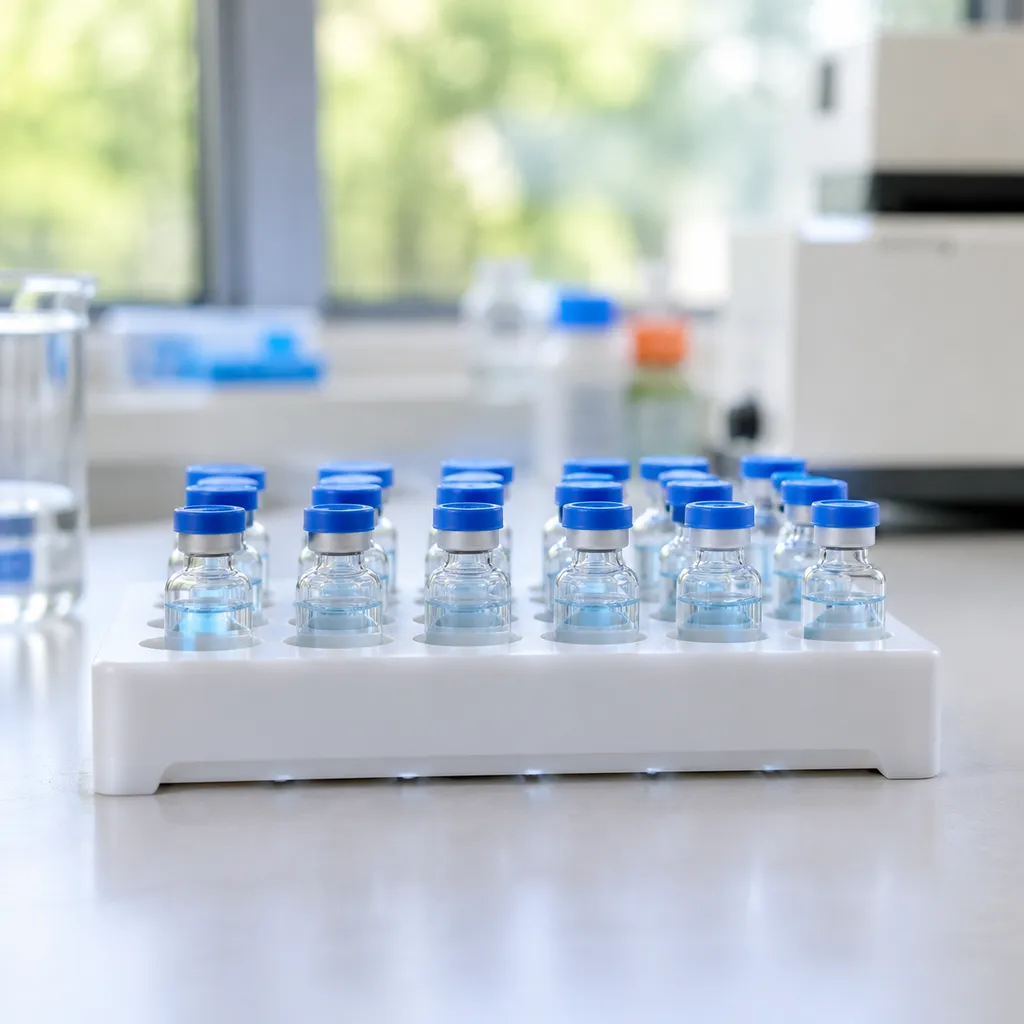
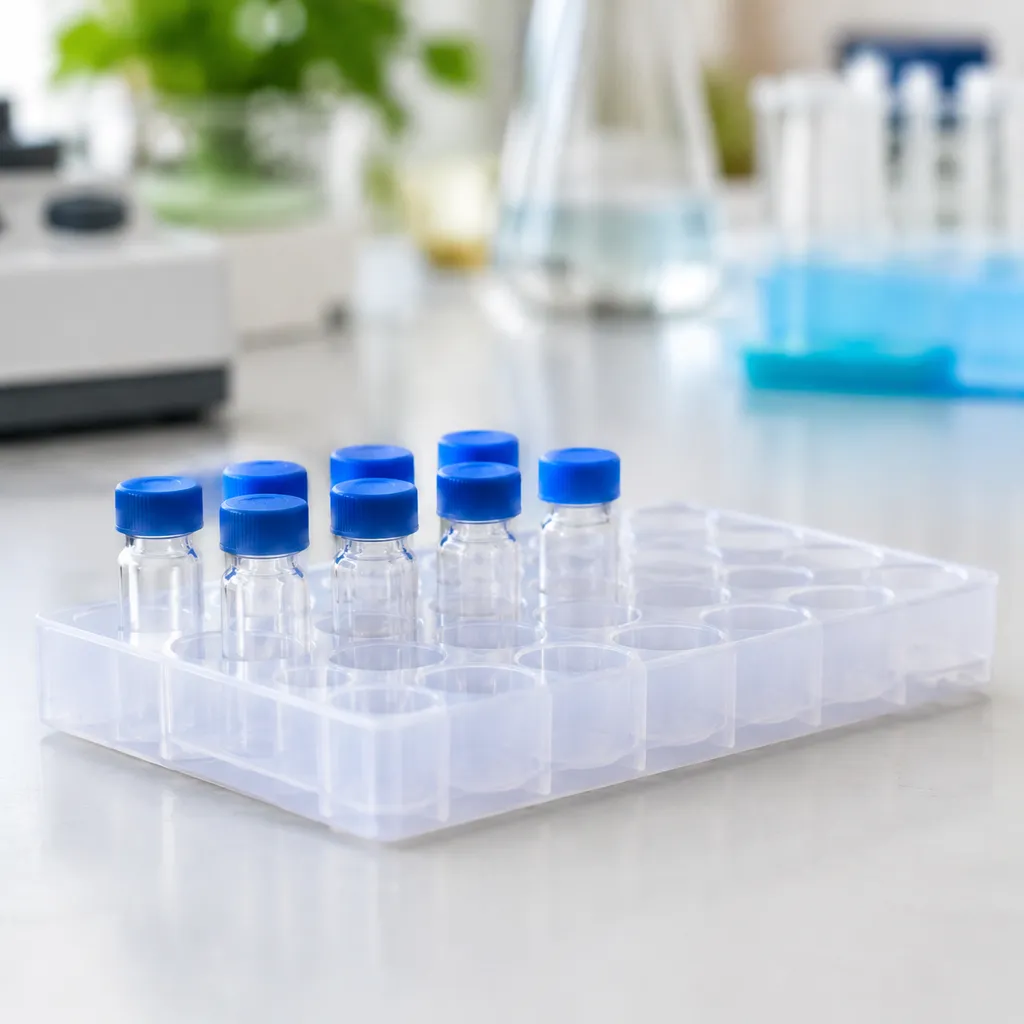
Virgin polypropylene serves as our standard for day-to-day analytical runs. A heavy-duty polypropylene vial box resists direct contact with aggressive mobile phases like acetonitrile, methanol, and THF without warping or hazing. The rigid well walls prevent vials from rattling during transit, making these boxes a dependable staple beside the autosampler. For high-volume facilities moving large sample sets between prep stations, integrating plastic vial trays for pharma lab storage and transport ensures stable handling across busy benches.
Cardboard and Water-Repellent Fiberboard Organizers
When managing large archival sample libraries, treated cardboard and fiberboard formats offer an economical solution.
Moisture-resistant coating: Repels bench condensation and light refrigerator dampness.
Removable grid inserts: Let you switch partition layouts or store odd-sized sample tubes.
Economical footprint: Low-cost archiving for completed projects and reference samples that do not require plastic housing.
Cryogenic Storage Boxes for Ultra-Low Temperature Freezers
Deep-freeze conditions make standard plastics brittle. We rely on specialized polymers engineered specifically for ultra-low temperature freezers down to -80°C.
High-impact resilience: Resists cracking when pulled directly from cold storage to room temperature.
Ventilation design: Built-in base and lid vents prevent pressure locks and facilitate rapid temperature equilibration.
Freezer rack compatibility: Sized to slide cleanly into standard freezer tower drawers, much like our compact vial packaging boxes for secure sample storage.
Light-Blocking Black and Amber Boxes for Photosensitive Compounds
Analytical targets such as vitamins, natural extracts, and photosensitive drug compounds degrade rapidly under standard laboratory lighting.
Full-spectrum protection: Opaque black and deep amber hplc vial box formats shield analytes from UV and ambient light degradation.
Clean workflow: Replaces messy foil wrapping on individual glass containers, keeping vial labels fully legible while maintaining sample stability from preparation to analysis.
Choosing the Right Capacity and Well Configuration for Your HPLC Vial Storage Box
Matching your sample volume to the proper grid setup prevents benchtop clutter and ensures your vials seat properly without wobbling or jamming. Whether you run daily routine assays or store thousands of reference standards, selecting the correct hplc vial box footprint keeps your analytical workflow smooth and predictable.
Standard 2ml Vial Layouts: 49-Place, 81-Place, and 100-Place Formats
Standard 1.5ml to 2.0ml autosampler vials (12×32 mm) dominate most chromatography workflows. We manufacture and configure our storage boxes to handle these dimensions securely, offering three primary well configurations:
- 81-Place Format (9×9 grid): This is the industry standard for analytical labs. The extra spacing between wells allows easy retrieval with gloved fingers or vial tweezers without bumping adjacent caps.
- 100-Place Format (10×10 grid): The go-to 100 well vial storage box for high-throughput screening and long-term sample archival. It maximizes every millimeter of bench and freezer space. When space optimization is critical, our dedicated 2ml vial box for lab storage delivers dependable sample containment without crowding caps.
- 49-Place Format (7×7 grid): A wider-spaced layout built for quick benchtop handling, batch grouping, or storing wider-profile micro-insert vials.
| Well Capacity | Grid Layout | Best Use Case | Vial Size Compatibility |
|---|---|---|---|
| 49-Place | 7 × 7 | Routine batch runs & wider-body vials | 12 × 32 mm (1.5ml / 2ml) |
| 81-Place | 9 × 9 | General analytical & QC sample trays | 12 × 32 mm (1.5ml / 2ml) |
| 100-Place | 10 × 10 | High-density archival & freezer racks | 12 × 32 mm (1.5ml / 2ml) |
| 25/36-Place | 5 × 5 / 6 × 6 | Headspace, volatile organics, & large volumes | 22.5 × 46 mm / 22.5 × 75 mm (10ml / 20ml) |
Headspace and Large-Volume Vial Boxes (10ml and 20ml)
Volatile organic analysis (VOA), headspace GC, and fraction collections require wider compartments than standard autosamplers. Using a forced fit into a 2ml grid cracks dividers and risks breaking valuable borosilicate glassware.
For 10ml and 20ml headspace vials (typically 22.5 mm in outer diameter), we build specific heavy-duty organizers using 25-place (5×5) or 36-place (6×6) grids. These deeper cavities support tall vial walls, keeping crimp tops and thick septa completely upright during transit. Review our 10ml and 2ml vial box dimensions guide to confirm exact cavity depth and diameter tolerances for your specific autosampler containers.
Compact Benchtop Footprints vs. High-Density Freezer Rack Storage
Laboratory real estate is always at a premium. Choosing between open benchtop organizers and enclosed freezer units comes down to environmental exposure and rack modularity:
- Standardized 133×133 mm Footprint: Our standard hplc vial storage box lines use an exterior footprint of 130 mm to 133 mm (approx. 5¼ inches). This global standard slips straight into standard upright and chest freezer rack towers without catching on shelf lips.
- Vertical Stacking Stability: Molded base ridges lock directly into lid recesses. This eliminates slipping when carrying stacks across the laboratory or layering boxes inside deep-freeze chests.
- Low-Profile Bench Trays vs. Deep Lids: For samples being prepped directly for the autosampler carousel, lower-profile open trays allow fast loading. For samples bound for storage, choose high-clearance lids that close fully over 9mm screw caps, crimp seals, and snap caps without compressing the septa.
Must-Have Features in an HPLC Vial Storage Box

Choosing the right hplc vial storage box comes down to real bench practicalities: avoiding sample mix-ups, surviving harsh solvents, and holding up under extreme temperature swings.
Alphanumeric Grid Indexing on Lids and Bases
We look for high-contrast, laser-etched, or molded alphanumeric indexing printed on both the inner grid and the top lid.
Prevents sample misalignment when working between 96-well sequences and autosampler trays.
Eliminates the need to mark plastic directly with laboratory markers that smear over time.
Ensures quick position verification (A1 through J10 in standard 100-well configurations).
Hinged Lids vs. Lift-Off Friction Lids
Both designs serve distinct benchtop functions:
Hinged Lids: Stay attached so you never misplace the cover or set it down on a dirty surface. They are ideal for rapid loading directly from prep stations.
Lift-Off Friction Lids: Save valuable bench space because they detach entirely, reducing tipping hazards around tight autosampler decks. For external transport, an enclosed custom vial sample box for safe storage and shipping keeps lids firmly clamped in transit.
Chemical and Thermal Tolerance Specs
A durable hplc vial box must withstand constant exposure to volatile mobile phases like acetonitrile (ACN), methanol (MeOH), and tetrahydrofuran (THF) without hazing, softening, or cracking.
| Feature | Standard Requirement | Practical Laboratory Benefit |
|---|---|---|
| Material Build | Medical-grade Polypropylene (PP) | High resistance to ACN, MeOH, DMSO, and dilute acids |
| Thermal Range | -80°C to +121°C | Transitions seamlessly from ultra-low freezers to autoclaves |
| Lid Clearance | Fits 12×32 mm profiles | Closes securely over both 9mm screw caps and 11mm crimp tops |
| Autoclave Cycle | 15–20 min at 121°C (15 psi) | Reusable and sterilizable without dimensional warping |
Best Practices to Organize Your HPLC Samples
Color-Coded Workflow Sorting
We rely on visual cues to instantly identify sample status across busy analytical teams:
Assign by Project or Client: Use distinct box colors (blue, green, red, yellow) to separate stability trials, method development, and batch release runs.
Track Analyst Runs: Dedicate specific colored organizers to individual chemists to avoid benchtop mix-ups during multi-user shifts.
Stage Sequence Queues: Designate clear box lids for prep stages, separating prepped sample queues from completed autosampler runs.
Frost-Resistant and Solvent-Proof Labeling
Standard laboratory tape and common markers peel or smudge quickly when exposed to methanol, acetonitrile, or sub-zero freezer cycles.
Solvent-Resistant Cryo Markers: Always mark external index labels with industrial alcohol-resistant pens that will not fade during solvent vapor exposure.
Side-Wall and Lid Indexing: Duplicate box IDs on both the lid rim and the box side wall. Lids can easily get swapped across open workstations.
Thermal Transfer Cryo Labels: When storing samples at -20°C or -80°C, apply cryo-rated labels to your hplc vial box to prevent adhesive detachment under frost buildup.
Segregating Raw Extracts from Run-Ready Vials
Cross-contamination often occurs during sample transfer and staged waiting periods. Keep unclarified, crude matrix vials entirely physically separated from filtered, autosampler-ready aliquots. Understanding the workflow distinction between containment levels—much like how primary vs. secondary packaging for vials explained isolates direct container risks—ensures your filtered extracts remain clean and ready for immediate autosampler sequencing. Always cap empty grid spots with clean dummy vials if your testing involves volatile analytes that might leach into adjacent wells.
Cleaning, Maintenance, and Reusability of Your HPLC Vial Storage Box
Reusing your sample storage hardware saves lab budget, but poor maintenance leads to cross-contamination or warped grids. We treat every hplc vial storage box as precision bench equipment to extend its usable lifespan across analytical campaigns.
Safe Cleaning Solutions for Residue Removal Without Cracking Plastics
Solvent residue from autosampler runoffs can degrade plastic over extended exposure. Keep these cleaning guidelines in mind:
- Routine Decontamination: Rinse with warm deionized water followed by a 70% isopropanol (IPA) or ethanol wipe down. This strips sample residue without clouding polycarbonate or polypropylene surfaces.
- Neutral Lab Detergents: Use dilute, neutral-pH laboratory detergents for stubborn biological residues. Ultrasonic baths work well, but limit cycles to 10 minutes to avoid surface pitting.
- Solvents to Avoid: Never soak an entire polypropylene vial box in acetone, pure THF, or dichloromethane. While PP offers broad chemical tolerance, long-term direct solvent exposure causes micro-cracking, crazing, and embrittlement.
- Removable Grids: For deep cleaning between dirty runs, using a dedicated vial box with inserts allows you to separate the well dividers from the outer shell to scrub trapped liquid from corners.
Autoclave Protocols to Maintain Structural Shape
Sterilizing an autoclavable storage box requires careful handling to prevent dimensional warping:
- Cycle Parameters: Run standard steam sterilization cycles at 121°C (250°F) under 15 psi for 15 to 20 minutes.
- Venting Is Critical: Never autoclave a sealed hplc vial box. Unlatch hinged lids and set friction lids loose on top of the base. Trapped pressure and rapid cooling will warp the grid spacing, making automated autosampler pickup misaligned.
- Cool-Down: Allow the boxes to return to room temperature naturally inside the autoclave chamber. Cold-water quenching causes immediate plastic stress and uneven shrinkage.
When to Retire and Recycle Warped or Degraded Vial Organizers
Holding onto compromised labware leads to dropped vials and delayed runs. We recommend discarding and recycling your chromatography vial organizer when you spot these warning signs:
| Defect Sign | Primary Cause | Operational Risk | Action |
|---|---|---|---|
| Bowed Well Floors | High autoclave heat or overloading | Autosampler needle collision | Recycle immediately |
| Faded Alphanumeric Grid | Repeated solvent wiping | Sample logging errors | Reassign to non-critical waste |
| Cracked Latches/Hinges | Deep-freeze thermal shock | Lid opens during transport | Replace box |
| Opaque, Crazed Lids | Aggressive chemical exposure | Obscured vial indexing | Retire from workflow |
HPLC Vial Storage Box FAQs
Can standard polypropylene HPLC vial boxes survive a -80°C freezer?
Standard virgin polypropylene boxes easily handle typical -20°C freezer runs, but taking them down to -80°C requires specific thermal conditioning. Standard plastics turn brittle at ultra-low temperatures, which can lead to stress cracks on the hinges or base corners if dropped. For long-term deep-freeze storage or vapor-phase setups, we recommend using a specialized cryo vial storage box for liquid nitrogen freezers that uses modified resins formulated to resist thermal shock and prevent brittleness.
Do these storage boxes fit both 9mm screw cap and 11mm crimp top vials?
Yes. The key dimension for an HPLC vial storage box is the outer diameter and height of the vial body, not the closure style. Both 9mm screw-thread vials and 11mm crimp-top or snap-ring vials share the industry-standard 12×32 mm footprint. Our standard well grids are engineered with a 12.5 mm to 13 mm cell diameter, allowing both capped styles to slide in smoothly without sticking or tilting during transit.
How do I protect light-sensitive analytes if my storage box is translucent?
When working with light-sensitive compounds (such as vitamins, polyaromatic hydrocarbons, or light-degrading active pharmaceutical ingredients), translucent boxes provide convenient sample visualization but zero UV protection. To safeguard photosensitive samples, you have two practical paths:
- Amber autosampler vials inside clear boxes: Provides standard photoprotection while still letting you view liquid levels.
- Solid opaque or amber polypropylene boxes: Blocks light completely across UV-Vis spectra, shielding both clear and amber glass vials from ambient benchtop fluorescent light and cleanroom UV systems.
What is the main difference between an HPLC vial rack and a storage box?
While analysts often use the terms interchangeably on the bench, they serve distinctly different roles in chromatography sample prep and archival workflows:
| Feature | HPLC Vial Storage Box | Open HPLC Vial Rack |
|---|---|---|
| Enclosure | Fully enclosed with hinged or lift-off lid | Open-top design with exposed caps |
| Primary Use | Long-term storage, transport, freezer storage | Immediate autosampler loading & pipetting |
| Protection | Guards against dust, solvent spills, and drops | Holds vials upright during reagent addition |
| Stackability | High; interlocking lids allow multi-tier stacking | Limited; cannot stack securely while loaded |
| Sample Security | Alphanumeric grid indexing with locked lid positions | Quick benchtop staging for active analytical runs |
An hplc vial box acts as your analytical archive, sealing your run-ready sequences against contamination, temperature swings, and workspace clutter.