Vial Box with Inserts Product Info and Reviews
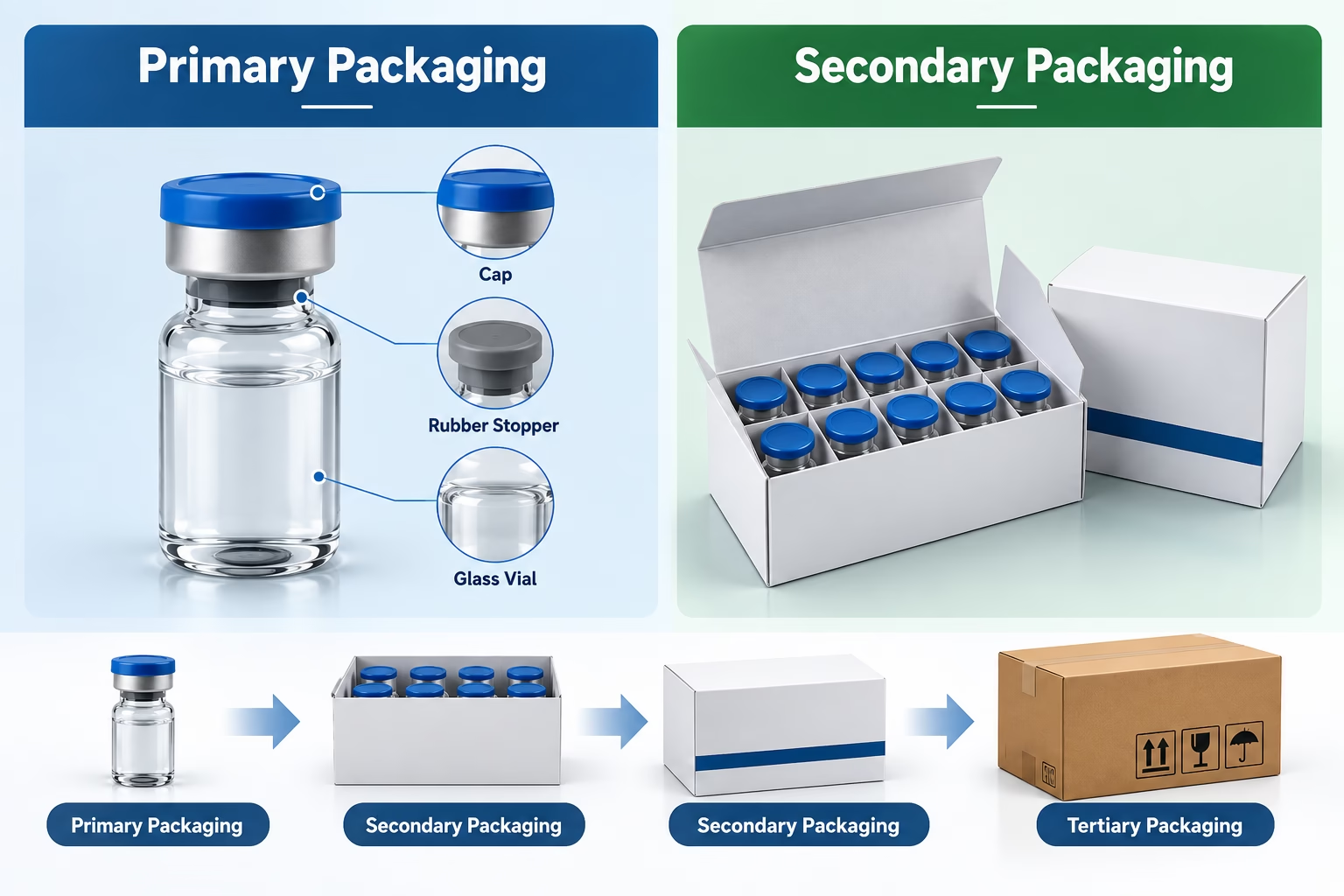
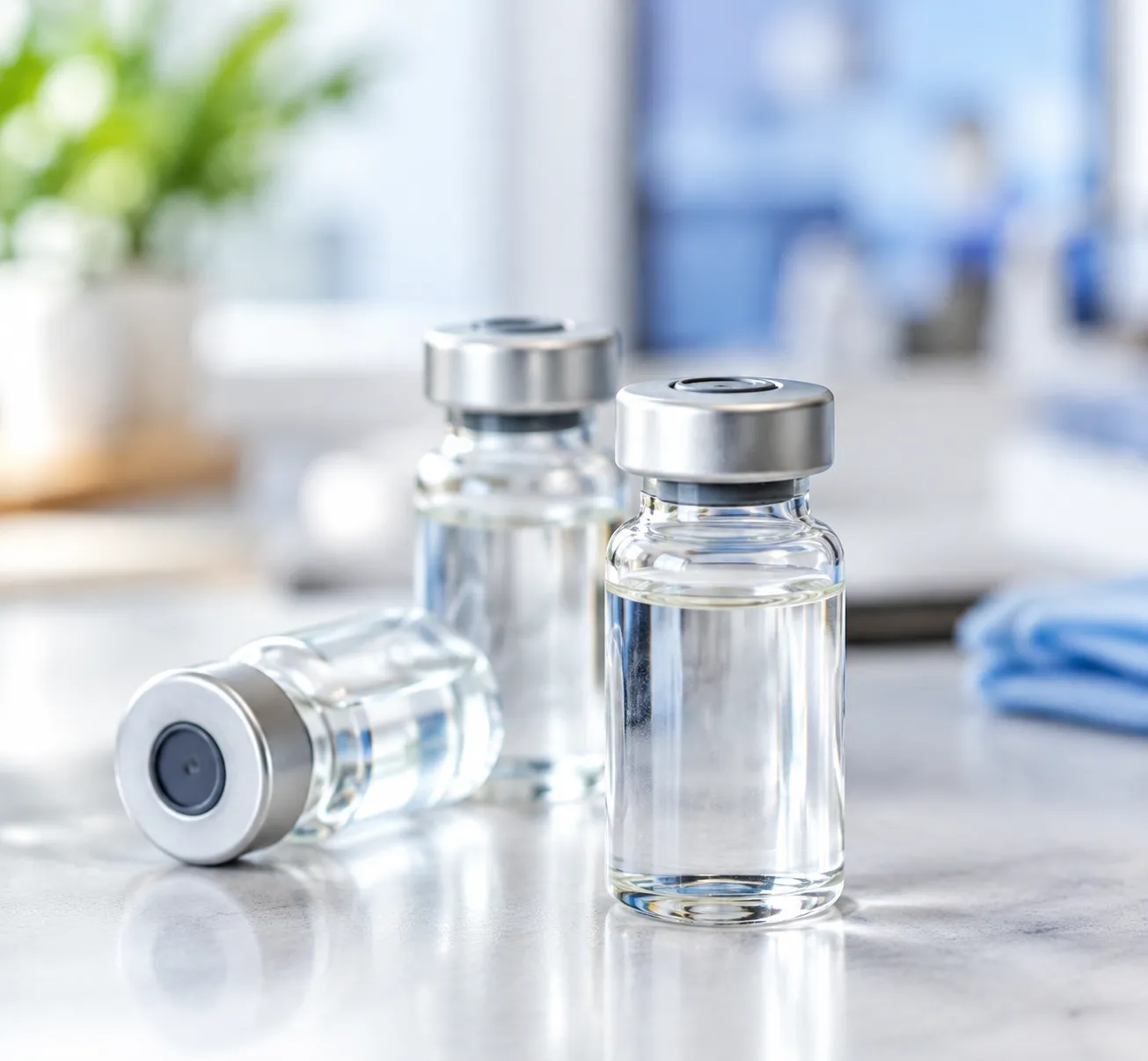
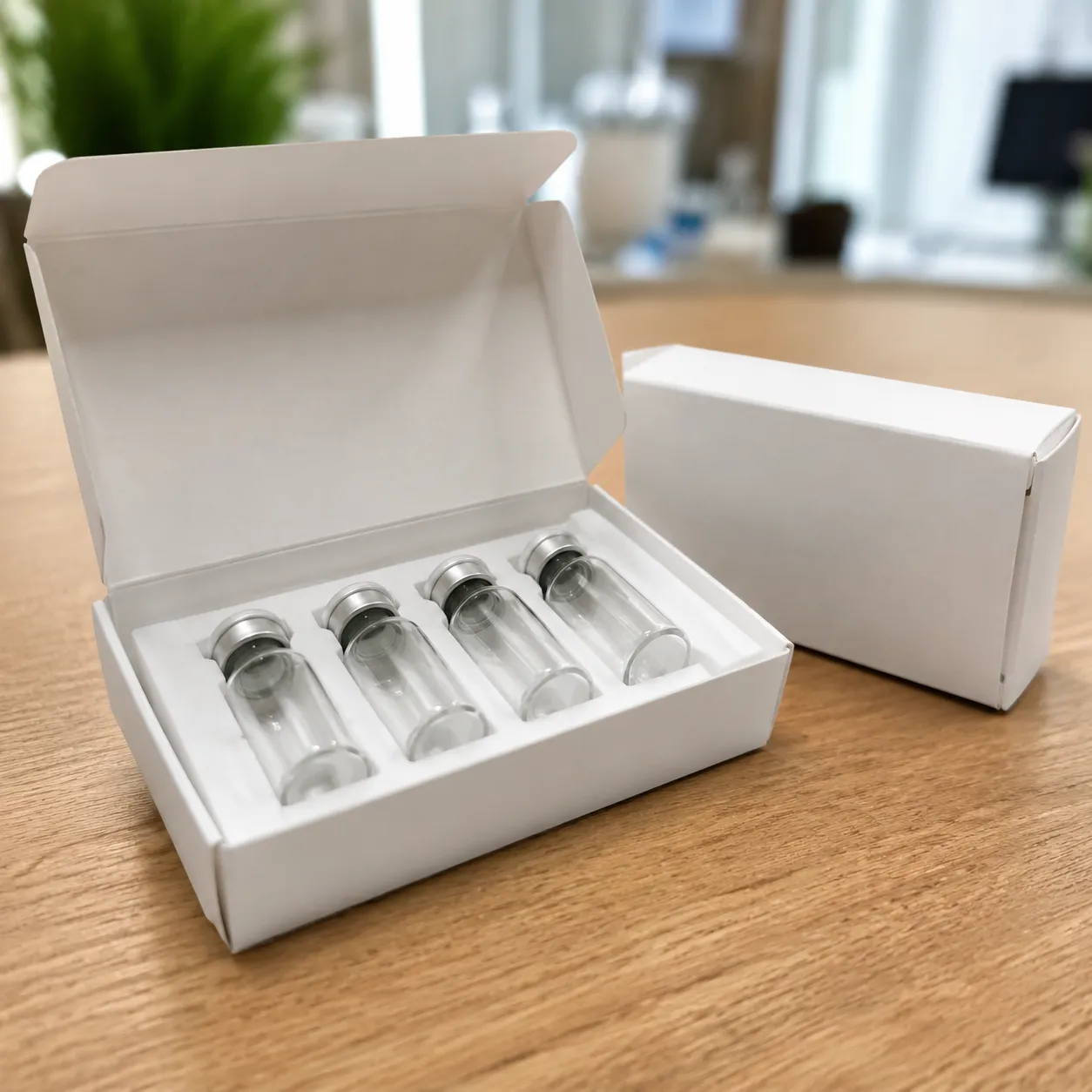
Glass vials holding sensitive serums, peptides, reagents, or essential oils face constant breakage risks during transit. We manufacture precision-engineered custom vial packaging paired with protective inserts to secure every glass bottle from production line to end-user.
+-------------------------------------------------------------------+
| OUTER RIGID BOX |
| +-------------------------------------------------------------+ |
| | CUSTOM DIE-CUT INSERT | |
| | [ Vial 1 ] [ Vial 2 ] [ Vial 3 ] [ Vial 4 ] | |
| | (2ml-30ml) (2ml-30ml) (2ml-30ml) (2ml-30ml) | |
| +-------------------------------------------------------------+ |
+-------------------------------------------------------------------+
Comprehensive Product Specifications & Structural Options
| Specification Parameter | Standard Options | Custom Capabilities |
|---|---|---|
| Vial Capacity | Single-vial, 2-vial, 5-vial, 10-vial sets | Mixed kits (vials + droppers + syringes) |
| Compatible Sizes | 2ml, 5ml, 10ml, 15ml, 20ml, 30ml | Custom bottle diameters & heights |
| Box Styles | Magnetic rigid, Lift-off lid, Drawer, Tuck-end | Custom geometric & book-style shapes |
| Board Caliper | 800gsm to 1800gsm greyboard | Virgin kraft & duplex white back |
| Lining / Wrapper Paper | 157gsm coated art paper, specialty paper | Soft-touch paper, metallic foil paper |
| Surface Finishes | Anti-scratch matte, Gloss lamination | Spot UV, Foil stamping, Embossing |
Standard & Custom Vial Size Compatibility (2ml to 30ml and Multi-Bottle Configurations)
We manufacture packaging calibrated to industry-standard and proprietary glass vial profiles:
- Small Volume (2ml & 5ml): Tailored for diagnostic samples, cosmetic ampoules, and concentrated peptide solutions. Cavities provide a firm grip on narrow bases.
- Mid-Range Volume (10ml & 15ml): The industry standard for 10ml vial box with insert designs used in cosmetics, essential oils, and medical testing.
- Large Volume (20ml & 30ml): Deep cavity structures built for tinctures, bulk serums, and chemical solutions.
- Multi-Vial & Kit Layouts: Configured in linear rows, paired grids, or combined with accessories like droppers, mixing vials, and application tips.
Primary Box Styles & Architectural Strengths
Choosing the right structural layout ensures smooth dispensing and robust protection:
- Magnetic Closure Rigid Box: Book-style opening with concealed neodymium magnets. Delivers high structural rigidity and a premium unboxing experience.
- Two-Piece Lid-and-Base Box: Classic telescoping design. Provides double-wall side reinforcement for heavy multi-vial collections.
- Slide Drawer Box: Sleeve-and-tray construction with pull ribbons. Keeps vials upright and protected during repetitive access.
- Tuck-End Folding Carton: Lightweight, flat-shipping paperboard option for single-bottle secondary retail packaging.
Premium Substrates & Board Calipers
- Rigid Greyboard (800gsm – 1800gsm): Dense, crush-resistant core that resists stacking pressure during export shipping.
- Coated Art Paper (128gsm – 157gsm): Smooth wrapper surface providing clean four-color CMYK and PMS printing fidelity.
- Natural Kraft Stock: Unbleached, sustainable board offering strong tear resistance with an eco-conscious look.
- Specialty Textured Stocks: Embossed, pearlized, and deep-dyed black boards for luxury aesthetic requirements.
Surface Treatments & Custom Branding Finishes
- Anti-Scratch Matte Lamination: Shields dark packaging surfaces from scuffs, fingerprints, and abrasive transit wear.
- High-Gloss Lamination: Amplifies color depth and creates a reflective, moisture-resistant barrier.
- Precision Spot UV: Accentuates logos, brand patterns, and technical text with raised, high-gloss contrast.
- Hot Foil Stamping: Applies crisp metallic finishes in gold, silver, holographic, or rose gold foils.
- Embossing & Debossing: Adds tactile dimensional relief to brand marks and clinical certification badges.
Detailed Insert Material Breakdown: Choosing the Right Protection
We engineer and manufacture four primary insert types tailored to specific product vulnerabilities, budgets, and unboxing standards.
High-Density Die-Cut EVA Foam
EVA (Ethylene-Vinyl Acetate) foam is our premier recommendation for medical reagents, peptides, and high-end cosmetic vials.
Shock Absorption: Dense closed-cell structure absorbs heavy drop impacts and vibrations.
Precision Edges: CNC and laser die-cutting yield crisp, tight-tolerance cavities that lock each vial firmly into place.
Surface Upgrades: Available with laminated velvet, plush flocking, or printed art paper toppers for a high-end presentation.
EPE Foam and Flexible Polyurethane Sponge
For fragile ampoules and lightweight glass containers, softer foam options provide gentle, resilient cushioning.
EPE (Expanded Polyethylene): Semi-rigid, non-abrasive, and highly cost-efficient for multi-vial master packs.
Open-Cell Sponge: Soft and compressible, making it ideal for packaging kits that include irregular glass dropper assemblies and syringes alongside vials.
Thermoformed Blister Trays
Rigid plastic inserts made from medical-grade PET, PVC, or PP deliver clean-room compatibility and structural rigidity.
Snap-Fit Retention: Engineered with micro-detents that click vials securely into individual slots, preventing lateral displacement.
High Efficiency: Lightweight and stackable, our plastic vial trays for pharma lab storage and transport drastically reduce volumetric shipping weight for bulk international supply chains.
100% Recyclable Paperboard Grid Dividers & Molded Pulp
For sustainability-focused brands requiring plastic-free packaging, structured paper solutions offer solid partition protection.
Interlocking Cardboard Grids: Custom-slotted folding partitions that isolate 10ml to 30ml bottles to stop transit scuffing.
Molded Pulp Trays: Biodegradable, thermoformed fiber trays offering contoured drop cushioning with zero synthetic resins.
Comparative Matrix: Insert Properties vs. Protection vs. Cost
| Insert Material | Shock Resistance | Visual Presentation | Unit Cost Tier | Primary Application |
|---|---|---|---|---|
| High-Density EVA Foam | Exceptional | Premium / Luxury | Mid to High | Peptides, clinical reagents, luxury serum vials |
| EPE / PU Sponge | High | Standard / Functional | Low to Mid | Large multi-vial transport packs, diagnostic kits |
| PET/PVC Blister Trays | Moderate–High | Clinical / Clean | Low (in high volumes) | Medical laboratories, automated filling lines |
| Paperboard Grid Dividers | Moderate | Minimalist / Eco-Friendly | Lowest | Essential oils, bulk pharmaceutical distribution |
Balancing structural performance against your per-unit target is straightforward when matching the right substrate to your transit risks. Reviewing our comprehensive breakdown on vial packaging cost custom wholesale boxes with inserts helps optimize material choices before entering mass production.
Engineering & Quality Standards for Protective Vial Packaging
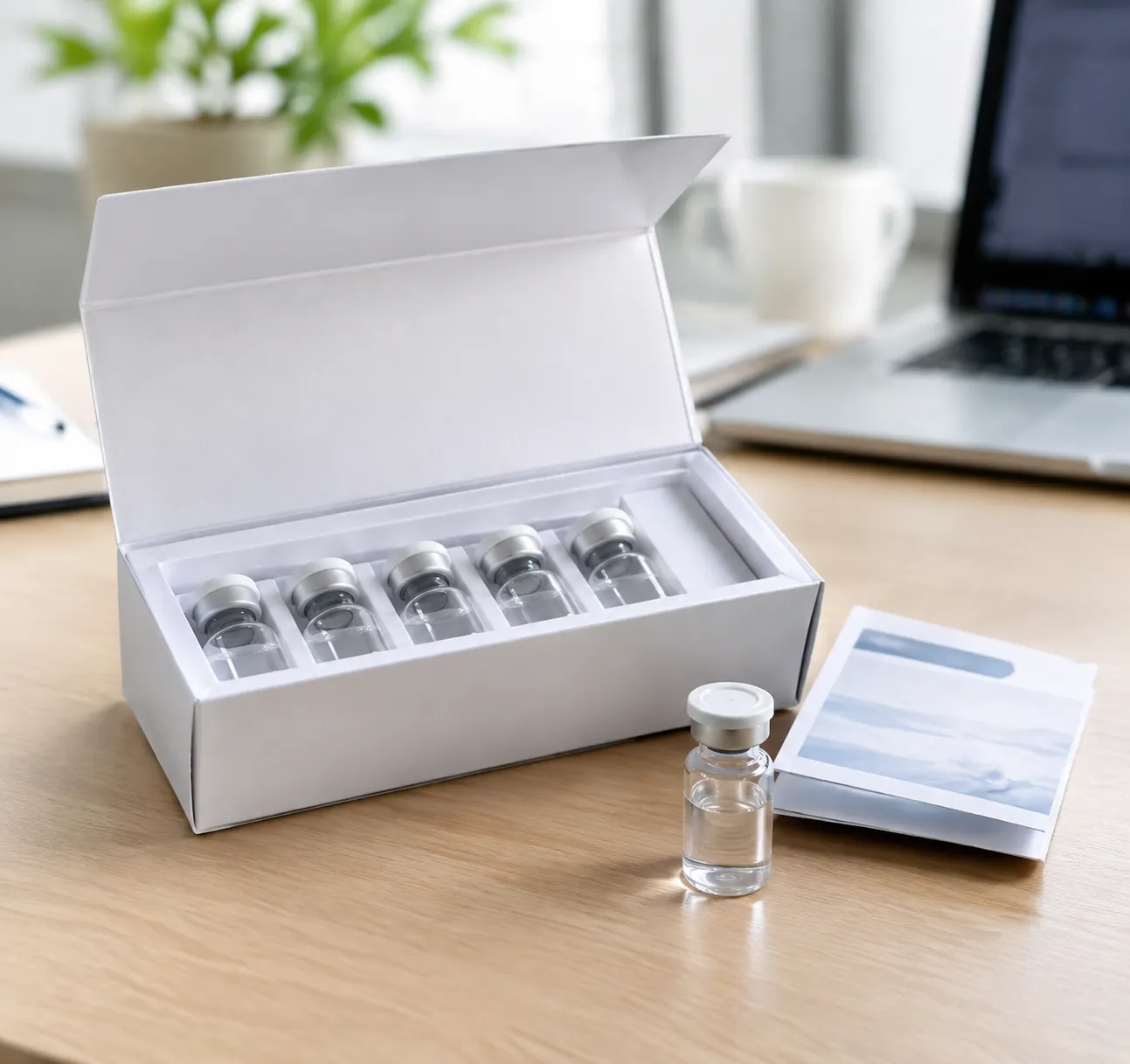
Precision Die-Cutting Tolerances (±0.5mm Fit)
Loose compartments cause liquid leaks, label scratching, and glass-on-glass collisions during courier transport.
- Snug Cavity Fit: We calibrate our high-speed die-cutting machines to maintain tolerances within ±0.5mm, holding each container firmly around the base, shoulder, and crimp cap.
- Custom Clearance Depths: Cavity cutouts align precisely with bottle heights, preventing vertical shifting when boxes sit upright or upside down.
- Specialized Lab Fitouts: For sensitive diagnostic serums and small-format samples, designs like our 2ml vial box for lab storage and serum packaging lock delicate glass in place without requiring aggressive force to insert or remove.
Drop-Testing & Transit Vibration Simulation
We test our secondary packaging structures against rough logistics environments, not just warehouse shelves:
- Drop-Test Certified Structures: Prototyped boxes undergo multi-angle drop tests according to ASTM and ISTA packaging protocols, absorbing shocks directly through high-density inserts rather than transferring kinetic energy to the glass.
- Vibration Resistance: Multi-bottle dividers isolate each container, keeping friction minimal to stop label fading and seal loosening during road, air, and ocean freight.
Raw Material Inspection & Batch-to-Batch Quality Control
Consistent protection requires reliable base materials across every production run:
- Greyboard & Paper Density Checks: We inspect paperboard caliper, density, and moisture content before mounting to prevent warping in high-humidity shipping routes.
- Foam Integrity & Odor Control: Our EVA and EPE foam batches are tested for resilience, uniform cell structure, and low-VOC emissions, keeping delicate pharmaceutical, lab, and cosmetic formulations free from chemical odors.
- In-Line Finishing Audits: Every production batch undergoes manual checks for foil adhesion, glue bond strength, and clean fold alignment before bulk export packing.
In-Depth Product Reviews & Real-World Application Case Studies
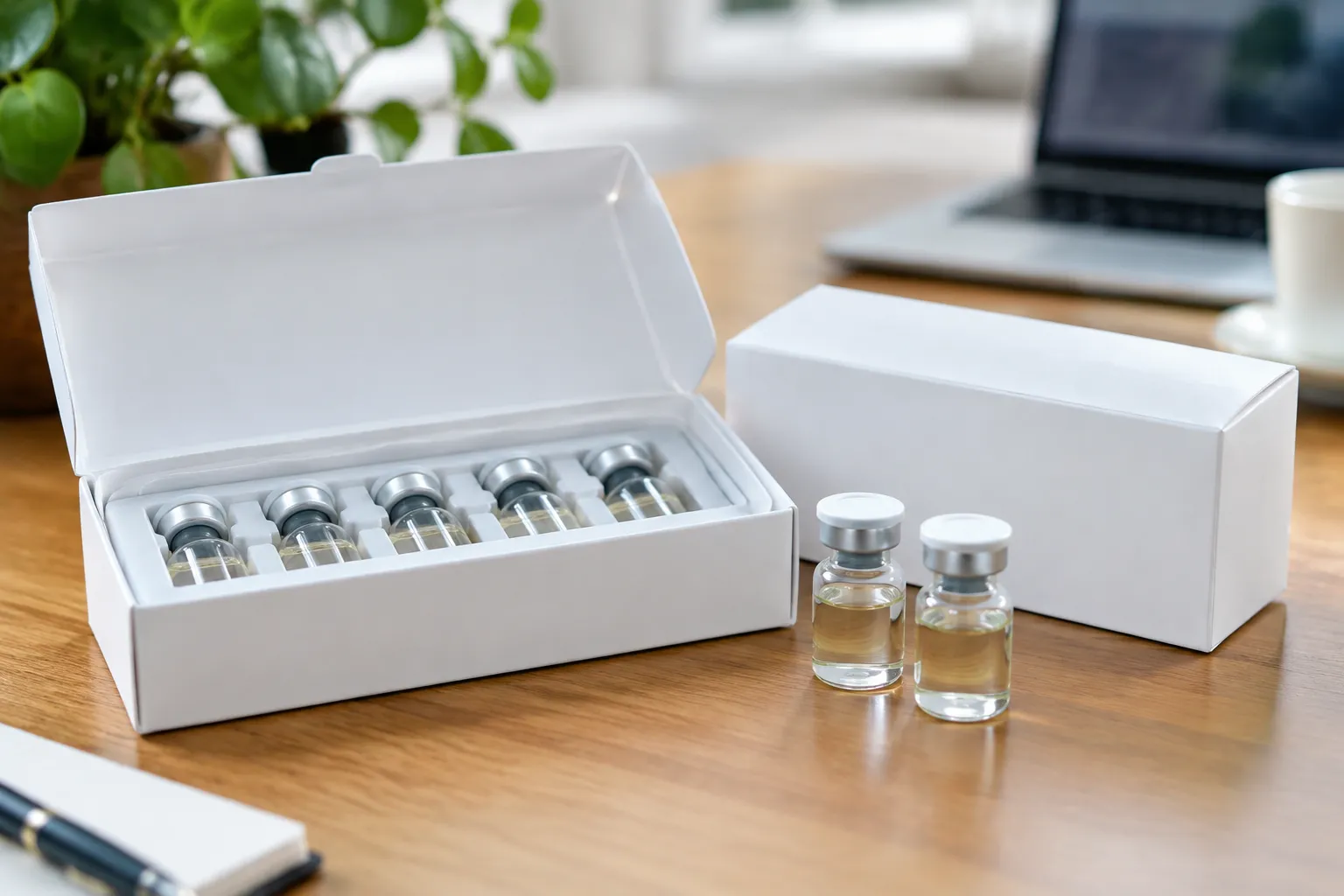
Real-world transit and retail conditions test the true limits of custom packaging. Below are actual client case studies and performance reviews highlighting how our custom vial boxes with precision-engineered inserts solve breakage, branding, and compliance challenges across diverse industries.
Review 1: Clinical Diagnostic & Biotech Laboratory (Zero-Breakage Reagent Cold-Chain Transport)
- Client Profile: In-vitro diagnostic reagent manufacturer (San Diego, CA)
- Packaging Configuration: Multi-cavity, high-density EVA foam tray housed inside a rigid tuck-end carton
- Key Challenge: Glass reagent vials cracking during air-freight vibration and dry-ice cold chain transit
"Before switching our packaging supply, we experienced a 2.4% transit failure rate from vial-to-vial contact inside low-grade thermoformed trays. The custom die-cut EVA foam inserts engineered by the team provide a micro-toleranced friction fit that isolates each bottle entirely. Over our last three production batches totaling 45,000 units, our breakage rate dropped to absolute zero under strict -20°C dry-ice conditions."
— Dr. Aris V., Operations Director
- Performance Highlights:
- Complete thermal contraction resistance without foam embrittlement
- Precise 0.5mm cavity spacing eliminating lateral glass collisions
- Clean-room compatible, dust-free foam surface
Review 2: High-End Cosmeceutical & Peptide Brand (Luxury Velvet-Flocked Magnetic Unboxing Box)
- Client Profile: Medical aesthetics skincare brand (Miami, FL)
- Packaging Configuration: Custom rigid book-style box with magnetic closure, soft-touch matte lamination, and black velvet-flocked EVA inserts
- Key Challenge: Scuffed bottle labels and lack of a premium unboxing experience for high-ticket 10ml peptide ampoule kits
"Our peptide kits retail above $180, so a flimsy carton was out of the question. The plush, velvet-coated foam keeps our 10ml vials firmly seated without scratching our foil-stamped labels. The structural rigidity and the satisfying snap of the magnetic lid elevated our customer unboxing experience immediately. The precision cutting on the inserts makes the product look surgical yet luxurious."
— Elena M., Brand Founder
- Performance Highlights:
- Non-abrasive flocked layer prevents label rub-off during transit
- Snug cavity depth allows effortless vial removal with thumb indents
- Scratch-resistant exterior coating preserves shelf aesthetics
Review 3: Organic Essential Oil Wholesaler (Plastic-Free Eco-Friendly Corrugated Grid Packaging)
- Client Profile: Direct-to-consumer and wholesale botanical oil brand (Portland, OR)
- Packaging Configuration: Heavy-duty corrugated box for 10ml vial sets with interlocking kraft paperboard grid dividers
- Key Challenge: Transitioning away from plastic/foam packaging while retaining drop-test integrity for 6-bottle sets
"Our brand ethos demands zero single-use plastic. We were skeptical that paper dividers could protect glass dropper bottles from warehouse drops. The interlocking corrugated partition design proved us wrong—the multi-cell layout absorbs impact evenly, flat-packs easily for storage, and cut our unit packaging costs by 18% compared to molded plastic trays."
— Marcus T., Supply Chain Lead
- Performance Highlights:
- 100% recyclable, curbside-disposable paperboard construction
- Interlocking partition walls deliver vertical stack strength up to 35 kg
- Flat-shipping inserts minimize incoming freight costs and storage footprint
Customization Workflow: Ordering Custom Vial Boxes with Inserts
Getting your custom packaging from design to delivery should be fast, transparent, and completely accurate. As an OEM custom vial box supplier, we use a streamlined four-step engineering process to ensure every vial sits securely and arrives damage-free.
| Workflow Stage | Primary Actions & Technical Deliverables | Typical Turnaround |
|---|---|---|
| 1. Specification Intake | Glass vial dimensions, cavity layout, material selection | 24 Hours |
| 2. CAD & Dieline Design | Custom box dieline, cavity layout vector, 3D digital mockup | 1–2 Business Days |
| 3. Prototyping & Testing | Physical sample creation, fit verification, drop-testing | 3–5 Business Days |
| 4. Mass Production & QC | High-speed printing, die-cutting, assembly, export packing | 10–15 Business Days |
Step 1: Technical Requirement & Bottle Dimension Submission
We start by collecting your exact bottle specifications:
Vial Dimensions: Outer diameter, total height (including crimp caps, dropper tops, or stoppers), and liquid weight.
Layout Needs: Single-vial boxes, multi-vial master packs, or mixed kits with accessories.
Material & Structure: Choose your exterior box style (rigid magnetic, slide drawer, or tuck-end carton) and insert type (high-density EVA foam, sponge, blister tray, or paperboard grids). Whether you need standard custom 10ml vial box packaging with inserts or custom-molded multi-bottle sets, we tailor the footprint to your exact product volume.
Step 2: Custom Dieline Creation & Insert CAD Prototyping
Our structural engineers generate precision CAD dielines calibrated to your bottles.
Zero-Tolerance Engineering: We program cutouts with optimal tolerances so glass bottles snap into place without label friction or rattling.
Artwork Alignment: We provide ready-to-use vector dielines for your graphic design team, showing exact bleed zones, fold lines, and foil-stamping areas. We also ensure your layout aligns with overall custom vial packaging design with inserts and compliance specifications.
Step 3: Physical Pre-Production Sampling & Drop-Test Verification
Before full-scale manufacturing, we produce physical pre-production samples to validate form, fit, and finish.
Fit Testing: You test the actual glass vials in the die-cut foam or thermoformed tray to confirm effortless insertion and secure hold.
Finishing Inspection: Review print resolution (CMYK/Pantone), hot foil stamping, embossing, and matte or gloss lamination under real-world lighting.
Drop Verification: Physical samples undergo transit vibration and impact testing to guarantee zero breakage during shipping.
Step 4: Mass Production, Rigid In-Line QC, and Bulk Export Packaging
Once you approve the pre-production sample, we begin mass manufacturing:
Offset Printing & Surface Treatment: High-speed Heidelberg printing runs paired with automated lamination and spot UV application.
Precision Die-Cutting & Insert Assembly: Computer-guided die-cutting presses punch clean-edged EVA foam, sponge, or paper partitions, followed by automated or skilled manual box assembly.
In-Line Quality Control: Every batch undergoes dimensional checks, insert alignment reviews, and magnetic closure strength tests.
Export-Ready Packaging: Finished boxes are shrink-wrapped in bundles, packed into heavy-duty 5-ply corrugated export cartons, and palletized for safe global delivery.
Frequently Asked Questions (FAQs)
What is the best insert material for glass vials containing liquid?
High-density die-cut EVA foam is the premier industry choice for liquid-filled glass vials. It provides exceptional impact absorption, structural rigidity, and bounce-back resilience during transit drops. Unlike low-grade foams, closed-cell EVA will not flake, generate dust, or break down if exposed to minor condensation. For high-volume runs requiring rigid, cleanroom-ready containment, thermoformed PET blister trays provide a clean, secure snap-fit alternative.
Can inserts be customized to fit mixed kits containing vials, droppers, and syringes?
Yes. We regularly design custom multi-cavity layouts tailored specifically for combination therapy sets, cosmeceutical routines, and clinical trials. Our CNC die-cutting processes accommodate varied component depths and irregular contours within a single tray. You can design compartmentalized layouts using our custom vial sample box for safe storage and shipping to securely seat vials alongside droppers, ampoule openers, and pre-filled syringes.
What are the typical sample turnaround times and production lead times?
We maintain rapid prototyping and manufacturing schedules to keep your product launches on track:
CAD Dielines & Technical Layouts: Delivered within 24 to 48 hours.
Physical Custom Pre-Production Samples: 3 to 7 business days with exact foam fit and custom print proofing.
Mass Production: Typically 12 to 18 business days, depending on overall batch volume, box structure, and specialized finishing requirements.
How do precision-fit foam inserts prevent vial labels from scuffing during transit?
Label abrasion occurs when bottles vibrate against rough paper dividers or loose-fitting cavities during courier handling. We mill our custom foam inserts to exact ±0.5mm tolerances, eliminating micro-movements, bottle rotation, and glass-to-glass contact. To provide extra protection for delicate film labels or foil-stamped vials, we apply a velvet-flocked top layer to the EVA foam, providing a plush, non-abrasive contact surface.