Formula details
Product Details
Overview
Validate Fit, Finish, and Protection Before Mass Production
Physical Sampling for Medical, Cosmetic, and Laboratory Vials
Every formulation requires unique physical parameters. Whether you handle amber glass injection vials, diagnostic reagents, or cosmetic dropper bottles, physical sampling verifies that your packaging performs under real-world shipping conditions.
- Dimensional verification: Snug fit for standard 2ml, 5ml, 10ml, 15ml, 20ml, and 30ml containers.
- Secondary protection: Accurate wall clearance preventing glass-to-glass contact.
- Line efficiency: Checking fold ease, bottom-lock integrity, and manual or automated packing speeds.
Stock Structural Sample Kit
Our packaging sample kit offers an immediate overview of material calipers, structural rigidity, and finishing standards.
- Includes assorted paperboard weights (250gsm to 450gsm SBS, CCNB, Kraft).
- Pre-cut insert templates showing various foam densities and paperboard partition options.
- Swatch sections displaying gloss, matte, soft-touch laminations, and foil embellishments.
Unprinted Structural White Mockup (24–48h CAD Cut)
When you need immediate dimensional verification, we supply an unprinted white structural mockup cut directly on our precision CAD tables within 24 to 48 hours.
- Turnaround: 24–48 hours from dieline confirmation.
- Focus: Caliper strength, clearance tolerance, insert alignment, and tuck-closure tension.
- Purpose: Rapid physical fit-test for vials, droppers, and package inserts without plate or printing setup costs.
Digital Pre-Production Sample
A digital pre-production sample bridges the gap between structural checks and finished aesthetics. We use high-resolution digital presses to output your artwork directly onto the specified production paperboard.
- Accurate placement of regulatory text, warning icons, and 2D datamatrix codes.
- CMYK color visualization and basic surface coating evaluation.
- Fully assembled unit to validate shelf presence and end-user unboxing mechanics.
Finished Industrial Production Prototype
For high-volume pharmaceutical and luxury cosmetic runs, we build an exact pharmaceutical box mockup using high-volume manufacturing lines.
| Feature | Specification |
|---|---|
| Print Method | High-precision commercial offset (CMYK + Pantone PMS matching) |
| Substrates | Virgin SBS paperboard, recycled kraft, or rigid greyboard |
| Tooling | Production-grade steel-rule cutting dies and custom-cut inserts |
| Finishes | Spot UV, tactile embossing, debossing, hot foil stamping |
| Validation Value | 100% replica of the mass-manufacturing run for lab testing and retail approvals |
Packaging Structural Styles & Opening Mechanisms
Choosing the right structural layout dictates how effectively your container holds up on the shelf, during transit, and in customer hands. We engineer and sample multiple opening mechanisms to match specific filling lines, manual pack-out routines, and branding goals before setting up full manufacturing runs.
Folding Paperboard Cartons (Straight Tuck, Reverse Tuck, Auto-Lock Bottom)
Folding paperboard cartons remain the industry benchmark for lightweight, high-speed secondary packaging. During initial prototyping, requesting a physical vial box packaging sample helps identify friction points and confirms tight closure fitment.
- Straight Tuck End (STE): Both top and bottom flaps tuck in on the same face. This creates a clean, seamless presentation panel on the reverse side—ideal for individual cosmetic serums and essential oil bottles.
- Reverse Tuck End (RTE): Flaps tuck on opposite sides, maximizing sheet-yield efficiency during production runs without sacrificing structural integrity.
- Auto-Lock Bottom (Crash Bottom): Features a pre-glued, self-erecting base that snaps into position instantly under manual pressure. It offers strong bottom reinforcement for heavier amber glass bottles and significantly speeds up fulfillment lines.
- Snap-Lock (1-2-3 Bottom): A cost-efficient interlocking base assembled manually in three folds, providing dependable downward support for medium-weight liquid containers.
Rigid Setup & Luxury Presentation Boxes (Two-Piece, Magnetic Closure, Slide-Out)
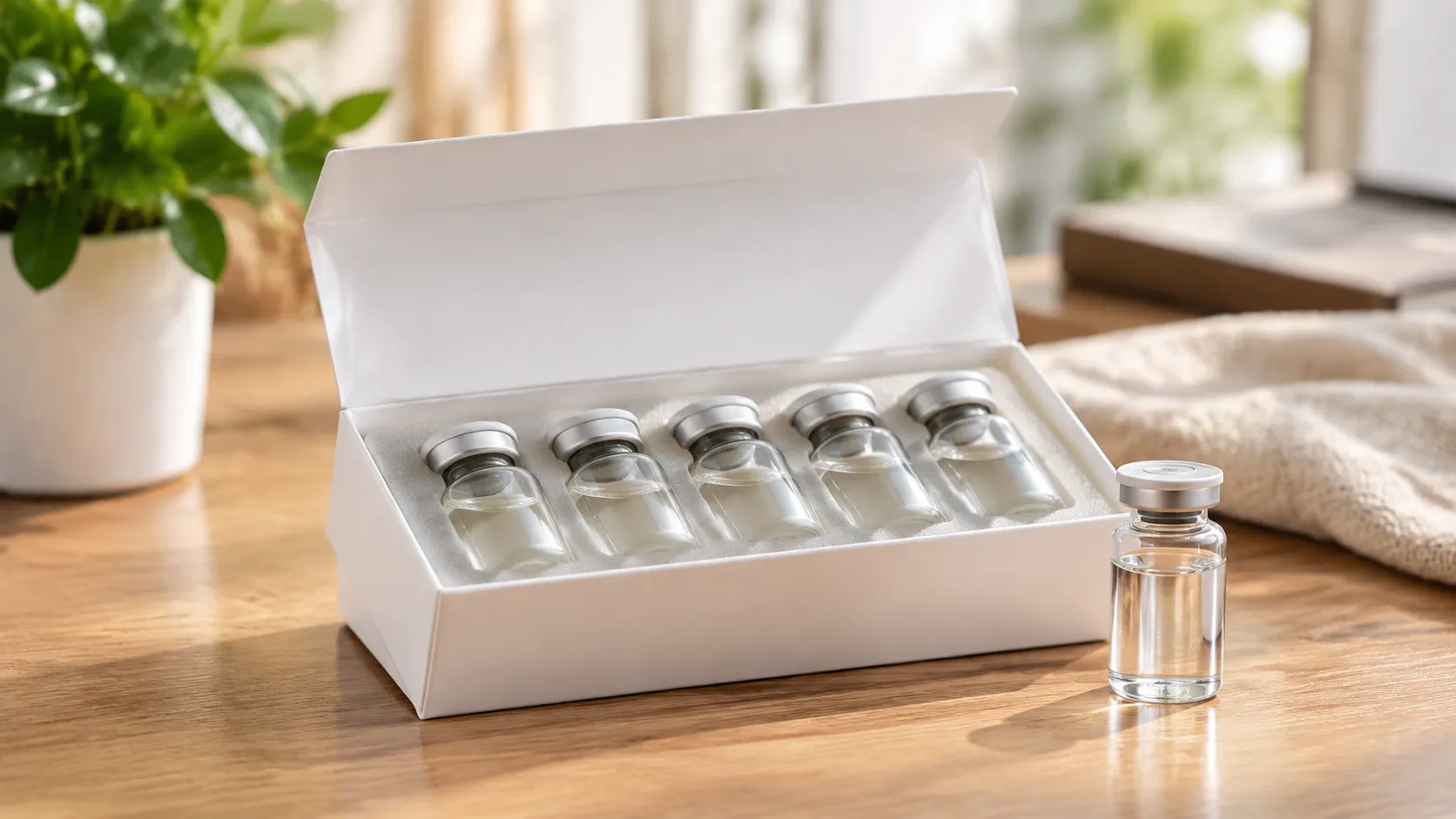
For premium clinical trials, luxury diagnostic kits, and medical-grade aesthetics, we manufacture heavy-duty rigid boxes wrapped in custom-printed art paper over thick chipboard cores. For small-footprint products, our custom 2ml vial packaging boxes with EVA inserts provide an exact blueprint for snug, impact-absorbing layouts.
- Two-Piece Setup (Lid and Base): Classic telescoping or shoulder-neck boxes offering a balanced, secure unboxing experience.
- Magnetic Closure Boxes: Book-style or clamshell constructions with concealed neodymium magnets embedded beneath the paper wrap, providing an audible snap upon closing.
- Drawer / Slide-Out Boxes: A sliding inner tray encased in an outer rigid sleeve, fitted with ribbon pulls or thumb notches for controlled horizontal extraction.
Multi-Pack & Dispenser Box Configurations with Tear-Away Headers
When managing kit rollouts or clinical test sets, consolidating multiple units into organized multi-packs protects sensitive ampoules from colliding. Reviewing structural options against your vial packaging cost calculations ensures the selected architecture stays well within margin targets.
- Perforated Gravity Dispensers: Countertop boxes designed with bottom pull-ports and perforated tear-away headers for smooth single-vial extraction in pharmacy or laboratory workflows.
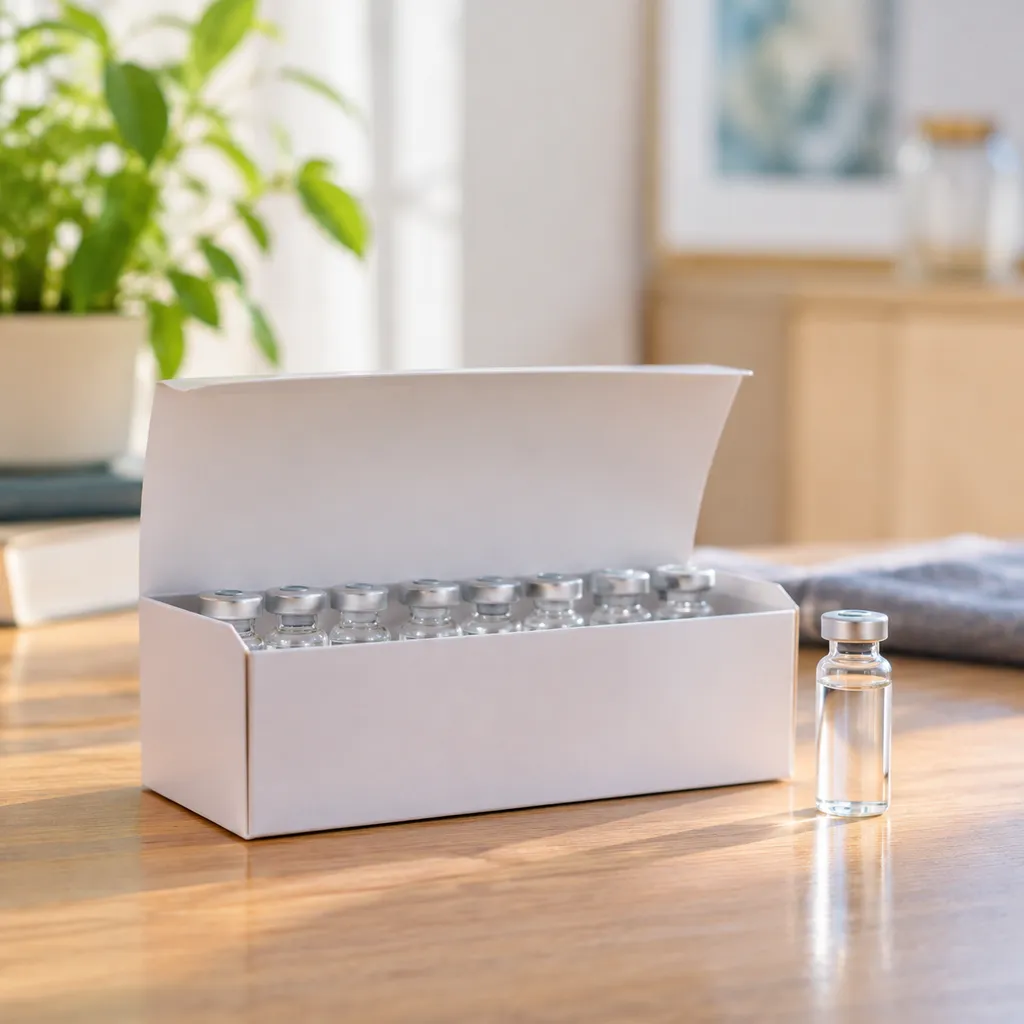
- Multi-Vial Partition Boxes: Single cartons equipped with glued or loose dividers to segregate 3, 5, or 10 vials upright.
- Clamshell Multi-Packs: Folding paperboard sleeves wrapped around deep cavities to secure paired sets of vials and diluent droppers.
Precision Protective Inserts & Interior Engineering
A reliable vial box packaging sample must prove that fragile glass containers stay secure under transit shock. We engineer custom interior cavity inserts to lock vials, droppers, and ampoules into place, preventing glass-to-glass contact and eliminating movement inside the outer carton.
Our team develops and validates multiple insert styles to match your functional requirements, product weight, and target presentation aesthetics:
- High-Density Custom-Cut EVA & EPE Foam Trays: CNC-cut or die-cut foam provides superior impact absorption, clean edges, and a snug friction fit for sensitive clinical and cosmetic containers. We tailor foam densities and top-layer laminations (including velvet flocking or smooth paperboard face sheets) so your sample shows exact vial retention.
- Eco-Friendly Recyclable Paperboard Dividers & Corrugated Partitions: For sustainable single-material recycling, we engineer folding paperboard grids and crash-lock partitions. These dividers provide structured compartmentalization for multi-vial kits while lowering overall tare weight and material costs.
- Thermoformed Blister Trays (PET/PVC) & Contoured Molded Pulp: When high-speed packing lines or sterile environments require rigid nesting, our custom vial packaging design with inserts integrates precision-molded clear PET or medical-grade plastic trays. We also produce contoured molded pulp cavities for brands seeking fully biodegradable, plastic-free vial cradles.
Structural Performance Comparison
| Insert Material | Impact Resistance | Tooling / Proofing Speed | Best Application |
|---|---|---|---|
| High-Density EVA Foam | Exceptional | Fast (Digital CAD cut) | Luxury serums, multi-use kits, diagnostic reagents |
| EPE Foam (Polyethylene) | High (Flexible) | Fast (Die-cut / CNC) | Heavy bottles, utility shipping packs |
| SBS Paperboard Partitions | Moderate | Immediate (Die-cut fold) | Multi-pack 10ml vials, retail display boxes |
| Thermoformed Plastic Trays | High (Rigid lock) | Fast-turn prototyping | Clinical trials, medical ampoules, automated lines |
| Contoured Molded Pulp | High (Cushioned) | Medium | 100% sustainable and eco-conscious lines |
We test every interior cavity mockup against drop impacts and vibration tolerances to ensure your production run avoids breakage completely.
Materials, Finishes & Technical Specifications
| Component | Standard Specifications | Common Applications |
|---|---|---|
| Paperboard Caliper | 300gsm – 450gsm (16pt – 24pt) | Unit cartons, multi-pack tuck boxes |
| Rigid Greyboard | 800gsm – 1800gsm (1.2mm – 2.5mm) | Luxury presentation boxes, diagnostic kits |
| Protective Coatings | Gloss / Matte Lamination, Soft-Touch, Aqueous | Scratch resistance, moisture barrier |
| Print Systems | Offset (CMYK + PMS spot inks), Digital Proofing | High-fidelity medical and cosmetic branding |
Paperboard Substrates (Coated SBS, Recycled Kraft, Rigid Greyboard)
We match your project’s barrier and sustainability requirements using proven stock options:
- Solid Bleached Sulfate (SBS): Premium white virgin fiberboard providing ultra-smooth ink holdout, bright white points, and clean crease lines. Ideal for pharmaceutical box mockups and clinical diagnostics.
- Recycled Kraft Paperboard: High-strength, eco-conscious brown or white-lined kraft suited for clean-label cosmetics and organic serums requiring high tear resistance.
- Rigid Greyboard: Heavy-density compressed paper core wrapped in printed art paper, engineered to build impact-resistant presentation sets for high-value biologicals. If you are comparing primary and secondary barriers, our ampoule packaging materials for glass, plastic, and sterility guide details how external cartons integrate with primary containers.
Commercial Printing & Embellishments
Every physical sample lets you review layout accuracy, legibility of fine text, and finish performance under commercial conditions:
- Offset CMYK & Pantone (PMS) Matching: Strict color consistency to preserve brand identity across large production lots.
- Foil Stamping: Metallic gold, silver, or holographic foils that enhance visual shelf appeal and brand authenticity.
- Spot UV & Embossing / Debossing: Dimensional textures that highlight logos or warnings, paired with our engineering team's custom packaging technical support to verify die lines and fold tolerances before press runs.
Security Elements & Tamper-Evident Solutions
Secondary packaging must guarantee product authenticity and provide clear evidence of interference before opening. We integrate functional tamper-proofing directly into your custom printed vial cartons:
- Perforated Tear Strips: Built into the carton tuck flap or outer sleeve to prevent opening without destroying the outer shell.
- Tamper-Evident Void Seals: Specialized film labels that reveal a permanent "VOID" pattern if lifted or re-applied.
- Serialized Barcodes & 2D Data Matrix: Crisp, high-contrast printing capable of holding scannable lot codes, expiration dates, and anti-counterfeiting tracking numbers.
Vial Box Specifications Matrix & Sizing Guide
Getting the exact interior clearance is critical when testing a vial box packaging sample. A box that is even one millimeter too loose allows glass-to-glass contact during freight, while a cavity that is too tight crushes crimp caps and damages labels. We build each prototype around standard industry vial capacities, ensuring exact bottle stability and outer protection.
For detailed tube and bottle footprints, refer to our 10ml and 2ml vial box dimensions guide or review the peptide vial sizes guide for specific multi-pack configurations.
Standard Vial Sizes Accommodated
| Vial Capacity | Typical Outer Dimensions (D × H) | Recommended Box Style | Typical Caliper / Weight |
|---|---|---|---|
| 2ml | 16 mm × 35 mm | Straight Tuck / Auto-Bottom | 14pt–16pt (300–350 gsm) SBS |
| 5ml | 22 mm × 40 mm | Reverse Tuck with Paperboard Insert | 16pt (350 gsm) SBS |
| 10ml | 22 mm × 50 mm | Tuck-End Carton / Rigid Slide Box | 16pt–18pt (350–400 gsm) SBS |
| 15ml | 24 mm × 65 mm | Auto-Lock Bottom Carton | 18pt (400 gsm) SBS |
| 20ml | 28 mm × 68 mm | Crash Bottom / Custom Foam Insert | 18pt–20pt (400–450 gsm) SBS |
| 30ml | 32 mm × 75 mm | Two-Piece Rigid Setup Box | 1.5mm–2.0mm Laminated Greyboard |
Dimensional Tolerances, Board Caliper, and Drop-Test Integrity
- Precision Tooling: We hold CAD sample cutting to a tight tolerance of ±0.5 mm, ensuring accurate clearances for rubber stoppers, flip-off caps, and dropper pipettes.
- Board Caliper Selection: Light medical cartons utilize 14pt to 18pt C1S/C2S SBS paperboard. High-value presentation boxes feature 600 to 1200 gsm greyboard wrapped in coated art paper.
- Drop-Test Structural Integrity: Physical mockups are engineered to withstand standard transit shock. Structural configurations with internal EVA or folding dividers distribute impact forces away from vial necks and glass shoulders.
Secondary Packaging Compliance Standards
- ISO 9001 Quality Control: Every production sample follows standard quality controls for dimension verification, crease scoring, and glue-line stability.
- FSC-Certified Substrates: We source paperboards from sustainably managed forests, supporting clean supply-chain requirements for pharmaceutical and cosmetic brands.
- RoHS & REACH Compliance: All printing inks, protective coatings, and hot-melt bonding adhesives meet international restrictions regarding heavy metals and hazardous substances.
The Prototyping & Sampling Process
Step 1: Custom CAD Dieline Setup & Vector Artwork Preparation
Everything starts with precise geometry. We map out a bespoke CAD dieline based directly on your container dimensions, whether you are using a standard crimp vial, screw-cap bottle, or dropper assembly.
- Structural calibration: We establish exact clearances for the primary container and secondary protective inserts.
- Vector alignment: Your graphics team drops branding, warning text, and regulatory marks onto our dielines, or our engineers position your artwork directly to prevent edge bleeding and score-line overlap.
Step 2: Rapid Sample Fabrication (CAD Cutting & Digital/Offset Proofing)
Once dieline paths and layouts receive sign-off, our team transitions directly to manufacturing prototypes through our dedicated fast sampling line.
- Structural cutouts: High-precision flatbed plotting tables cut and score the paperboard and interior partitions without expensive steel-rule tooling.
- Color and finish proofs: Digital or short-run offset presses reproduce color density, coating textures, and foil accents so you can inspect an authentic pre-production packaging proof before approving commercial runs.
Step 3: Global Express Delivery & Dimensional Validation
We pack and ship your physical prototypes via tier-one international air couriers to keep your launch timetable on track. Once the package arrives at your facility, you can run hands-on physical validation:
- Insert live vials into the cavities to evaluate friction fit, top-clearance, and ease of removal.
- Test closure tension on tuck flaps, auto-lock bases, or magnetic lids.
- Run real-world transit drop evaluations with our reinforced custom vial sample box options to confirm complete glass protection.
Step 4: Sample Fee Rebate on Mass Production Orders
We treat physical sampling as a mutual commitment to product quality, not a profit center. Any prototyping fees incurred during dieline creation, board sampling, or finish testing are credited directly against your invoice when you place your qualifying full-scale production order. This setup ensures zero financial risk while confirming that your custom printed vial cartons match your exact technical standard.
Frequently Asked Questions (FAQ)
Here are direct answers to the most common technical questions our engineering team receives regarding prototype runs and physical testing.
How quickly can I receive a blank structural sample to test vial clearance?
We cut and assemble unprinted structural white mockups within 24 to 48 hours after dieline confirmation. Standard international air express typically delivers the sample to your facility in 3 to 5 business days. This gives you a fast, zero-risk way to verify base clearance, crimp-cap clearance, and drop resistance before committing to print plates.
| Sample Stage | Production Time | Primary Purpose |
|---|---|---|
| Blank CAD Mockup | 24–48 Hours | Vial fit, cap clearance, fold alignment |
| Digital Print Proof | 2–3 Days | Visual layout, text legibility, dieline fit |
| Wet Production Proof | 5–7 Days | Spot Pantone accuracy, coating, foil stamp |
Can you build custom multi-compartment inserts for mixed vial and dropper sizes?
Yes. We routinely fabricate partitioned layouts to hold different components within the same carton. Whether you need a side-by-side slot for a 10ml liquid vial alongside a separate dropper pipette, or multi-cavity trays for combo therapies, our engineers calculate the precise pocket depth and separation walls. You can evaluate layout variations using a physical vial box with inserts to verify that neither component shifts or collides during transport.
Do physical production samples include exact Pantone color matching?
Yes. If you request a full industrial prototype rather than a digital mockup, we run wet proofs on actual production presses using calibrated Pantone Matching System (PMS) inks.
- Digital proofs: Ideal for checking graphic alignment and bar code readability, achieving roughly 90–95% Pantone approximation.
- Offset wet samples: Essential for critical brand colors, metallic inks, and custom coatings, giving you a 1:1 match to the final production run.
What vector dieline formats are required before cutting begins?
We work with native vector files saved in:
Adobe Illustrator (.AI)
Editable Vector PDF (.PDF)
Encapsulated PostScript (.EPS)
Please keep dielines on a dedicated, locked layer with separate stroke colors for through-cuts, creases/scores, and perforations. If you do not have a dieline ready, send us your bottle dimensions, and our team will generate a custom template for you.
Are sample paperboards and foams compliant with pharmaceutical packaging requirements?
Yes. Our sample stocks use identical substrates to our mass-production runs. We utilize virgin solid bleached sulfate (SBS) paperboards, low-migration inks, and medical-grade EVA or high-density EPE foam. These materials resist dusting, contain no heavy metals, and maintain structural integrity under standard temperature and humidity storage conditions.
Request Your Custom Vial Box Packaging Sample
Ordering a physical prototype eliminates sizing risks, material mismatch, and transit breakage before you commit to bulk production. We engineer every vial box packaging sample to match your exact container tolerances, closure requirements, and visual branding standards.
Submit Exact Vial Dimensions and Target Specifications
To ensure a seamless fit, provide your exact container specs or ship blank containers directly to our testing lab. We cross-verify bottle clearance, cap allowances, and insert cavity depths using our custom cardboard vial box packaging solutions to guarantee zero rattling during transit.
| Parameter | Required Specification Details | Standard Options |
|---|---|---|
| Vial Diameter & Height | Caliper measurements in mm (with crimp/dropper cap) | 2ml, 5ml, 10ml, 15ml, 20ml, 30ml |
| Pack Count per Box | Single-unit container or multi-pack configuration | Individual tuck box, 5-pack, 10-pack trays |
| Box Construction | Primary folding carton or rigid setup style | Straight tuck, reverse tuck, auto-bottom, slide box |
| Insert Material | Protective shock-absorbing interior structure | High-density EVA foam, EPE foam, folded paperboard |
| Proofing Level | Physical verification type needed | 24h blank CAD cut, fully printed production proof |
Direct Technical Consultation with Structural Packaging Engineers
You work directly with our in-house packaging engineers rather than standard sales reps. We review your vector dielines, recommend appropriate paperboard calipers (ranging from 16pt to 24pt SBS), and optimize cavity layouts for your custom 10ml vial box packaging with inserts.
- Precision CAD Prototyping: Blank mockups cut and assembled within 24 to 48 hours for immediate clearance testing.
- Production-Grade Proofs: Full offset-printed samples featuring your specified pantone inks, foil stamping, soft-touch coatings, and spot UV treatments.
- Insert Integrity Validation: Custom-routed foam cavities and paperboard partitions tested against simulated drop-test impacts.
- Dieline Distribution: Immediate release of production-ready vector templates (AI, PDF, DXF) mapped precisely to your container dimensions.