Understanding Ampoules: Features and Best Uses
What Is an Ampoule?
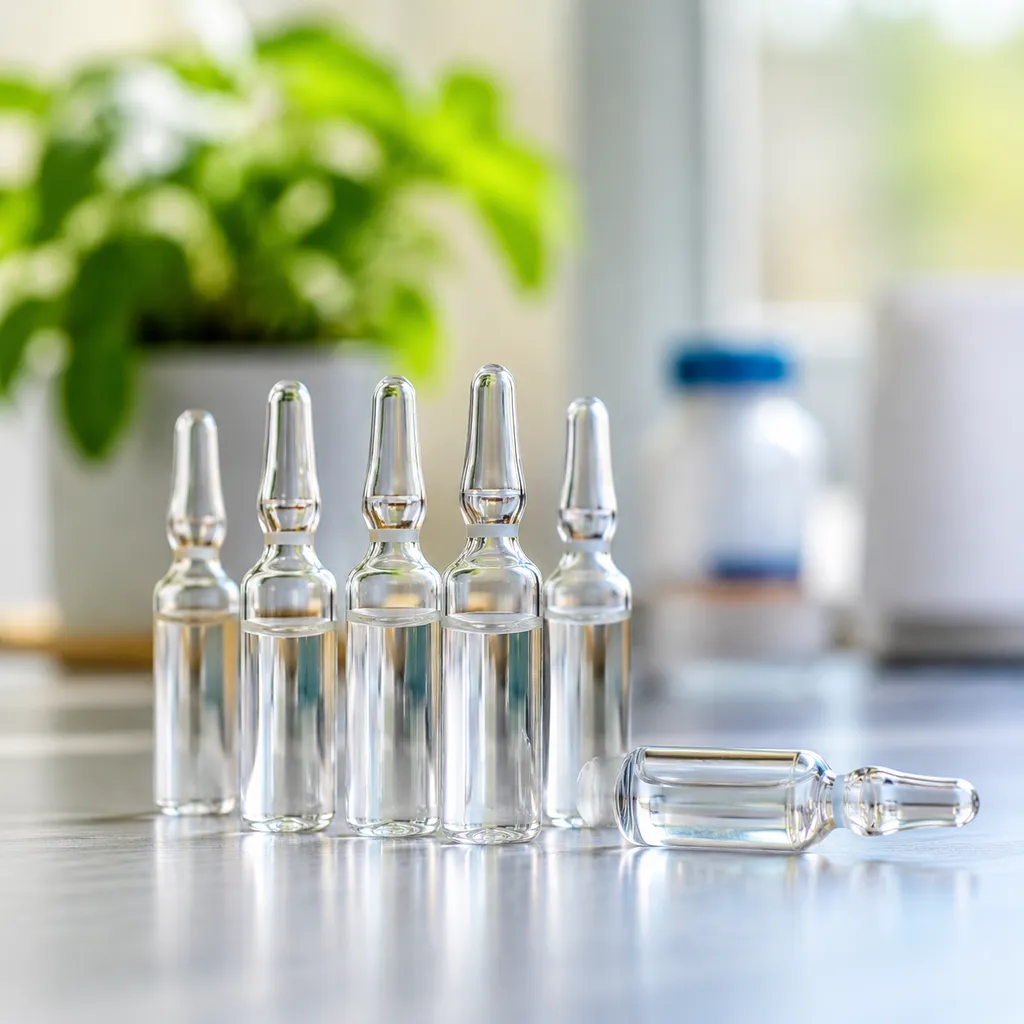
An ampoule is a small, hermetically sealed container formed entirely from high-grade glass tubing. Unlike standard multi-piece containers, an ampoule is melted shut with an open flame after filling. This completely fuses the glass neck, eliminating mechanical closures, rubber gaskets, or secondary crimp seals.
Core Advantages: Total Airtightness and Tamper Evidence
Our pharmaceutical glass manufacturing relies on flame sealing to deliver unmatched product protection:
- True Hermetic Barrier: Continuous, seamless glass prevents all gas exchange, moisture permeation, and evaporation.
- Zero Elastomeric Leaching: Without rubber stoppers, formulations avoid contact with plasticizers, sulfur, or extractable compounds.
- Tamper-Evident Security: Accessing the contents requires snapping the neck at a pre-scored cut or color-break ring. Once opened, it cannot be resealed.
Primary Use Cases
Ampoules are specifically engineered for single-use applications where product degradation is an immediate risk:
- Single-Dose Injectables: Ideal for critical emergency medicines, biologics, and sterile saline where single-entry administration prevents cross-contamination.
- Oxidation-Prone Liquids: Active chemical compounds and premium cosmetic serums that degrade in the presence of oxygen benefit from oxygen-free, sealed headspaces.
- Volatile Formulations: Solvents and chemical standards that rapidly evaporate through standard elastomer septa.
Material Standards: High-Purity Borosilicate Glass
We produce our borosilicate glass ampoules strictly utilizing USP Type I neutral glass to ensure optimal chemical inertness:
| Parameter | Specification Standard | Manufacturing Advantage |
|---|---|---|
| Glass Type | USP Type I Neutral Borosilicate | Superior hydrolytic resistance; minimizes alkali leaching into liquid products. |
| Color Formats | Flint (Clear) & Amber Glass | Amber protects light-sensitive actives from UV degradation down to 500 nm. |
| Wall Integrity | Uniform tubular wall construction | Resists thermal stress during autoclaving and prevents breakage during transport. |
| Opening Mechanism | Score-ring, One-Point-Cut (OPC), or Color-break band | Ensures clean breaks with minimal splintering or particulate generation. |
Understanding Vials: Versatility and Functionality
When deciding between an ampoule vial format for your product line, vials stand out for their adaptability, multi-entry convenience, and robust closure systems. Unlike single-use glass containers, a vial is engineered for flexible dispensing, allowing users to withdraw precise doses while maintaining barrier integrity.
What Is a Vial?
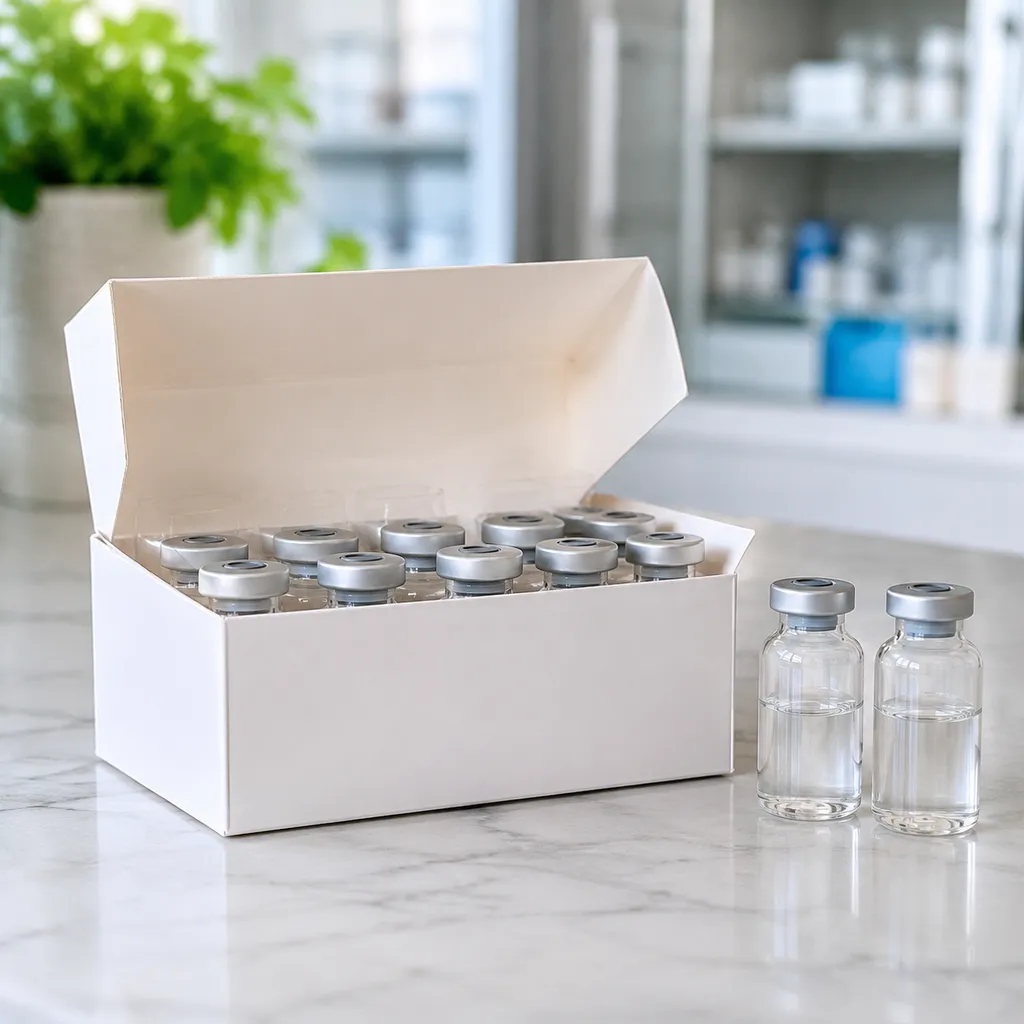
A vial is a flat-bottomed glass or plastic vessel designed to hold liquids, lyophilized powders, or specialized formulations. While an ampoule is entirely glass-sealed and broken open, a vial relies on an integrated closure assembly:
Elastomeric Rubber Stopper: Forms the primary contact seal and reseals after needle puncture.
Aluminum Crimp Collar: Compresses the stopper firmly against the glass flange to ensure an airtight seal.
Protective Cap: Keeps the injection site sterile prior to activation.
For a deeper dive into container classifications, review our detailed guide on vial container definition, types, and uses.
Core Advantages of Glass Vials
- Multi-Dose Capability: The self-sealing rubber septum allows repeated needle access without exposing the remaining contents to open air.
- Application Versatility: Vials easily integrate with syringe needles, reconstitution adapters, dropper tops, or spray pumps.
- Reduced Particle Risk: Because there is no glass neck to snap, the risk of glass particulate falling into the solution is entirely eliminated.
Primary Use Cases
We produce pharmaceutical glass vials and tubular glass vials across standard sizes to support high-value market sectors:
Multi-Dose Injectables: Antibiotics, vaccines, and insulin requiring repeated, sterile withdrawals.
Cosmetic Serums: High-potency active serums, hyaluronic acid formulas, and peptide solutions where precise, hygienic dispensing is vital.
Diagnostic & Clinical Reagents: Laboratory standards and sensitive chemical reagents that require secure storage between test runs.
Common Closure Systems
Choosing the right closure is just as important as choosing the right glass:
Flip-Off Caps: An aluminum band topped with a plastic flip button that offers clear tamper evidence and fast sanitization.
Rubber Septa (Stoppers): Made from bromobutyl or chlorobutyl formulations to deliver low gas permeability and excellent resealability.
Standard Aluminum Crimps: Economical, durable crimp collars engineered for cleanroom production lines and long-term storage stability.
Glass Ampoule vs Vial: Direct Technical Comparison

Choosing between an ampoule and a vial comes down to your drug formulation, target stability profile, and clinical workflow. Both formats serve as dependable sterile glass containers, but their engineering and sealing methods address completely different packaging needs.
| Feature / Metric | Glass Ampoule | Pharmaceutical Glass Vial |
|---|---|---|
| Closure Type | 100% Hermetic glass flame seal | Elastomeric rubber stopper + aluminum crimp seal |
| Dosing Capability | Single-use only | Single-dose or multi-dose applications |
| Permeability Risk | Zero gas or moisture transmission | Slight risk of gas/vapor permeation over time |
| Particle Risk | Potential glass micro-shards upon snap | Potential stopper coring from repeated needle punctures |
| Packaging Machinery | Open-flame ampoule filling and sealing lines | Aseptic liquid/powder filler, stopper inserter, and crimper |
Sealing Integrity: Flame Seals vs. Elastomeric Barriers
Ampoules offer the absolute gold standard in sealing integrity. We melt the neck shut with a high-temperature flame, turning the container into a continuous, 100% hermetically sealed container. Because there are no gaskets, elastomers, or secondary closures, moisture and oxygen cannot migrate into the solution.
Vials depend on an elastomeric rubber stopper held under mechanical compression by an aluminum crimp. While modern stoppers provide an outstanding barrier for most pharmaceutical solutions, they do not match the absolute gas barrier of fused glass. For deeper details on barrier characteristics, explore our breakdown of ampoule packaging materials and sterility.
Sterility and Safety: Coring Risks vs. Particulate Control
- Needle Coring in Vials: Piercing a vial stopper multiple times creates a risk of needle coring, where tiny elastomeric fragments shear off into the liquid. Using the correct needle gauge and point style helps mitigate this.
- Glass Splinters in Ampoules: Snapping an ampoule neck open can release microscopic glass particles into the liquid. To prevent particulate injection, healthcare teams must use a specialized filter needle when drawing medication.
- Long-Term Sterility: Ampoules provide tamper-evident, non-resealable safety for unstable injectables. Vials allow multi-entry dosing with bacteriostatic agents, though every needle puncture introduces an external touchpoint.
User Experience: Snap-Opening vs. Multi-Entry Extraction
Opening an ampoule vial format dictates the clinical workflow:
- Ampoules: Feature a pre-scored cut-ring or One-Point Cut (OPC) that snaps cleanly with manual pressure. They provide instant access for emergency medications where assembling a vial syringe adapter takes too long.
- Vials: Feature flip-off plastic buttons that expose the sterile septum underneath. They offer far better ergonomics for daily clinical use, cosmetic serums, and reconstitution of lyophilized powders.
Cost and Production Equipment
Your packaging decision directly impacts your capital equipment requirements. Ampoules require dedicated filling and flame-sealing machines equipped with inert gas purging (nitrogen flushing) before and during the melt cycle.
Vials require a modular line: washing, depyrogenation tunnel, liquid filling, stopper placement, and aluminum capping. To simplify operations and lower capital expenditure, many pharmaceutical teams switch to pre-sterilized formats using a vial nest and tub system for RTU aseptic fill-finish, eliminating the need for standalone washing and sterilization equipment on-site.
Why Glass Quality Matters for Sterile Packaging

USP Type I Borosilicate Glass: Stopping Chemical Leaching
Inferior glass formulations react with liquid drugs over time, causing ion exchange, pH shifts, and glass delamination—a critical failure where thin glass lamellae shed into the liquid.
To eliminate this contamination risk, we prioritize USP Type I neutral borosilicate glass across all primary pharmaceutical packaging lines:
Near-zero extractables and leachables: High chemical resistance maintains product purity, even for low-pH or high-pH formulations.
Hydrolytic resistance: The chemical matrix resists water attack during extended shelf lives.
Elimination of delamination: Controlled tubular glass forming prevents localized thermal stress points where flakes typically develop.
Thermal Shock Resistance and Autoclaving Strength
Sterilization puts intense physical strain on glass walls. Whether processing products through dry-heat depyrogenation tunnels at 300°C or high-pressure steam autoclaves at 121°C, sudden temperature jumps can trigger catastrophic wall cracking.
Our high-purity borosilicate containers feature low thermal expansion coefficients (~33 to 50 × 10⁻⁷/K), providing distinct processing benefits:
High mechanical wall strength: Resists burst pressure during rapid pressure drops in autoclaving cycles.
Extreme thermal shock limits: Safely withstands swift thermal transitions of over 100°C without micro-fracturing.
Minimized line downtime: Lowers line breakages during automated washing, sterilizing, and filling operations.
Amber vs. Clear Glass: Shielding Active Ingredients
Selecting between clear (flint) and amber glass balances photochemical protection against visual inspectability:
| Glass Variant | Primary Function | Spectral Protection | Primary Applications |
|---|---|---|---|
| Clear (Flint) Glass | Maximum visual clarity for particle inspection | Minimal UV protection (transmits visible/UV light) | Stable biologics, diagnostic reagents, general antibiotics |
| Amber Glass | Maximum light filtration against photo-degradation | Absorbs harmful UV and visible wavelengths (290–450 nm) | Light-sensitive vitamins, hormonal therapies, oxidation-prone actives |
For light-vulnerable drugs, our vitamin D ampoule packaging for amber glass protection delivers an impenetrable barrier against direct light-induced degradation while complying with all standard pharmacopeia spectral transmission limits.
Custom Glass Specifications: Tolerances and Branding
High-speed automated fill-finish lines require extreme container uniformity. A millimeter deviation in neck finish, wall concentricity, or base flatness can jam feeding tracks, damage filling needles, or compromise closure integrity.
We engineer custom glass vial packaging options for bulk orders under tight dimensional tolerances:
Tight dimensional control: Consistent outer diameter, wall thickness, and total height ensure seamless integration with high-speed pucks and starwheels.
Precision neck finishes: Consistent crimp bevels and ampoule cut-ring depths guarantee reproducible sealing and opening forces.
Surface branding and identification: High-temperature ceramic silk-screen printing, one-point cut (OPC) identification rings, and color-break lines survive sterilization without flaking or fading.
How to Choose the Right Ampoule Vial Packaging Manufacturer
Finding a dependable glass manufacturing partner directly impacts your fill-finish yield, batch safety, and regulatory approval. When selecting a vendor for an ampoule vial production line, we recommend auditing facilities based on strict manufacturing metrics rather than just per-unit pricing.
Cleanroom Standards, ISO 15378, and cGMP Certification
Primary pharmaceutical packaging requires production environments that eliminate particulate and microbiological risks at the source.
ISO 15378 Certification: Confirms that the manufacturer applies specific cGMP principles directly to primary packaging materials for medicinal products.
Controlled Cleanrooms: Forming and packaging must take place in ISO Class 7 or Class 8 cleanrooms to minimize bioburden.
Processing Compatibility: Evaluate whether you need bulk glass for in-house depyrogenation or ready-to-use formats. Read our RTU packaging vs wash-and-depyrogenate processing guide to see how different supply workflows match specific cleanroom setups.
Dimensional Accuracy and Line Efficiency
High-speed automated filling lines cannot tolerate dimensional variance. When glass dimensions drift, machines jam, glass cracks, and entire runs get rejected. We focus on critical mechanical checkpoints:
Neck Finish: Precise outer and inner diameters ensure hermetic flame sealing for ampoules and leak-free crimping for vials.
Wall Thickness Uniformity: Consistent glass distribution prevents weak spots that fail under thermal autoclaving or mechanical stress.
Base Flatness: Prevents tipping on high-speed conveyors and ensures steady heat transfer during lyophilization cycles.
| Quality Checkpoint | Evaluation Standard | Impact on Production |
|---|---|---|
| Cleanroom & cGMP | ISO 15378, ISO Class 7/8 | Eliminates particulate contamination and bioburden |
| Dimensional Control | Tight tolerances (±0.05 mm) | Prevents line jams, breakage, and closure failures |
| In-Line Inspection | 100% Automated Optical Systems | Rejects micro-cracks, bubbles, and foreign particulates |
| Supply Chain & QA | Batch COA, clear MOQs, stable lead times | Ensures uninterrupted drug manufacturing schedules |
Automated Camera Inspection for Zero-Defect Quality
Manual spot-checks no longer meet modern quality standards. Leading manufacturing lines utilize continuous, multi-angle camera inspection systems directly on the forming line. These automated cameras inspect every single tubular glass unit for:
Micro-cracks and stress lines at the neck, shoulder, and base.
Cosmetic flaws, such as bubbles, stones, or airline inclusions.
Geometric non-conformity, instantly rejecting units that deviate from defined dimensional tolerances.
Reliable Supply Chain, MOQs, and Batch Testing
A factory is only as good as its delivery record. We maintain strict batch traceability, providing comprehensive Certificates of Analysis (COA) with every lot. Transparent minimum order quantities (MOQs), established buffer inventory programs, and tested logistics packaging protect both tubular glass vials and borosilicate glass ampoules from transit breakage, keeping your filling schedule on track.
Frequently Asked Questions About Ampoules and Vials
Choosing between an ampoule vial system often comes down to formulation stability, dosing methods, and packaging integrity. Here are direct answers to the most common questions we address for labs and drug developers.
| Feature | Glass Ampoule | Glass Vial |
|---|---|---|
| Primary Use | Single-use doses only | Single or multi-dose options |
| Sealing Method | 100% hermetic flame fusion | Elastomeric rubber stopper + crimp cap |
| Re-sealability | None (broken upon opening) | Resealable septum for repeated draws |
| Tamper Evidence | Inherent (neck snapping) | External tamper-evident tear-off caps |
| Extraction Tool | Filter needle / standard syringe | Syringe via stopper penetration |
Can an ampoule be resealed after breaking the neck?
No. An ampoule is designed strictly as a single-use container. Once the glass neck snaps open, the hermetic barrier is permanently destroyed. Attempting to store or re-close an opened ampoule exposes the liquid to ambient oxygen, particulate matter, and microbial contamination. Any unused product must be discarded immediately.
Which packaging format provides higher sterility for injectables?
Both serve as trusted sterile glass containers, but flame-sealed ampoules provide an absolute gas-tight and chemical-free seal. Because ampoules consist entirely of glass without elastomeric gaskets or glues, they eliminate gas permeation and stopper-extractable risks. However, modern injection vial packaging solutions match these standards for clinical safety through high-purity chlorobutyl or bromobutyl stoppers under controlled crimp pressures.
How do healthcare workers avoid glass splinter contamination with ampoules?
To prevent micro-glass particulate entry during clinical draws, practitioners rely on two standard protocols:
One-point cut (OPC) or score-ring ampoules: Factory pre-weakened break points ensure a clean, low-force snap without shattering.
Filter needles and filter straws: Syringes equipped with 5-micron filter needles trap any microscopic glass flakes during liquid aspiration, ensuring only clear solution enters the patient.
What is the main difference between USP Type I and Type II glass?
- USP Type I (Borosilicate Glass): Offers the highest chemical inertness, high thermal shock resistance, and minimum alkali leaching. It is the global benchmark for injectable drug packaging and sensitive biologics.
- USP Type II (Treated Soda-Lime Glass): Standard soda-lime glass de-alkalized with sulfur dioxide on its inner surface. While suitable for neutral or acidic aqueous preparations, its protective layer can degrade under high-alkaline conditions or repeated autoclave runs.
Why do cosmetic brands choose glass vials over plastic dropper bottles?
Cosmetic formulators turn to tubular glass vials to safeguard active ingredients like pure Vitamin C, peptides, and retinol from rapid oxidation. Plastic containers allow gas exchange over shelf life and risk chemical interaction with oil-heavy matrices. Glass vials paired with airtight crimps preserve cosmetic efficacy, avoid formula discoloration, and present a premium clinical aesthetic. For facilities handling transit between filling and finishing lines, pairing these units with rigid plastic vial trays prevents surface scuffing and breakage during distribution.