Formula details
Product Details
Overview
Vial Shipping Box Specifications and Sizing Matrix
Target Container Capacities from 2ml to 50ml
Our production lines support standardized glass and polymer liquid packaging profiles:
| Vial Capacity | Standard Outer Diameter (OD) | Standard Total Height | Common Application |
|---|---|---|---|
| 2ml – 3ml | 16 mm | 35 mm – 40 mm | Cryovials, diagnostic controls, reagents |
| 5ml | 22 mm | 40 mm – 45 mm | Clinical trial pharmaceuticals, serum aliquots |
| 10ml | 24 mm | 50 mm – 55 mm | Injectables, essential oils, laboratory standards |
| 20ml – 30ml | 30 mm – 32 mm | 65 mm – 75 mm | Diagnostic buffers, high-viscosity reagents |
| 50ml | 42 mm | 75 mm – 90 mm | Transport media, bulk biological stocks |
Outer Mailer Box Structural Profiles
We build external packaging to endure standard courier sortation networks and palletized transport:
- Roll End Tuck Front (RETF): Self-locking side flaps with dust tabs provide double-wall side impact defense.
- Roll End with Attached Lid (RETE): Streamlined assembly optimized for high-volume automated fulfillment lines.
- Rigid Setup Box: Heavy-board construction for high-value diagnostic test kits and premium pharmaceutical packaging.
- Corrugated Board Grades: High-durability E-flute (1.5mm) and B-flute (3.0mm) offering strong puncture resistance and high edge crush test (ECT) performance.
Interior Protective Insert Configurations
Interior inserts secure containers vertically to stop lateral movement and impact damage:
- High-Density Closed-Cell EVA Foam: Non-shedding, chemical-resistant, and cleanroom-compliant for laboratory environments.
- Resilient Cross-Linked EPE Foam: Multi-directional shock absorption tailored for fragile, thin-walled glass vials.
- Fluted Corrugated Dividers: Cost-effective, fully recyclable kraft partitions engineered for multi-pack volume runs.
- Custom Cavity Geometry: Tailored routing holds crimp seals, screw caps, and dropper pipettes firmly in place.
Minimum Order Quantities and Sample Availability
- Standard Trial Runs: Low MOQ starting at 500 units for standard dimensional die-lines.
- Custom Multi-Cavity Orders: MOQ starting at 1,000 units for fully customized tooling setups.
- Rapid Physical Sampling: 48-hour dispatch for blank structural prototypes cut to your exact vial dimensions.
- Pre-Production Verified Samples: 5 to 7 business days for fully printed, insert-fitted production validation units.
Engineering and Zero-Breakage Cushioning Technology
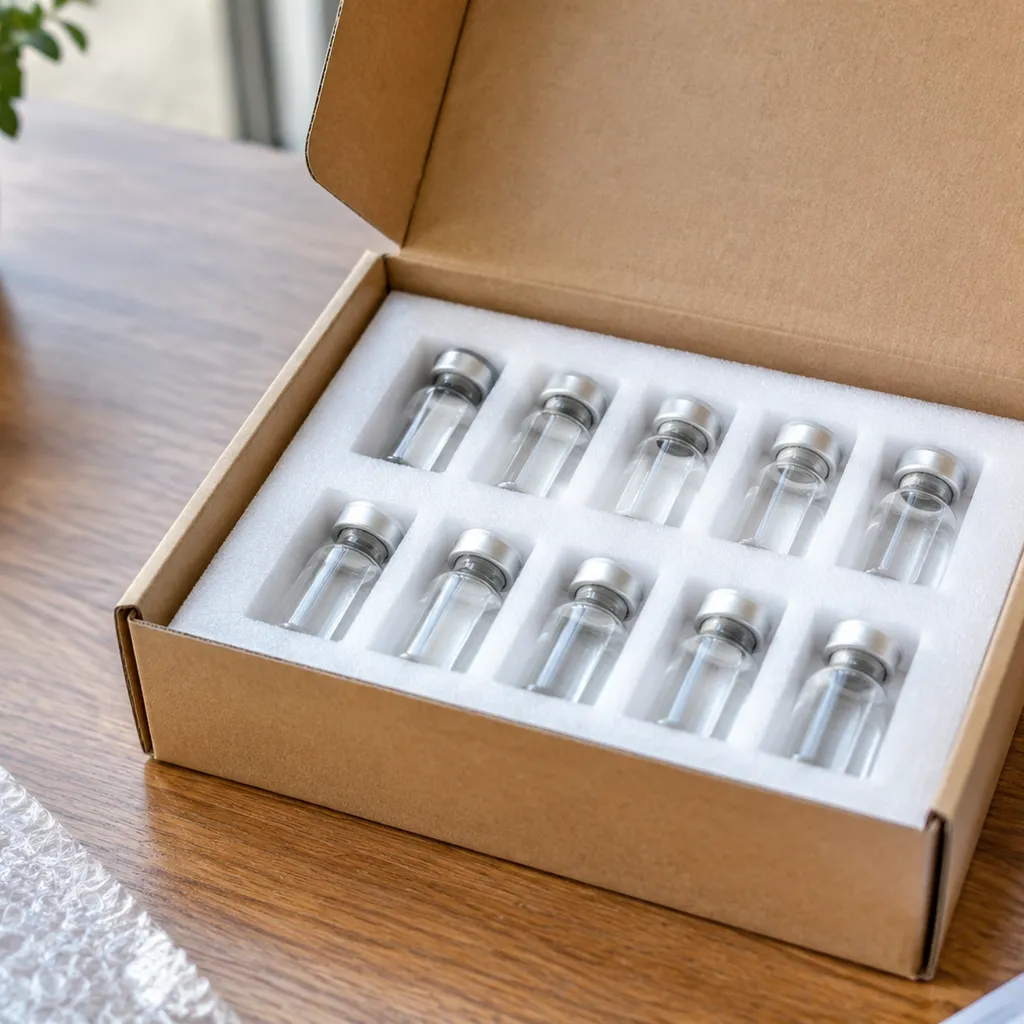
Liquid-filled glass containers face severe stress during automated sorting and rough transit. To counter this, our packaging pairs high-strength outer cartons with engineered foam insert packaging boxes that isolate each vial in its own protective pocket.
Precision Die-Cut Cavities Tailored to Neck and Cap Profiles
Standard square-cut foam leaves empty space that allows glass vials to shift, rotate, and collide with carton walls. We precision-cut each cavity using multi-depth CNC routing and steel-rule die-cutting to match the exact profile of your containers:
- Cap and Crimp Recesses: Custom recesses lock aluminum crimp seals, screw caps, or dropper bulbs securely in place to prevent accidental unsealing or torque loss during transit.
- Shoulder Support: Snug contours cradle the vial shoulder to prevent lateral movement without putting pressure on delicate glass necks.
- Base Anchors: Snug base wells keep vials upright, ensuring even weight distribution and keeping them away from the outer carton walls.
Top and Bottom Foam Shock Absorbers for Vertical Impact Protection
Axial drops onto concrete surfaces are the primary cause of bottom shatter in glass containers. Our protective vial shipper setups use a three-piece floating sandwich design:
- Bottom Pad: A dense 10mm to 20mm closed-cell foam base absorbs vertical deceleration shock before it reaches the vial base.
- Central Routing Grid: A custom high-density EVA foam vial insert provides lateral separation and prevents glass-to-glass contact.
- Top Cushion Pad: A matching compression lid pad applies controlled downward pressure upon box closure, locking each container into its pocket and neutralizing vertical bounce.
Structural Cushioning Specifications
| Protection Layer | Material Base | Density / Rating | Primary Transit Function |
|---|---|---|---|
| Outer Carton | B-Flute / E-Flute Corrugated | 32 ECT to 44 ECT (Edge Crush Test) | Resists external compression, stacking loads, and puncture impacts |
| Central Insert | Cross-Linked PE / High-Density EVA | 30 kg/m³ to 45 kg/m³ | Delivers zero-movement lateral stabilization and perimeter impact buffers |
| Base & Top Pads | Medical-Grade EPE Foam | 25 kg/m³ to 35 kg/m³ | Dissipates vertical drop energy and cushions axial shock waves |
| Secondary Barrier | Multi-Layer Co-Ex / Absorbent Mat | 150ml/m² minimum absorption | Captures fluid in the event of primary vial leakage |
Outer Carton Crush Resistance and High Edge Crush Test Ratings
We manufacture our outer cartons from heavy-duty corrugated board rated between 32 ECT and 44 ECT, along with rigid box options boasting burst strengths over 200 psi. These high structural ratings prevent side-wall buckling under heavy pallet loads, automated hub sorting, and mixed-cargo courier transit. Reinforced double-wall corners provide vertical rigidity, ensuring external forces never transfer to the interior glass payload.
Cleanroom-Compatible and Anti-Static Foam Options
For diagnostic kits, active pharmaceutical ingredients, and automated processing lines, particulate contamination is unacceptable. We fabricate our inserts from non-crosslinked closed-cell polyethylene and medical-grade EVA that will not shed, dust, or flake.
For electronics-adjacent assays, diagnostic sensors, and sensitive lab environments, we provide pink anti-static (10⁹ to 10¹¹ ohms/sq) and black conductive foam configurations. Much like using sterile pharmaceutical trays for safe drug handling, our particulate-free packaging materials safeguard cleanroom integrity from initial assembly directly to the testing bench.
Secondary Leak-Containment Integration
Transit packaging for liquid reagents, biological samples, and chemical vials must handle unexpected seal failures. We build secondary containment directly into the vial shipping box layout:
- Absorbent Base Liners: Cellulose or super-absorbent polymer (SAP) pads sit beneath the foam matrix, calculated to absorb the total liquid volume of all enclosed vials in case of accidental rupture.
- Airtight Secondary Pouches: Die-cut foam inserts slide easily into 95 kPa certified specimen bags, ensuring full compliance with biological sample transport regulations without compromising physical shock absorption.
- Gasketed Rim Sealing: Precision-molded closures seal the box perimeter, blocking leaks and keeping external dust, moisture, and contaminants out.
Capacity Layouts and Vial Compatibility
Single-Vial Diagnostic Specimen Mailers
Single-vial mailers are built specifically for decentralized clinical trials, direct-to-patient diagnostic tests, and return-specimen logistics.
Primary Container: 2ml to 10ml blood collection, saliva, or transport tubes.
Architecture: Compact corrugated mailer box lined with precision die-cut foam.
Safety Integration: Cavities leave sufficient clearance for secondary leak-proof biohazard bags and absorbent sheets without compressing the vial cap.
Multi-Pack 2 to 6-Slot Serum Test Kit Boxes
Multi-slot layouts organize mixed reagents, diluents, and active solutions within a single protective footprint. For multi-component clinical assays or therapies, we design secure multi-compartment layouts such as our 2ml vial box for lab storage and serum packaging to isolate individual ampoules or glass containers.
Separation Integrity: 5mm to 10mm foam wall bridges isolate each slot to prevent glass-to-glass contact during mechanical drops.
Access Ergonomics: Finger-recess cutouts allow lab technicians to remove vials smoothly without tilting or damaging crimp seals.
Bulk 10 to 100-Pack Transport Trays and Partitions
For high-volume business-to-business batch transport, clinical trial supply chains, and bulk lab distribution, space efficiency is critical.
Corrugated Partitions: Interlocking, dust-free E-flute or B-flute dividers configured in 10, 25, 50, or 100-cell matrices.
Tiered Foam Trays: Stackable closed-cell trays fitted inside an outer heavy-duty corrugated vial mailing box for bulk glass protection.
Modular Loading: Trays lift directly from the shipper into cold-storage refrigeration or robotic fill-and-finish lines.
Cryogenic Vial and Autosampler Tube Sizing
Cryovials present unique geometry, including external threading, silicone gaskets, and skirted conical bottoms.
Base Stabilization: Recessed lower cavities grip the conical base firmly, preventing autosampler tubes and cryovials from shifting off-axis.
Low-Temperature Resistance: Cavity tolerances factor in material shrinkage under dry-ice exposure (-78.5°C) and vapor-phase liquid nitrogen conditions.
Universal Wells: Form-fitted storage profiles accommodate 0.5ml, 1.5ml, 2.0ml, and 5.0ml cryovial dimensions.
Pharma Crimp-Top and Cosmetic Dropper Bottle Options
Standard bottles with high-profile closures require specialized vertical clearance. Our serum vial packaging wholesale glass vials and boxes match varied neck finishes, ensuring pressure is never transferred to fragile closures during freight stacking.
| Container Profile | Standard Volume | Typical Closure Finish | Recommended Box Layout | Protective Cavity Type |
|---|---|---|---|---|
| Diagnostic Specimen Tube | 2ml – 5ml | Screw cap / Rubber stopper | Single or 2-Slot Mailer | High-density cross-linked foam |
| Lyophilized Drug Vial | 2ml – 10ml | 13mm / 20mm Crimp seal | 5 to 10-Slot Kit Box | Dual-tier cavity with neck support |
| Cryogenic Vial | 1.2ml – 5ml | External thread / Skirted base | 25 to 100-Slot Grid Tray | Anti-static grid partitions |
| Cosmetic Serum Dropper | 15ml – 50ml | Glass pipette / Bulb dropper | 1 to 4-Slot Rigid Box | Contoured EVA foam cradle |
| Autosampler HPLC Tube | 1.5ml – 2ml | Screw neck / Snap cap | 50 to 100-Pack Shipper | Precision die-cut top/bottom pads |
Shipping Compliance and Transit Drop Standards
We design every vial shipping box to withstand real-world logistics hazards, from automated sorting belts to rough tarmac transfers. By focusing on verified structural integrity, we eliminate transit loss and safeguard hazardous or fragile liquid samples.
ISTA 1A and 3A Certified Impact and Compression Protection
Our packaging configurations undergo rigorous simulation testing to meet courier transit benchmarks:
Drop Impact Resistance: Multi-angle free-fall drop testing onto concrete, protecting fragile glass shoulders and crimp seals.
Dynamic Compression: High-yield crush resistance designed to handle heavy parcel stacking in parcel networks.
Vibration Dampening: Custom interior cavities lock each container in place, neutralizing harmonic road and air freight vibrations.
UN3373 and P650 Biological Specimen Packaging Readiness
Transporting biological specimens and diagnostic liquids requires strict regulatory compliance. When paired with primary leak-proof containers and absorbent packing materials, our boxes function seamlessly as compliant secondary and outer packaging.
Formatted to align with Packing Instruction 650 (P650) for Category B biological substances.
Clear exterior display panels for mandatory UN3373 diamond labeling and orientation markings.
For comprehensive regulatory configurations, review our custom vial packaging design with inserts and compliance to ensure zero seal breaches under 95 kPa differential pressure demands.
Cold-Chain Thermal Insulation and Cold-Pack Liner Pairing
Temperature-sensitive reagents, biologics, and clinical serums require stable interior environments. We build thermal adaptability directly into the footprint of the mailer:
Thermal Liner Integration: Sized to house vacuum insulated panels (VIP), expanded polystyrene (EPS), or biodegradable thermal liners without compromising structural strength.
Refrigerant Pockets: Dedicated recessed cavities hold wet ice packs, phase-change materials (PCMs), or dry ice blocks away from direct contact with glass walls to avoid thermal shock breakage.
Consistent Payload Security: Retains snug fit and structural rigidity even in high-humidity cold-chain transit environments.
Custom Vial Packaging OEM and Branding Capabilities
Multi-Component Cavity Tooling for Mixed Kit Contents
Modern test kits and therapy regimens rarely travel as isolated bottles. We fabricate precision multi-cavity layouts engineered to seat varied components securely within a single protective footprint:
Asymmetric Cavity Sizing: Combine primary glass vials with diluent ampoules, dropper assemblies, reconstitution needles, or swab tubes.
Secondary Cutouts: Dedicated recesses for desiccants, package inserts, and instruction booklets that prevent shifting during transit.
Ergonomic Finger Notches: Precision thumb indents engineered for clean, zero-snag extraction in laboratory settings.
If your protocol calls for pre-configured, tested formats, explore our engineered vial box with inserts for validated structural protection.
Printing, Exterior Finishes, and Visual Branding
Your exterior packaging serves as both a rugged barrier and the primary touchpoint for your brand:
High-Definition Print Systems: High-volume offset lithography for razor-sharp CMYK and Pantone color reproduction, alongside flexible digital printing for short-run clinical trial batches.
Protective Exterior Lamination: Matte, soft-touch, or gloss films that shield against moisture and transit abrasion.
Precision Surface Accents: Spot UV varnish to highlight brand typography, paired with anti-scratch coatings that maintain pristine presentation after cross-dock handling.
Tamper-Evident Security and Structural Closures
Sample integrity and cold-chain custody demand verifiable chain-of-custody packaging:
Integrated Tear Strips: High-shear pull tabs that provide instant, irreversible visual proof of first opening.
Tamper-Proof Void Seals: Adhesive closure zones that leave residual evidence if breached.
Reinforced Locking Tabs: Heavy-duty tuck-in flaps designed to withstand aggressive courier drop-chutes without splitting.
Sustainable and Molded Pulp Insert Alternatives
For operations balancing breakage prevention with corporate sustainability goals, we offer plastic-free alternatives to traditional foam insert packaging boxes:
Thermoformed Molded Fiber Trays: 100% biodegradable, curbside-recyclable cellulose pulp contoured to snug vial geometries.
FSC-Certified Corrugated Partitions: High-density, folded-board dividers engineered for rigid vial separation without synthetic plastics.
Recycled Paperboard Mailers: Lightweight, fully compostable outer structures that maintain high crush resistance under dynamic compression.
Technical Material Specifications for Vial Shipping Boxes

Outer Box Board Selection: Flute vs. Rigid Stock
Outer cartons rely on specific wall configurations to balance structural rigidity against parcel sorting abuse:
- E-Flute Corrugated (approx. 1/16" / 1.5mm): High-density fluting providing a smooth surface for fine print graphics, ideal for lightweight kits and individual diagnostic mailers.
- B-Flute Corrugated (approx. 1/8" / 3.0mm): Delivers superior side-wall crush strength and puncture resistance for heavier multi-pack bulk shipments.
- Rigid Greyboard (1,000 to 1,800 GSM): Wrapped structural paperboard used for luxury clinical trials or cosmetic presentations where box compression resistance is prioritized without an industrial corrugated look. Consult our 10ml and 2ml vial box dimensions guide to match outer carton thicknesses directly to standard container heights.
| Substrate Type | Thickness / Caliper | Burst Strength (Mullen) | Edge Crush Test (ECT) | Primary Application |
|---|---|---|---|---|
| E-Flute Single Wall | 1.2 mm – 1.8 mm | 150 – 200 psi | 29 – 32 ECT | Direct-to-patient specimen mailers |
| B-Flute Single Wall | 2.8 mm – 3.2 mm | 200 – 250 psi | 32 – 44 ECT | Multi-unit glass vial shipping containers |
| Rigid Setup Board | 1.5 mm – 2.5 mm | N/A (Rigid standard) | High Yield Compression | Clinical trials & premium serum kits |
Foam Insert Density and Cushion Resilience
A reliable protective vial shipper depends on interior foam inserts to isolate delicate glass from kinetic impact. Matching insert density to the structural tolerances of different vial container types and uses guarantees consistent shock dampening across temperature variations:
- High-Density EVA Foam (38–45 kg/m³): Firm, cross-linked closed-cell foam that holds precision die-cut tolerances without crumbling or generating particulate dust.
- Medical-Grade EPE Foam (20–30 kg/m³): Flexible, non-abrasive expanded polyethylene providing high rebound memory under multiple dynamic drops.
- Static-Dissipative Formulations: Surface resistivity rated between 10^6 and 10^9 ohms/sq to eliminate electrostatic buildup during transport of sensitive diagnostic reagents.
Drop Thresholds and Closure Mechanisms
We validate drop performance against standard courier handling standards (ASTM D5276 / ISTA 1A):
- Drop-Test Thresholds: Rated for drop heights up to 1.2 meters (48 inches) onto concrete without transfer of breaking force to primary glass containers.
- Burst Strength: Outer corrugated mailers deliver Mullen test ratings from 200# to 275# test, guarding against puncture from adjacent conveyor cargo.
- Self-Locking Roll-End Flaps: Dust-proof tuck-in flaps (Tuck-top roll-end) provide secure mechanical closure without tape for quick lab assembly.
- Magnetic Closures: Dual or quad neodymium magnets sealed within rigid box walls for clean, reusable closing action in clinical laboratory settings.
- Peel-and-Seal Adhesive Strips: High-tack synthetic adhesive with integrated tear-strip perforations for single-use, tamper-evident security during direct shipping.
Industry-Specific Applications for Protective Vial Shippers
Every payload demands a dedicated packaging approach. We engineer each vial shipping box to handle the exact transit hazards of your industry, combining rigid outer mailers with tailored interior cushioning.
Clinical Diagnostics and Diagnostic Test Kit Distribution
Diagnostic reagents and controls require absolute stability in transit. We design compact specimen transport boxes that hold collection tubes, dropper bottles, and buffer vials firmly in place. Our custom inserts isolate each component to prevent cross-contamination and seal integrity failure during standard parcel sorting. For sensitive testing assays, explore our specialized solutions for clinical diagnostic packaging built to streamline kit assembly and end-user handling.
Pharmaceutical and Biotech Clinical Trial Logistics
Investigational drugs and clinical trial supplies move through strict, temperature-controlled distribution networks. Our pharmaceutical protective vial shippers offer the following advantages:
Shock and vibration isolation: High-density foam inserts hold glass vials securely to absorb multi-axis drops.
Secondary containment readiness: Cavities accommodate primary leak-proof pouches and absorbent sleeves.
Cold-chain compatibility: Inserts retain structural flexibility and dimensional stability alongside dry ice and gel packs.
Toxicology, Blood, and Specimen Laboratory Transport
Forensic, toxicology, and pathology laboratories process thousands of daily test samples. We manufacture rugged lab vial mailing boxes engineered for fast sample loading and reliable courier transport:
Precision die-cut slots accommodate standard 2ml to 10ml blood and urine vials.
Snug-fit friction cavities eliminate vial-to-vial contact and glass friction.
Tamper-evident closures safeguard chain of custody from the draw site to the testing analyzer.
High-End Cosmetic Serum and Essential Oil Shipping
Fragile glass droppers, ampoules, and concentrate bottles require premium presentation alongside drop protection. We supply rigid paperboard and corrugated mailers paired with clean-cut, velvet-topped or anti-scratch inserts. These custom layouts protect sensitive formulas such as cosmetic packaging vials while delivering an unboxing experience that reflects luxury brand standards.
Order Workflow and Rapid Prototyping for Your Vial Shipping Box

We streamline the development cycle to take your custom protective vial shipper from concept to fulfillment without engineering bottlenecks. Every stage is built to verify fit, structural strength, and freight efficiency.
1. Dimension Submission and Tolerance Evaluation
We begin with your exact container parameters. You provide outer diameter (OD), total height, crimp collar profile, and cap closure specifications. Our packaging engineers calculate precise nesting tolerances—typically within ±0.5 mm—to guarantee a snug fit that prevents lateral movement during transit while allowing smooth loading and unloading in lab settings.
2. 24-to-48-Hour 3D CAD Modeling and Digital Dielines
Once dimensions are evaluated, our design team produces 3D structural CAD models and exportable digital dielines within 24 to 48 hours. This step models:
Cavity layout optimization for single-row, multi-tier, or multi-slot configurations.
Compression allowances for high-density foam or corrugated dividers.
Critical structural fold lines, glue flaps, and external carton dimensions.
3. Physical Prototyping and Transit Verification Testing
Before committing to full production tooling, we fabricate working prototypes using CNC sample-cutting tables. We run physical samples through standard drop and vibration checks to validate vial packaging for pharmaceuticals secure transit. This confirms:
Impact absorption: Zero glass-on-glass contact under courier drop conditions.
Cap retention: No dislodging of rubber stoppers, dropper bulbs, or crimp seals.
Ergonomics: Intuitive finger access cutouts for quick vial removal.
4. Mass Production, AQL Inspection, and Flat-Pack Logistics
Upon sample sign-off, we move straight to automated die-cutting, insert fabrication, and printing.
- Quality Control: Every production batch follows standard AQL (Acceptable Quality Limit) 2.5 criteria, checking dimensional accuracy, foam adhesion, and carton fold integrity.
- Logistics & Warehousing: Completed boxes are shipped flat-packed alongside pre-assembled foam trays or partitions. This minimizes freight cube volume, lowers container shipping costs, and keeps your warehouse storage footprint lean when managing custom glass vial packaging options for bulk orders.
Frequently Asked Questions About Vial Shipping Boxes
Can one box accommodate mixed vial sizes and accessories?
Yes. We engineer multi-cavity inserts tailored to diverse diagnostic and clinical kits. A single custom vial shipping box can feature dedicated compartments for different bottle diameters (such as combining 2ml freeze-dried serum vials with 10ml diluent bottles), alongside fitted slots for droppers, swabs, transfer pipettes, and documentation inserts. For standard formats, you can view our custom 2ml vial packaging boxes with EVA inserts to see how precision cavities isolate sensitive glass containers.
How do these boxes meet courier drop-test standards?
We design our protective mailers to withstand real-world parcel distribution transit. By calculating exact deceleration forces, we match outer corrugated wall grades with the correct insert densities to meet ISTA and carrier drop requirements:
Impact Absorption: High-density foam inserts keep glass vials suspended away from the outer carton walls.
Vertical Containment: Top and bottom foam pads prevent cap displacement and vertical impact damage during sudden falls.
Rigid Compression: Heavy-duty corrugated outer mailers resist dynamic crushing forces inside automated sorting hubs.
What are the standard tooling lead times for custom inserts?
Custom die-cut tooling typically requires 3 to 5 business days after digital CAD approval. Once the steel-rule or CNC routing tooling is ready, physical prototypes take 2 to 3 days to manufacture and evaluate before mass production starts. If you are balancing design options and budget constraints, review our guide on vial packaging cost factors and wholesale insert options to optimize your tooling and unit expenditures.
Are vial shipping boxes supplied assembled or flat-packed?
We ship outer corrugated mailers flat-packed in bulk bundles to reduce freight volume and warehouse storage footprint. Interior foam or molded pulp inserts are nested separately. For operations requiring streamlined packing-line workflows, we also supply pre-assembled boxes with inserts pre-fitted into the outer cartons upon request.
What sustainable alternatives exist for EVA foam inserts?
For teams seeking recyclable and plastic-free solutions, we provide:
Molded Fiber Pulp: Formed from recycled paper, offering contoured bottle protection with zero plastic content.
Die-Cut Corrugated Partitions: Multi-tier cardboard slot systems that lock vials securely while remaining 100% curb-side recyclable.
Biodegradable Molded Cushioning: Bio-based plant starches that provide reliable transit damping while fully decomposing in industrial composting facilities.